AMRO "Korean Economy Slows to 1.9% Next Year"
Amid ongoing warnings that the South Korean economy is on the brink of a prolonged recession, an international economic organization that recently met with economic ministries projected that South Korea will find it difficult to maintain growth in the 2% range next year. It identified the semiconductor market downturn, export momentum slowdown due to the shock of U.S. tariff hikes, and risks of financial sector insolvency as the biggest threats to the South Korean economy. The organization recommended further interest rate cuts to stimulate domestic demand and government spending restructuring measures to reduce the budget. The forecast did not take into account the economic impact of the martial law aftermath and the onset of the impeachment political crisis.
The ASEAN+3 Macroeconomic Research Office (AMRO) forecasted in its '2024 South Korea Annual Consultation' report released on the 6th that South Korea's economic growth rate will slow to 1.9% next year. The ASEAN+3 Macroeconomic Research Office is an international organization analyzing the economies of ASEAN and South Korea, China, and Japan. AMRO reached this conclusion based on the results of an annual consultation conducted last month when its mission team visited South Korea and met with the Ministry of Economy and Finance, the Bank of Korea, the Financial Services Commission, and the Korea Development Institute.
AMRO stated, "After growing 2.2% this year, the South Korean economy is expected to slow to 1.9% next year, reflecting the global economic environment, especially rising uncertainties regarding U.S. trade policies." AMRO further explained, "Domestic demand is expected to recover due to eased monetary conditions and a rebound in manufacturing investment, while export momentum is likely to slow considering the semiconductor cycle downturn and the possibility of U.S. tariff increases." Regarding consumer prices, which have recently stabilized, AMRO expects a gradual deceleration to continue next year. It projected inflation rates of 2.3% for this year and 1.8% for next year, noting that inflationary pressures will be contained by stable domestic food prices and easing global energy prices.
As risks to the South Korean economy, AMRO pointed to sluggish export growth and financial sector insolvency risks. AMRO noted, "Sharp growth slowdowns in the U.S., Europe, and China could reduce global demand and impact South Korea's exports," adding, "If the next U.S. administration significantly raises import tariffs, South Korea's export outlook could worsen." It also highlighted risks in the savings bank sector, which has supported a substantial portion of real estate project financing (PF) loans with default concerns. "Especially with rising unsold housing in local areas, many developers face financial pressure, and some savings banks' financial buffers may not be sufficient to absorb a surge in non-performing loans (NPLs)," it pointed out.
To overcome the economic slowdown, AMRO recommended that the Bank of Korea lower interest rates further. AMRO assessed that "the debt repayment capacity of small and medium-sized enterprises, small business owners, self-employed individuals, and low-income households remains vulnerable, reflecting the scars of the COVID-19 pandemic," and argued that "the degree of monetary policy tightening should be continuously eased." While lowering policy rates may lead to increased household loans, it would help alleviate the debt burden of existing borrowers and stimulate domestic demand. It also diagnosed that rate cuts could ease funding conditions for developers, construction companies, and non-bank financial institutions involved in problematic PF projects.
Considering the sluggish domestic demand, AMRO stated that an expansionary fiscal stance is appropriate but emphasized that strengthening fiscal discipline, increasing revenue, and implementing government spending restructuring measures are essential in the long term.
AMRO's growth forecast matches the 1.9% growth rate projection for next year previously presented by the Bank of Korea. This is below the Bank of Korea's estimated potential growth rate of 2%, suggesting that the South Korean economy may be entering a low-growth phase. Major global institutions have also been revising down their growth forecasts for South Korea next year. The average growth forecast for South Korea next year from eight global investment banks (IBs) including Morgan Stanley, Citi, Barclays, and HSBC was 1.8% (as of the end of November), down 0.2 percentage points from a month earlier. The International Monetary Fund (IMF) and the Organisation for Economic Co-operation and Development (OECD) recently lowered their forecasts to 2.0% and 2.1%, respectively.
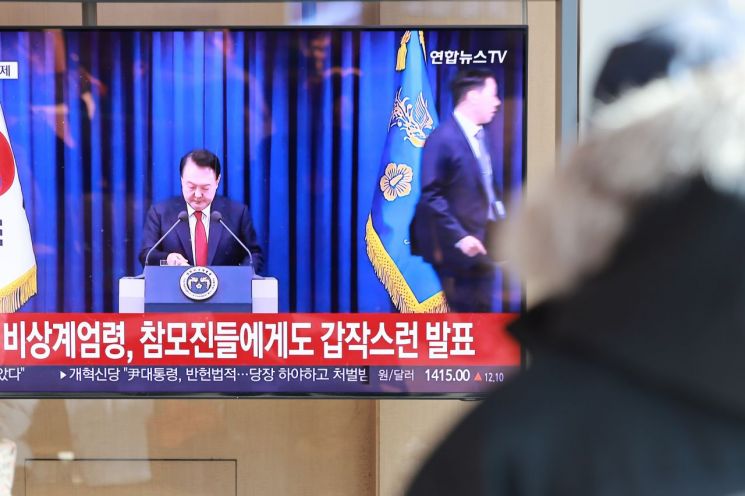
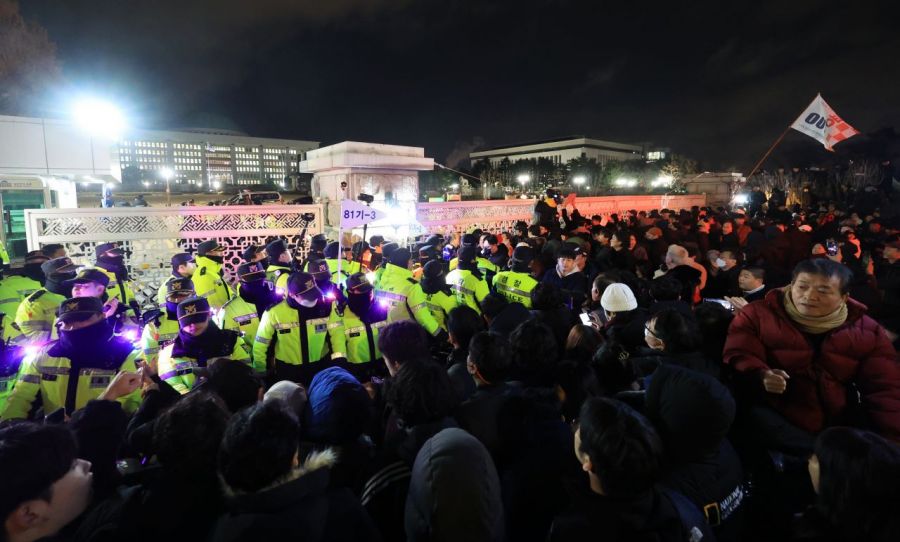
The economic impact of the martial law aftermath and the onset of the impeachment political crisis was not reflected in this forecast. Experts are concerned that these events could further drag down the already sluggish economic growth rate through declines in export growth and domestic demand contraction. With exports losing strength mainly in key industries such as semiconductors and political risks compounding the situation, the economy is on a worsening path, yet there are no adequate measures to overcome this due to the impeachment political crisis. Kim Young-se, a professor of economics at Sungkyunkwan University, said, "The martial law incident has enormously increased the country's default risk," adding, "Until this situation is resolved, any remedy will be ineffective."
© The Asia Business Daily(www.asiae.co.kr). All rights reserved.
![Clutching a Stolen Dior Bag, Saying "I Hate Being Poor but Real"... The Grotesque Con of a "Human Knockoff" [Slate]](https://cwcontent.asiae.co.kr/asiaresize/183/2026021902243444107_1771435474.jpg)

















