Follow-up to the 'Two-State Theory'... Prospects for a Separate State Constitutional Amendment
North Korea has decided to convene its Supreme People's Assembly, equivalent to our National Assembly, and begin constitutional amendments. Attention is focused on whether new territorial provisions will be reflected, given that severance measures have continued under Chairman Kim Jong-un's 'hostile two-state theory.'
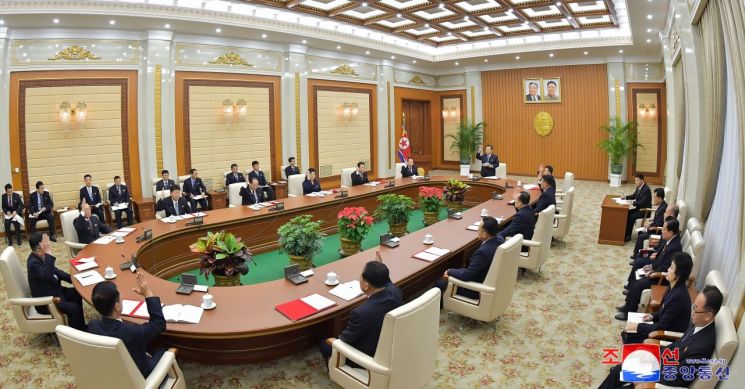 The Standing Committee of the Supreme People's Assembly of North Korea held the 34th plenary meeting of the 14th term at the Mansudae Assembly Hall in Pyongyang on the 5th and decided to convene the 12th session of the 14th Supreme People's Assembly on January 22 next year. Yonhap News
According to the Korean Central News Agency on the 6th, the Standing Committee of the Supreme People's Assembly held the 34th plenary meeting of the 14th term at the Mansudae Assembly Hall in Pyongyang the previous day and decided to convene the 12th session of the 14th Supreme People's Assembly on the 22nd of next month. This can be understood as a concept similar to our National Assembly convening a regular session.
The Standing Committee announced that it would discuss amendments to certain articles of the socialist constitution at this meeting. Chairman Kim had instructed constitutional amendments in January, including the incorporation of territorial provisions separating the South and the North and the deletion of the term 'unification.' Although the Supreme People's Assembly was held in October, there was no mention of constitutional amendments.
However, in mid-October, North Korea directly disclosed through domestic and foreign media the news of the demolition of the inter-Korean connecting roads on the Gyeongui and Donghae lines. At that time, North Korean media explained the background of the demolition as "a requirement of the Republic's constitution, which strictly regulates the Republic of Korea as a hostile state," and this content was published on the front page of the Rodong Sinmun, which residents read. This indirectly informed that the South had already been constitutionally defined as a 'hostile state.'
Accordingly, there is a possibility that the upcoming regular session of the Supreme People's Assembly will produce substantive follow-up measures to concretize the hostile two-state theory, such as territorial provisions defining inter-Korean relations as 'separate states.'
© The Asia Business Daily(www.asiae.co.kr). All rights reserved.
![Clutching a Stolen Dior Bag, Saying "I Hate Being Poor but Real"... The Grotesque Con of a "Human Knockoff" [Slate]](https://cwcontent.asiae.co.kr/asiaresize/183/2026021902243444107_1771435474.jpg)
















