Emergency Macroeconomic and Financial Issues Meeting
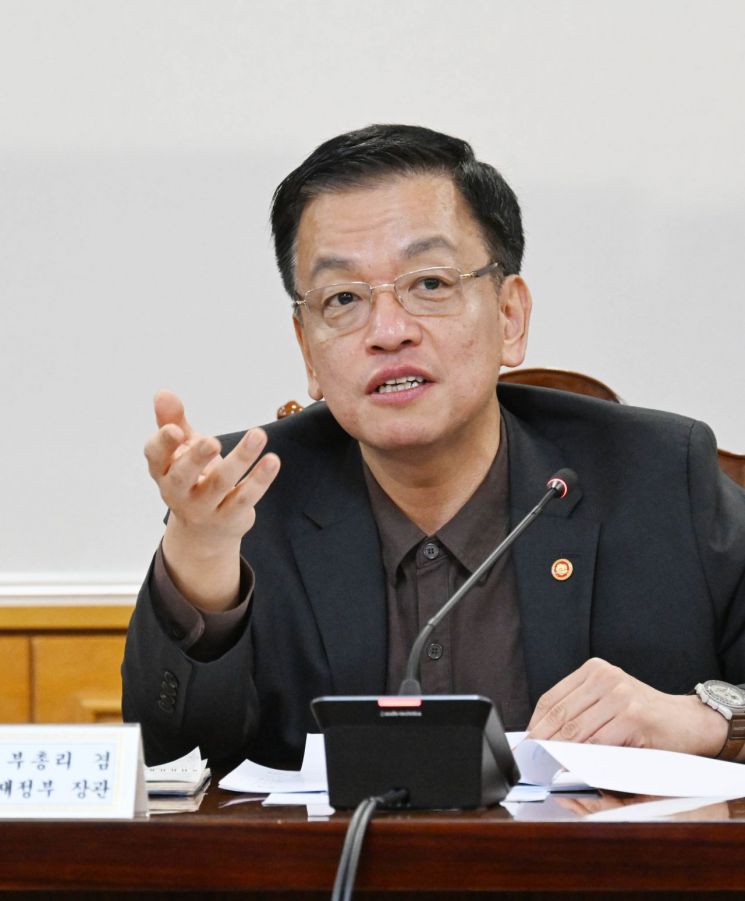 Choi Sang-mok, Deputy Prime Minister for Economic Affairs and Minister of Economy and Finance, is presiding over an emergency macroeconomic and financial issues meeting on the 6th at the Korea Federation of Banks in Jung-gu, Seoul. (Photo by Ministry of Economy and Finance)
Amid the complete halt of National Assembly negotiations on next year's budget and tax reform bills due to the aftermath of martial law, the government announced its commitment to resolving uncertainties related to the budget and tax laws as quickly as possible.
On the 6th, the Ministry of Economy and Finance held an "Emergency Macroeconomic and Financial Issues Meeting" at the Korea Federation of Banks building, chaired by Deputy Prime Minister and Minister of Economy and Finance Choi Sang-mok, to review trends in the financial and foreign exchange markets and discuss future response strategies. Attendees included Lee Chang-yong, Governor of the Bank of Korea; Kim Byung-hwan, Chairman of the Financial Services Commission; and Lee Bok-hyun, Governor of the Financial Supervisory Service.
At the meeting held on the third day after the martial law incident, economic leaders agreed that the market has stabilized as a result of the proper functioning of the constitution and market economy system. They shared the view that, based on past cases, shocks from non-economic factors such as politics were temporary and had almost no economic impact in the medium to long term. They also noted that global credit rating agencies like Standard & Poor's (S&P) hold similar positions.
Although volatility in the domestic financial markets?including stock prices, exchange rates, and foreign investor flows?increased on the 4th when the emergency martial law was declared and then lifted, swift stabilization measures by financial authorities have generally restored stability.
They stated, "Regardless of recent political developments, we will steadfastly continue the mid- to long-term structural reform policies that the government has been pursuing, such as strengthening industrial competitiveness and advancing the foreign exchange and capital markets."
In particular, they evaluated that "the market capitalization of KOSPI value-up disclosure companies recently reached 38.2% of the total, indicating a gradual expansion of value-up participation." They added, "We will consistently pursue efforts to enhance shareholder value and advance the capital market through corporate governance improvements including amendments to the Capital Market Act, the establishment and execution of a 500 billion KRW value-up fund, and tax support for value-up initiatives, as well as the establishment of a fair and transparent market order." They also confirmed that detailed tasks related to inclusion in the World Government Bond Index (WGBI) will be carried out without delay.
Furthermore, they pledged to resolve uncertainties surrounding next year's budget and tax reform bills as quickly as possible. This is to prevent the deadlock in budget negotiations?which have already exceeded the legal deadline due to the impeachment crisis triggered by the martial law incident?from dragging on further. However, with the budget and tax reform bills postponed to the plenary session on the 10th and the situation delayed until after the impeachment vote, delays in National Assembly approval are inevitable.
Given that domestic and international uncertainties still persist, they committed to maintaining a high level of vigilance and a 24-hour response system. Since the previous day, an "Economic and Financial Situation Monitoring Task Force" involving not only financial and foreign exchange markets but also ministries and agencies related to the real economy has been activated to continuously monitor consumption, investment, exports, employment, inflation, and overall economic and livelihood conditions in real time.
They added that they will actively explain the solid fundamentals of the Korean economy and policy response capacity to international financial institutions, global credit rating agencies, allied countries' economic teams, overseas investors, domestic economic organizations, and financial market stakeholders to ensure that external credibility is not affected and will continue these efforts.
© The Asia Business Daily(www.asiae.co.kr). All rights reserved.

















