Emart Discovers Winter Corn Amid Seasonal Produce Shortage
Lotte Mart and Supermarkets Supply Chungju Tanggeumhyang as Tangerine Alternative
Domestic Seafood Catch Declines, Increasing Proportion of Distant-Water Products
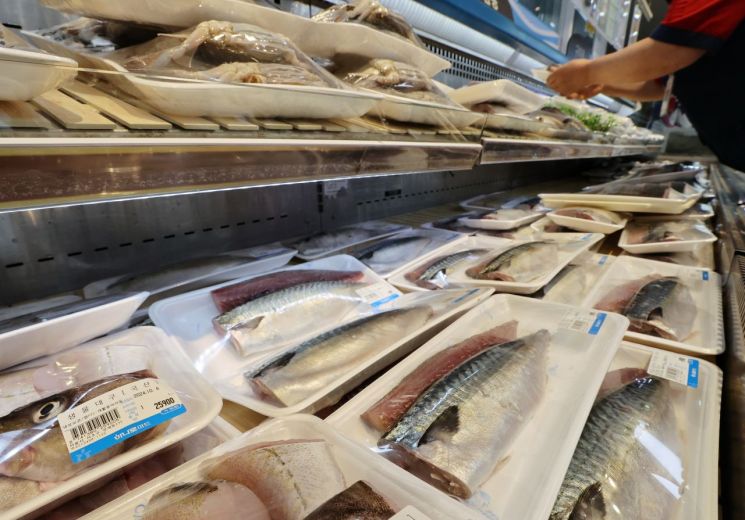 Fresh cod and mackerel displayed at the seafood section of a large supermarket in Seoul. Photo by Yonhap News
The distribution industry is facing difficulties in procuring seasonal fresh produce due to prolonged heatwaves, heavy rains, and other abnormal weather conditions. Accordingly, efforts are being made to stabilize supply and demand by discovering alternative production areas and expanding new varieties.
According to the industry on the 7th, Emart has discovered corn, a representative summer agricultural product, as a new food item that can be eaten in winter, considering the recurring late heatwaves. Typically, corn is in season from mid-July to early August, but as warmer weather continues later each year, it is expected that corn can be harvested even in November. Preparations have been underway for three years. An Emart official said, "November to December is a period when seasonal vegetables and fruits are relatively scarce, causing agricultural product prices to rise. In preparation for this, we harvested a small amount of winter corn for the first time in the industry this year and plan to expand this operation from next year."
Vegetables such as spinach and napa cabbage, whose prices soared until autumn due to heatwaves and prolonged monsoons, are items for which purchase prices were lowered by diversifying production areas. Previously, spinach production areas were concentrated in northern Gyeonggi regions such as Pocheon and Namyangju, but this year, contract farming expanded to the Chungcheong region, including Yesan. Napa cabbage production areas were formed nationwide, including Mungyeong in Gyeongbuk, Asan, Yesan, and Seosan in Chungnam, Chuncheon in Gangwon, and Haenam and Muan in Jeonnam, minimizing volatility caused by climate change and securing supply.
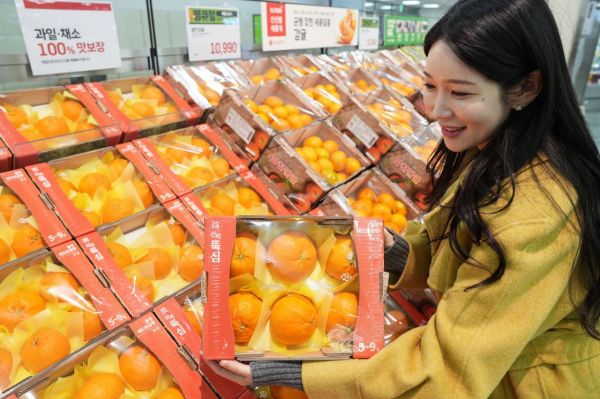 Tangunhyang mandarins grown inland displayed at the fruit section of Lotte Mart Zeta Flex Seoul Station branch. Provided by Lotte Mart·Super
Lotte Mart and its supermarkets are also focusing on responding to abnormal weather conditions, mainly for seasonal fruits. Recently, about 50 tons of Chungju Red Tankumhyang mandarins were secured and supplied to the market as a substitute for winter fruit, tangerines. This is an increase of more than 60% compared to the previous year. The number of heatwave days from July to September in Jeju, the tangerine production area, reached a record high, causing heat damage (peeling of tangerine skin) and coloring damage (failure to turn yellow), resulting in a decrease in the shipment volume of regular products. As the cultivation areas for fruits move northward due to rising temperatures, apples were officially launched this January with Yanggu Punch Bowl apples from Gangwon instead of the main production area in Gyeongsang Province. For watermelon, a representative summer fruit, new production areas were secured in Yanggu, Bonghwa in Gyeongbuk, and Danyang in Chungbuk, in addition to the existing areas of Haman and Geochang in Gyeongnam and Wanju in Jeonbuk.
The supply and demand of seafood due to climate change is also a concern for the distribution sector. This is because rising water temperatures have caused a decrease in catch volumes or a northward shift of existing production areas, resulting in significant changes. To compensate for the decreasing domestic catch, the industry is expanding imports and distant-water fishing volumes. For example, the proportion of imported seafood in Emart's total seafood increased annually from 45% in 2021 to 51% as of September this year. As domestic catch volumes decreased, sales of imported squid increased by 90% compared to the same period last year, while imported flatfish and mackerel rose by 20% and 15%, respectively. Sales of imported seafood such as salmon, shrimp, and tuna also grew by double digits.
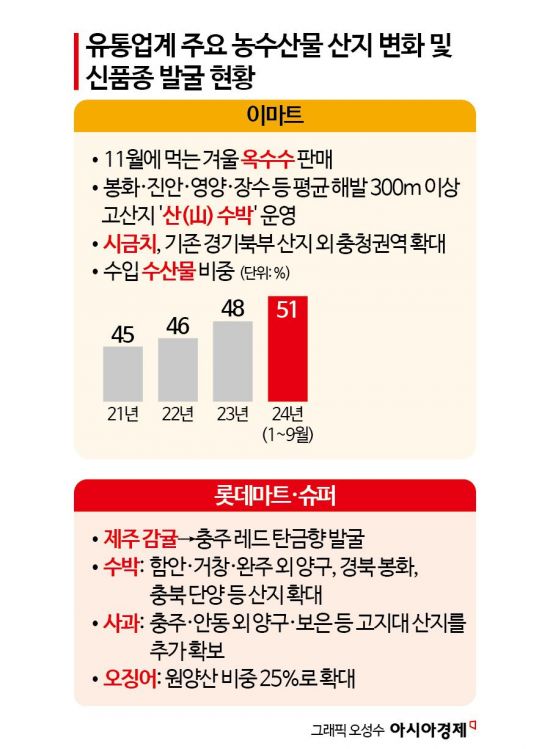
Lotte Mart and its supermarkets have also expanded the proportion of distant-water squid to 25% this year. This is to compensate for the decrease in squid catch in the East Coast, the main production area, due to rising water temperatures. Distant-water squid is caught by domestic fishing vessels in distant waters near the Falkland Islands and is generally regarded as domestic seafood, as it is included in government-led domestic seafood events.
An industry official said, "Warm-current species such as yellowtail and Spanish mackerel were previously mainly produced in southern regions including Jeju, but due to climate change and the appearance of predators like sharks, the fishing grounds are shifting northward every year. We are focusing on securing alternative production areas to ensure stable supply and price stability of seasonal agricultural and marine products."
© The Asia Business Daily(www.asiae.co.kr). All rights reserved.



















