Fair Trade Commission, Ownership and Investment Status of Holding Companies
It has been revealed that large corporations are making indirect investments in domestic affiliates through overseas affiliates. This is an evasion tactic to avoid regulations on holding companies and undermines the very purpose of the holding company system, which was introduced to enhance transparency in corporate governance.
According to the "2024 Holding Company Ownership and Investment Status and Profit Structure Analysis" announced by the Korea Fair Trade Commission on the 5th, as of the end of September this year, out of 88 large business groups, 43 groups have transitioned to a holding company system under the control of their owners.
This is about double (21 groups) the number from the first survey in 2018, which recorded 22 groups. The Fair Trade Commission evaluated that "the holding company system has established itself as a representative form of corporate organization."
Excluding POSCO and NongHyup, which do not have controlling owners, an analysis of 41 holding companies showed that the average shareholding ratio of controlling owners in general holding companies within the transitioning groups was 24.7%, and that of the controlling family was 47.7%. This is a slight increase from the previous year (23.2% and 46.6%, respectively).
This level is somewhat higher than the average shareholding ratios of controlling owners and their families in general large business groups that are not holding companies (22.4% and 40.2%, respectively).
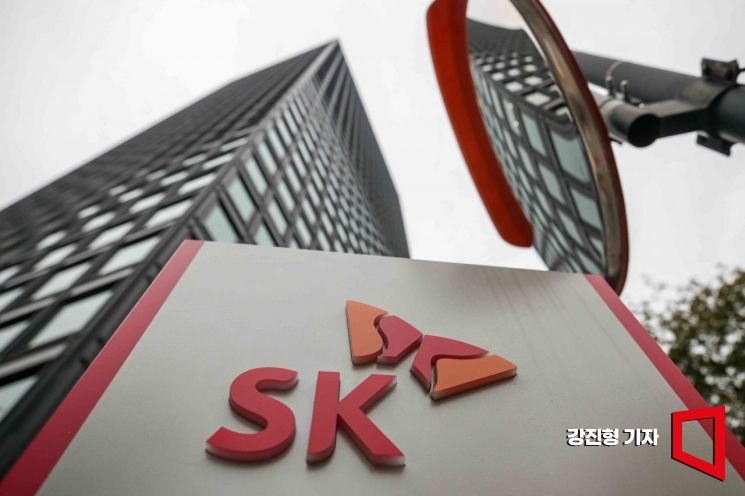 The merged entity of SK Innovation and SK E&S, with assets totaling 105 trillion won (as of the first half of this year), has officially launched. After about three months of preparation following the merger announcement in July, the largest private energy company in the Asia-Pacific region has been established. The photo shows the SK Seorin Building in Jongno-gu, Seoul, where SK Innovation's headquarters is located. Photo by Kang Jin-hyung
368 Companies Controlled Outside the Holding Company System by Controlling Families
Among the analyzed large business groups, 368 companies were found to be controlled by controlling families outside the holding company system. Of these, 228 companies (62%) were subject to regulations against unfair internal transactions.
Among the 228 companies, 25 held shares in holding companies. This means that the controlling families indirectly invested in holding companies through companies subject to unfair internal transaction regulations outside the system.
The proportion of internal transactions among domestic affiliates within holding companies was 12.6%, similar to that of general large business groups with controlling owners (12.4%). The domestic internal transaction ratios increased the most in Celltrion (22.03 percentage points), Booyoung (4.39 percentage points), and Bando Holdings (3.20 percentage points).
The average proportion of dividend income in the sales of representative holding companies was 50.2%. Groups with a high proportion of dividend income included Nongshim (100%), Taeyoung (99%), OCI (94.9%), EcoPro (85.8%), and HiteJinro (85.0%).
The total amount of trademark royalty fees among the top five groups was 992.5 billion KRW this year, an increase of 32.3 billion KRW compared to the previous year. Specifically, LG (354.5 billion KRW), SK (318.3 billion KRW), CJ (126.0 billion KRW), GS (105.2 billion KRW), and Lotte (88.5 billion KRW) ranked in order. The largest year-on-year changes were seen in SK (44.0 billion KRW), LX (29.4 billion KRW), HD Hyundai (28.5 billion KRW), Lotte (7.0 billion KRW), and LS (5.5 billion KRW).
Evasion of Regulations Through Indirect Investments via Overseas Affiliates
There were 32 cases of holding companies making indirect investments in domestic affiliates through overseas affiliates, an increase of 7 cases from 25 last year.
According to the Fair Trade Commission's investigation, Lotte (16 cases), SK (9 cases), LX, Dongwon, Wonik (3 cases each), Kolon (2 cases), and LG, GS, Hanjin, LS, Doosan, OCI, EcoPro, Korea & Company Group, Dongkuk Steel, DN, and HiteJinro (1 case each) made investments in domestic affiliates through overseas affiliates.
While subsidiaries of holding companies are prohibited from owning shares in domestic affiliates other than their subsidiaries, this prohibition can be circumvented by going through overseas affiliates. The Fair Trade Commission stated that since cases of investments in domestic affiliates through overseas affiliates are occurring, close monitoring of such indirect investments is necessary.
The Fair Trade Commission said, "We plan to regularly inspect the use of the holding company system for illicit expansion of control, unfair internal transactions, and acts of private gain within holding company groups, and to strictly sanction any violations of the law."
© The Asia Business Daily(www.asiae.co.kr). All rights reserved.

















