Busan National University and Hospital's 'Radioactive Microparticle Technology' Transferred to SNBIA, a Subsidiary of Busan National University Technology Holdings
Contributing to the Localization of High-Cost Radioactive Isotope Therapeutic Materials and Activation of Industry-Academia-Research-Hospital R&D
The radioactive material 'Lutetium-177,' which has been entirely dependent on imports, was recently developed using domestic technology, and Pusan National University plans to become the first institution in the Busan and Gyeongnam regions to receive it and actively embark on technology commercialization for the development of radiopharmaceuticals.
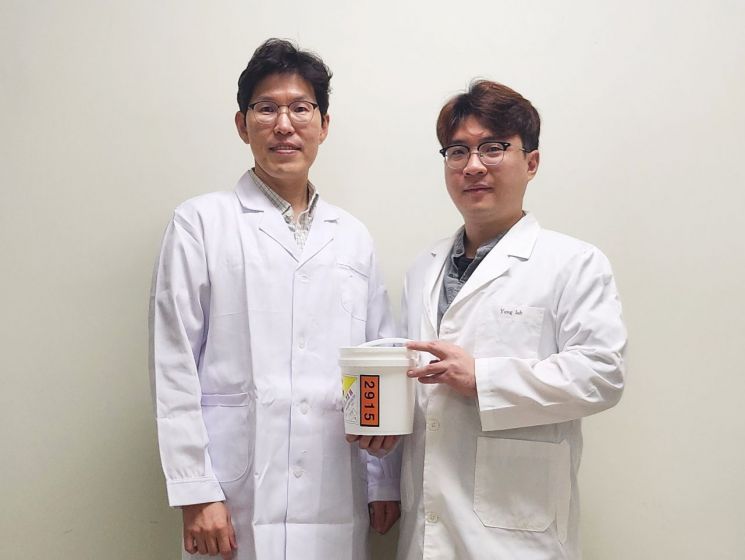
Pusan National University (President Choi Jae-won) and Pusan National University Hospital (Director Jung Sung-woon) announced on the 5th that they have received Lutetium-177 (Lu-177, Luthetium-177) from the Korea Atomic Energy Research Institute and will promote the development of therapeutic radiopharmaceuticals using microparticles.
'Lutetium-177' is a radioactive material that emits both beta and gamma rays simultaneously and is known as a radioactive isotope that produces revolutionary effects in the treatment of prostate cancer and neuroendocrine tumor patients.
Due to the short half-life of the radioactive isotope, there have been limitations in transporting it to Busan, and the high cost has made it difficult to utilize Lutetium-177 for research purposes in Busan until now.
However, with Lutetium-177 developed purely with domestic technology by Chief Researcher Choi Kang-hyuk of the Korea Atomic Energy Research Institute (Director Joo Han-kyu) being supplied to Pusan National University for the first time in the Busan and Gyeongnam regions, a significant breakthrough is expected in radiopharmaceutical development research.
In particular, the 'Lutetium-177 labeled hyaluronic acid-based biodegradable radioactive microparticles (Lu-HA microgel),' being developed collaboratively by Professor Yang Seung-yoon of the Department of Biomaterials Science at Pusan National University and Professor Kim Geun-young of the Nuclear Medicine Department at Pusan National University Hospital using Lutetium-177, is expected to provide an effective treatment option for liver cancer patients by enabling safe and localized radiation therapy.
The research results have been transferred to 'SNBIA,' a subsidiary of Pusan National University Technology Holdings' 17th issue (CEO Lee Kang-oh), and have been selected for the Ministry of Trade, Industry and Energy's materials and components technology development project, where full-scale research and development for technology commercialization is underway.
This achievement marks an important milestone in the localization of radioactive isotopes, which the domestic medical community had been entirely dependent on importing from overseas, and is expected to invigorate the development of medical technologies using radioactive isotopes in the Busan and Gyeongnam regions.
Currently, under the leadership of the Ministry of Science and ICT and the Korea Atomic Energy Research Institute, construction is underway for a 'new research reactor for export' responsible for producing radioactive isotopes in the Medical Science Industrial Complex in Gijang-gun, Busan, raising expectations that the Busan area will become a hub leading radioactive isotope therapy technology in the future.
© The Asia Business Daily(www.asiae.co.kr). All rights reserved.
![Clutching a Stolen Dior Bag, Saying "I Hate Being Poor but Real"... The Grotesque Con of a "Human Knockoff" [Slate]](https://cwcontent.asiae.co.kr/asiaresize/183/2026021902243444107_1771435474.jpg)
















