Evaluation Institute Announces 2025 CSAT Scoring Results
1055 Perfect Scores in Korean, 1522 in Math
Over 20,000 Students Achieve Top Grade in English, Up from Last Year
"Inquiry Subjects Show Advantages and Disadvantages Depending on University-Specific Conversion"
The 2025 College Scholastic Ability Test (CSAT) was generally easier than last year. The highest standard scores dropped by 11 points in Korean and 8 points in Mathematics compared to last year, reducing the differentiation among top scorers. The number of students achieving the top grade in English also reached the 20,000 range. On the other hand, the perceived difficulty of the inquiry subjects varied by subject, likely causing advantages and disadvantages depending on the chosen subjects.
On the 5th, the Korea Institute for Curriculum and Evaluation announced the "2025 CSAT Scoring Results" at a briefing held at the Government Sejong Complex. The results will be notified to examinees nationwide tomorrow, the 6th.
A total of 463,486 students took this year's CSAT, including 302,589 current students and 160,897 graduates and those who passed the qualification exam. By subject area, 461,252 took the Korean section, 443,233 took Mathematics, 459,352 took English, and 463,486 took Korean History. For the social and science inquiry sections, 447,507 took the social/science inquiry, 3,628 took vocational inquiry, and 44,102 took the second foreign language/Chinese characters section.
This CSAT, the first since the increase in medical school admissions, was analyzed to be generally of easy difficulty. Consequently, there are forecasts that differentiation among the highest scorers will decrease. The Ministry of Education explained that 11 students achieved perfect scores in all subjects according to the scoring results.
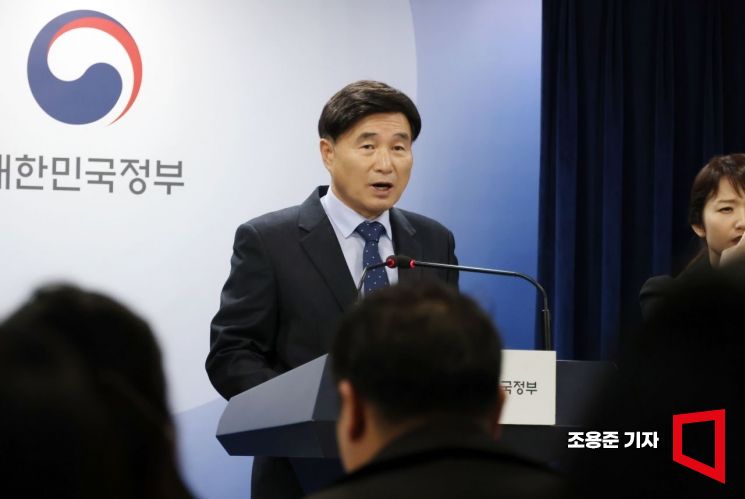 On the 7th, Oh Seung-geol, President of the Korea Institute for Curriculum and Evaluation, announced the 2024 College Scholastic Ability Test scores and grading results at the Government Seoul Office in Jongno-gu, Seoul. Photo by Jo Yong-jun jun21@
The perceived difficulty by subject also decreased compared to last year. The standard score indicates how far a raw score deviates from the average; if the test is easier and the average score is higher, the highest standard score decreases. The highest standard score in the Korean section was 139 points, 11 points lower than last year's 150 points. The highest standard score in Mathematics was 140 points, down 8 points from last year's 148 points.
The number of perfect scorers (highest standard score) was 1,055 in Korean and 1,522 in Mathematics. In last year's "difficult CSAT," there were 64 perfect scorers in Korean and 612 in Mathematics, so this year’s numbers increased approximately 16.5 times and 2.5 times, respectively.
In the English section, which is graded on an absolute scale, the top grade rate was 6.22% (28,587 students), up 1.51 percentage points from last year's 4.71%. With the top grade count in the 20,000 range, it is interpreted that differentiation among the highest scorers was not high.
This year, as more universities relaxed restrictions on elective subjects for science and engineering departments in college admissions, a phenomenon called "Satam-run (Satam + run)" occurred, where natural science students chose social inquiry subjects instead of science inquiry. Because of this, predicting inquiry scores has become more difficult than last year.
In particular, 47,723 students took one social inquiry subject and one science inquiry subject, about three times more than last year's 15,927. This is the largest scale since the integrated CSAT was introduced in 2022. The number of students who took only social inquiry subjects also reached a record high of 225,135, a 12.6% increase from last year's 199,886. Conversely, the number of students who took only science inquiry subjects was 174,649, the lowest since 2022.
The difficulty of inquiry subjects was analyzed to be more differentiating than Korean, Mathematics, and English. However, since the perceived difficulty varies between elective subjects, advantages and disadvantages likely occurred depending on the subject.
Among the nine social inquiry subjects, the highest standard scores increased in six subjects compared to last year, suggesting a higher perceived difficulty. Compared to last year, Life and Ethics rose from 65 to 77 points, the highest increase. Ethics and Ideology was 73 points (63 last year), Korean Geography 69 points (65), World History 68 points (63), World Geography 68 points (67), and East Asian History 67 points (66). Conversely, Politics and Law (66 points), Society and Culture (69 points), and Economics (72 points) saw decreases in their highest standard scores.
In science inquiry, only two of the eight subjects saw an increase in the highest standard score. Biology 1 was 70 points (69 last year), and Earth Science 1 was 72 points (68). Conversely, Chemistry 2 was 73 points (80), Chemistry 1 was 65 points (69), Physics 1 was 67 points (69), Physics 2 was 70 points (74), and Biology 2 was 72 points (73), all showing decreases. Earth Science 2 remained the same at 72 points as last year.
Regarding this CSAT scoring result, Lim Seong-ho, CEO of Jongro Academy, said, "In the top-tier subjects such as medical school Korean and Mathematics, Mathematics showed relatively higher differentiation." He added, "In the 2025 regular admissions, Mathematics will be more important than Korean, and the inquiry section will see significant advantages and disadvantages depending on each university's announcement of inquiry conversion standard scores." He also noted, "The number of repeat test-takers (graduates and above) reached the highest in 20 years since 2006, so the influence of top-tier repeat test-takers in the CSAT could be considerable."
Kim Won-jung, head of the admissions strategy office at Daesung Academy, analyzed, "The 2025 CSAT was relatively easier than the previous year but overall maintained differentiation. Students who chose Calculus are still expected to have an advantage over those who chose Probability and Statistics."
© The Asia Business Daily(www.asiae.co.kr). All rights reserved.

















