Maintaining Seafood Production at 3.7 Million Tons by 2030
Keeping Consumer Price Index for Seafood Price-Controlled Items in the 2% Range
The Ministry of Oceans and Fisheries announced that despite environmental changes caused by climate change, it aims to maintain seafood production at 3.7 million tons and achieve fishing household income of 65 million KRW by 2030. It also set a goal to keep seafood prices within a 2% range. To achieve this, the ministry plans to promote the relocation of aquaculture farms and support changes in aquaculture business licenses. The number of seafood price management items, previously limited to six types, will also be expanded.
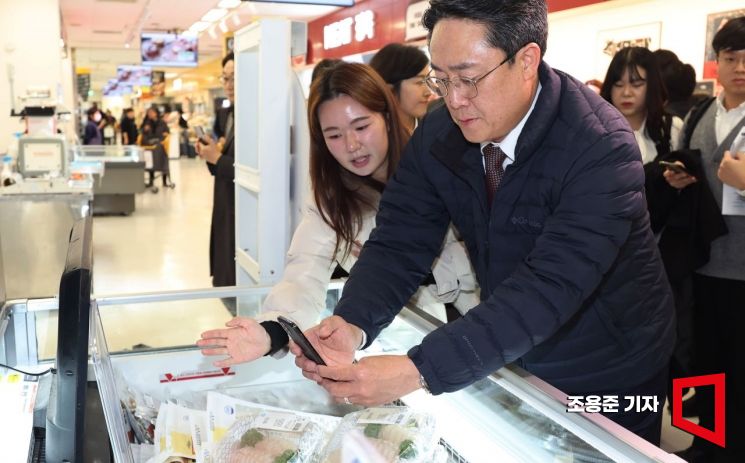 Kang Do-hyung, Minister of Oceans and Fisheries, is checking the traceability of seafood using a smartphone at the seafood traceability promotion booth set up at E-Mart Yongsan in Yongsan-gu, Seoul on the 19th. The Ministry of Oceans and Fisheries is conducting the "Korea Seafood Expo - Korea Seafood Festa" event together with online and offline distributors to promote seafood consumption during the kimchi-making season and to ease the burden on the national grocery basket. Photo by Jo Yong-jun
On the 5th, the Ministry of Oceans and Fisheries announced this as part of the ‘Comprehensive Plan for Climate Change Response in the Fisheries and Aquaculture Sector’ at the National Policy-Related Ministers’ Meeting. The coastal surface water temperature has risen by about 1.44℃ over the past 56 years, and this trend is expected to continue. The ministry stated, “This comprehensive plan is the first phase of policies aimed at reducing damage to fishermen caused by climate change and improving the structure of the fishing industry,” adding, “Specific measures by species and region will be prepared next year.”
First, the ministry will promote the relocation of aquaculture farms to enhance the climate change adaptability of the aquaculture industry. Areas frequently affected by climate disasters will be designated as ‘Climate Change Resilient Waters,’ where stocking density and facilities will be adjusted according to the carrying capacity of fishing grounds, and support will be provided for species conversion and license relocation. Additionally, a ‘wide-area license transfer system’ crossing city, county, and district boundaries will be introduced to allow aquaculture farms to move to more suitable locations.
Kang Do-hyung, Minister of Oceans and Fisheries, said, “Due to changes in the temperature front near the West Coast, Jeollabuk-do, and Chungcheongnam-do, aquaculture of species like rockfish may become difficult,” and added, “We will discuss the relocation of aquaculture farms through the approval process of the Central Fisheries Adjustment Committee and regional fisheries adjustment committees, aiming for coexistence between local governments and fishermen.”
In response to rising surface water temperatures, the ministry will also develop aquaculture species that can adapt well to high temperatures. To reduce damage to aquaculture caused by temperature changes, management throughout the entire aquaculture cycle?from breeding to shipment?will be strengthened. Plans include developing and distributing temperature-resilient species, introducing intermediate breeding facilities, developing and spreading smart aquaculture technologies, and enhancing climate change response capabilities through equipment distribution, emergency release, and early harvesting in preparation for high-temperature events.
To prevent significant increases in seafood prices due to climate change, the ministry will expand the list of seafood price management items. Currently, the six managed seafood items are mackerel, hairtail, yellow croaker, dried anchovy, pollock, and squid. The ministry plans to analyze species affected by climate change and expand the management list accordingly. Minister Kang stated, “We will add items based on market trends.” The ministry also set a goal to maintain the consumer price index for seafood price management items within a 2% range by 2030.
Furthermore, to strengthen the global supply chain, the ministry will pioneer overseas fishing grounds and aquaculture farms, and support related facilities such as freezing and refrigeration facilities and fishing ports to revitalize the distant-water fishing industry. Minister Kang said, “Based on the comprehensive plan for climate change response in the fisheries and aquaculture sector, we will establish and implement more specific species- and region-specific measures tailored to the characteristics of each fish species and region.”
© The Asia Business Daily(www.asiae.co.kr). All rights reserved.

















