Aftermath of Martial Law Emergency
Possibility of Early Presidential Election
Semiconductors, Steel, Petrochemicals Expected to Take Passive, Management-Focused Approach
The declaration of martial law has shaken the industrial sector, increasing the likelihood that next year's business environment will deteriorate to its worst level. Amid already accumulated complex adverse factors such as the overheating US-China hegemonic competition, Trump risk, and China's low-price offensive, the business community evaluates that uncertainty has reached its peak and is taking measures to address it. Experts predict that the business sector will adopt a passive approach focused on management in the short term rather than aggressive investment. If domestic demand remains sluggish and corporate investment contracts, the difficulties facing our economy next year are expected to worsen.
According to the industrial sector on the 5th, major companies have recently begun reviewing their investment plans and considering revisions to their business plans for next year.
A senior executive of a major group said in a phone interview with Asia Economy, "We held internal meetings regarding the martial law, and there was an opinion that we need to look into next year's investment plans as well," adding, "There is a possibility of adjustment depending on the situation." In this regard, major companies such as Samsung, SK, and LG are preparing scenario-based countermeasures for their core businesses.
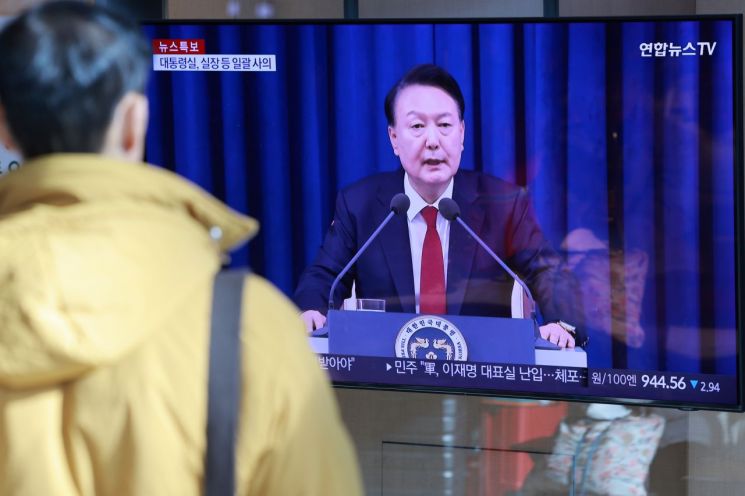
Companies are revisiting their investment plans because the impeachment phase has newly unfolded after martial law, making the possibility of an early presidential election unavoidable. There are concerns that projects strongly promoted by the current administration, such as nuclear power plants, may lose momentum next year.
Companies have already set conservative investment plans for next year. According to the '2025 Top 500 Companies Investment Plan Survey' recently released by the Korea Economic Association, most companies (87.2%) do not plan to increase investment quantitatively next year, and many (77.8%) chose a passive approach of maintenance and repair qualitatively. With forecasts that the global economy will slightly slow down next year compared to this year and global trade contraction due to intensified protectionism, a decrease in investment was anticipated. The addition of political risks has put companies in a position to tighten their belts even more.
In particular, secondary battery companies are expected to adopt even more conservative investment plans next year. This year, facility investment peaked, significantly increasing foreign currency debt. LG Energy Solution recorded foreign currency debt of about 6.8 trillion won as of the third quarter, and SK On's foreign currency debt was 3.4379 trillion won. Samsung SDI also significantly increased its facility investment compared to last year, making it highly likely to suffer losses due to high exchange rates in the future.
Major manufacturing companies that have made investments worth tens of trillions of won in the US, such as semiconductor and automobile companies, are considering whether to provide additional support overseas rather than domestically. When the new US administration takes office in January next year, information sharing and responses regarding subsidy reductions and tariff increases will be necessary, but there are concerns that government-level diplomatic support and negotiation power may weaken.
A business community official said, "Since President Yoon is pushing for a Korea-US summit, there was an expectation that there would be an opportunity to convey the positions of domestic companies after the inauguration of the Donald Trump administration," adding, "It seems that summit diplomacy has become impossible, and if policies such as tariff increases and subsidy reductions are pushed through, we are worried that we will be helpless."
Industries facing difficult business conditions, such as steel and petrochemicals, are worried that government-level plans to strengthen business competitiveness or support measures may be delayed one after another. These sectors have emphasized a 'public-private one team' approach with the government, so the shock is significant.
In particular, the petrochemical industry, which had high expectations for restructuring support measures, cannot hide its embarrassment as the plan's announcement is delayed. Initially, Choi Sang-mok, Deputy Prime Minister and Minister of Economy and Finance, planned to hold an Industrial Competitiveness Enhancement Ministerial Meeting this month and announce measures to improve the competitiveness of the petrochemical industry. The core contents, such as low-interest policy finance support and tax benefits, fall under the Ministry of Economy and Finance's jurisdiction, but it has become unpredictable whether the plan will proceed as scheduled due to the resignation announcement of a cabinet member.
A petrochemical industry official said, "We expected measures to be announced by January or February next year at the latest, but this incident has made that uncertain," adding, "There is also concern that the measures might be completely scrapped." Another industry official said, "The petrochemical issue is related not only to companies but also to the regional economy," adding, "It is an urgent situation for the industrial complex areas with a high petrochemical ratio."
The steel industry is also on high alert about whether the anti-dumping investigation on low-priced Chinese thick plates will be affected. Hyundai Steel has filed a sole anti-dumping petition against Chinese thick plates after domestic companies lost competitiveness due to Chinese products. A steel industry official said, "It does not seem to have affected operations or workplaces yet, but we need to keep an eye on the anti-dumping investigation situation."
With the possibility of strong tariffs on imports from China and other countries being anticipated, export companies are also expected to face adverse conditions. An industry official said, "If the presidential impeachment process begins, a leadership vacuum of at least three months is inevitable," adding, "The government's role is especially important in trade issues, and the current situation is worrisome." Another major company official pointed out, "There is nothing that makes companies more anxious than domestic and international political volatility," adding, "Whether it is presidential impeachment or suspension of duties, it is better to have a quick decision so that preparations can be made accordingly."
© The Asia Business Daily(www.asiae.co.kr). All rights reserved.
![Clutching a Stolen Dior Bag, Saying "I Hate Being Poor but Real"... The Grotesque Con of a "Human Knockoff" [Slate]](https://cwcontent.asiae.co.kr/asiaresize/183/2026021902243444107_1771435474.jpg)
















