Major Countries Designate Korea as 'Travel Risk Country'
Concerns Over National Image Damage
Airline and Travel Stocks Plunge
Following President Yoon Suk-yeol's sudden declaration of martial law, major countries have issued 'travel advisories' for South Korea. Concerns are growing that this incident will severely damage South Korea's national image and tourism industry.
On the 4th, the U.S. Embassy in Korea stated, "Even after President Yoon's announcement of lifting martial law, the situation remains fluid," emphasizing that "U.S. citizens should anticipate potential disruptions." It added, "When in public places, be aware of your surroundings and take routine safety precautions," and urged, "Avoid areas where protests are taking place and exercise caution near large gatherings, assemblies, or crowds." The embassy also repeatedly warned, "Protests that were intended to be peaceful may turn confrontational and escalate into violence."
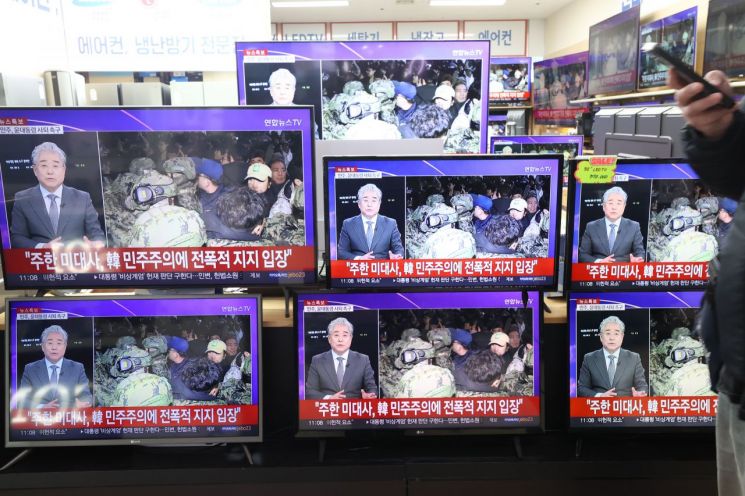 On the morning of the 4th, a citizen is watching a news report about the declaration and lifting of martial law at an electronics store in Yongsan-gu, Seoul. Photo by Yonhap News.
On the same day, New Zealand's Ministry of Foreign Affairs upgraded its travel advisory level for South Korea from Level 1, 'General safety and security precautions,' to Level 2, 'Exercise increased caution.' New Zealand's travel advisories have four levels: Level 3 is 'Avoid non-essential travel,' and Level 4 is 'Do not travel.' The Ministry also mentioned inter-Korean relations in relation to political tensions, warning, "North Korea has further heightened tensions on the Korean Peninsula through multiple nuclear tests and regular ballistic missile tests," and cautioned that "future (nuclear and ballistic missile) tests cannot be ruled out," signaling the possibility of escalating North-South tensions.
Canada also updated its advisory on the afternoon of the 3rd (local time), recommending avoidance of travel to South Korea. The Canadian government urged its citizens to avoid protests and large gatherings in South Korea and to monitor local media for the latest information. Similarly, the United Kingdom, Japan, and some European Union (EU) countries issued cautionary guidelines. The UK Foreign Office, reporting on the South Korean president's declaration of martial law, stated, "We are monitoring the situation closely," and urged its citizens to "follow the advice of South Korean authorities and avoid political gatherings." Bulgaria, Latvia, and Ireland each emphasized to their citizens the importance of avoiding areas in South Korea where protests or large assemblies are taking place.
Even Russia, which is currently at war, expressed concern. Dmitry Peskov, spokesperson for the Kremlin, said, "The situation in South Korea is worrisome," and pledged to monitor it closely. The Ukrainian Embassy in South Korea also stated, "We are closely watching the situation regarding martial law in South Korea," and advised, "Monitor the embassy's updates." The Israeli government urged its citizens to reconsider visiting South Korea unless absolutely necessary and advised against travel to the country.
Israel issued relatively strong cautionary guidelines. The Israeli Ministry of Foreign Affairs issued a travel alert for South Korea, urging, "Reconsider the necessity of visiting South Korea." The ministry emphasized, "Until the situation becomes clearer, follow media updates from home or your current location."
As global concerns arise over South Korea's 'safety' and 'public order,' which are the biggest advantages of domestic travel, worries are mounting that the inbound travel industry (foreigners entering the country) will contract. Since the night of the 3rd, when President Yoon declared martial law, social networking services (SNS) such as X (formerly Twitter) have been flooded with posts canceling trips to South Korea citing safety concerns. One netizen posted on the 4th, "I was planning to go to South Korea with my mother in a week, but canceled because the situation is not good." Another shared domestic news related to martial law, saying, "I canceled my trip to South Korea after watching the news." Other comments expressed fears such as "I'm too scared to go to South Korea" and "It seems like something bad will happen if I go to South Korea."
In fact, foreign visitors to South Korea are reportedly greatly unsettled. Hotels in areas with a high proportion of foreign guests, such as Myeongdong and Hongdae, have been receiving numerous related inquiries, creating ongoing incidents. As South Korea is perceived as a risky travel destination, the stock market has also been affected. Shares of travel companies like Hanatour and Modetour, as well as airline stocks such as Korean Air and Asiana Airlines, fell by 2-4% on the day.
© The Asia Business Daily(www.asiae.co.kr). All rights reserved.

















