There are concerns in Japan that the 'state of emergency martial law' abruptly declared and lifted by President Yoon Suk-yeol could damage the improving South Korea-Japan cooperative relationship.
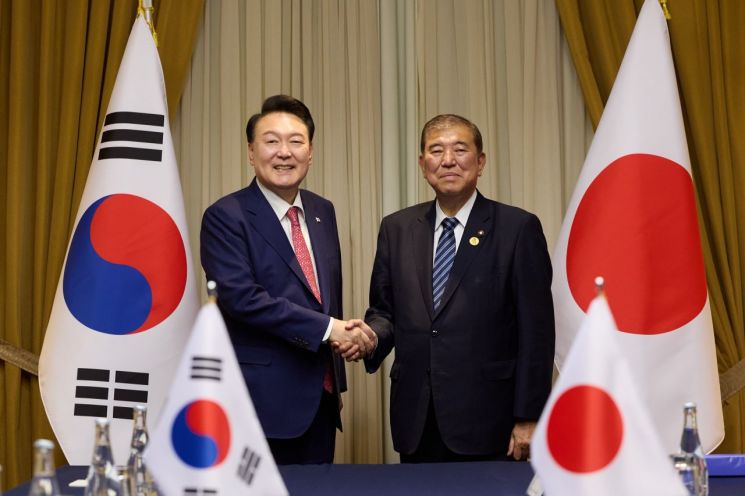 President Yoon Suk-yeol is taking a commemorative photo with Japanese Prime Minister Ishiba Shigeru before their summit meeting at a hotel in Lima, Peru, on the 16th of last month (local time). Photo by Yonhap News
The Yomiuri Shimbun reported on the 4th that the Japanese government is increasingly worried that the South Korea-Japan relationship, which had been improving under the Yoon administration, may regress as an aftermath of this incident.
The newspaper stated that the plan of Japanese Prime Minister Ishida Shigeru, who was coordinating a visit to South Korea around January next year to mark the 60th anniversary of the normalization of diplomatic relations between the two countries, is expected to be postponed depending on the situation in South Korea.
Prime Minister Ishida was reportedly considering a visit to South Korea in early January, before the regular Diet session, to revitalize the 'shuttle diplomacy' between the two leaders that resumed during former Prime Minister Kishida Fumio's administration.
However, a senior official from the Ministry of Foreign Affairs suggested the possibility of reconsidering the plan, saying, "Diplomacy with South Korea will be difficult for the time being," according to the newspaper.
On the same day, Prime Minister Ishida told reporters at the Prime Minister's residence that "nothing concrete has been decided yet" regarding the visit to South Korea.
Local media reported that former Prime Minister Suga Yoshihide, who is the chairman of the Japan-Korea Parliamentary League, has already decided to cancel his planned visit to South Korea on the 15th and 16th.
Former Prime Minister Suga had planned to visit South Korea with executives of the Japan-Korea Parliamentary League to meet with Joo Ho-young, the chairman of the Korea-Japan Parliamentary League and vice speaker of the National Assembly, to confirm cooperative relations and hold commemorative events to promote exchanges ahead of the 60th anniversary of normalization of diplomatic relations next year.
He was also reportedly pursuing a meeting with President Yoon Suk-yeol.
In this regard, a Japanese government official said, "This is a critical phase where the improving trend in bilateral relations could shrink."
Kyodo News also reported that the aftermath of the martial law declaration could affect cooperation in security, economy, and other fields that South Korea and Japan have been promoting since former Prime Minister Kishida, increasing concerns within the Japanese government.
It added, "There is no guarantee that if President Yoon steps down, the newly established (South Korean) government will be able to keep pace with the development of relations planned around the 60th anniversary of diplomatic ties."
However, Prime Minister Kishida said during a response to questions from representatives of each party in the House of Councillors (upper house) on the same day, "South Korea and Japan are important neighboring countries that must cooperate on various international issues," and "We will monitor the situation and make appropriate judgments."
Kyodo News also reported that Japanese Defense Minister Nakatani Gen, who had been planning a visit to South Korea within the year, decided to postpone the visit following the resignation announcement of South Korean Defense Minister Kim Yong-hyun.
Defense Minister Nakatani and Minister Kim held a bilateral meeting on the 21st of last month during the 11th ASEAN Defense Ministers' Meeting-Plus (ADMM-plus) held in Laos, where they agreed on Nakatani's visit to South Korea within the year.
The Asahi Shimbun predicted that the aftermath of the martial law declaration would also affect the trilateral cooperation among South Korea, the United States, and Japan, which was agreed upon at the Camp David declaration last August.
The three leaders who participated in the Camp David summit were U.S. President Joe Biden, South Korean President Yoon Suk-yeol, and then Japanese Prime Minister Kishida.
With the uncertainty increasing due to the expected inauguration of President-elect Donald Trump in January next year, and President Yoon also facing a crisis, the outlook for South Korea-U.S.-Japan cooperation has become even more uncertain.
© The Asia Business Daily(www.asiae.co.kr). All rights reserved.
![Clutching a Stolen Dior Bag, Saying "I Hate Being Poor but Real"... The Grotesque Con of a "Human Knockoff" [Slate]](https://cwcontent.asiae.co.kr/asiaresize/183/2026021902243444107_1771435474.jpg)
















