Exposed to Unprecedented Uncertainty... Rushing to Manage
F4 Holds Two Issue Briefings Approximately 7 Hours Apart
Urgent Meetings Amid Exchange Rate and Capital Market Instability
Emergency Standby Orders to Agencies... Focus on Liquidity Supply
Amid unprecedented uncertainty in the financial markets following news that President Yoon Suk-yeol declared martial law on the night of the 3rd, the heads of the economic and financial control towers rushed to manage the aftermath. From immediately after the martial law declaration, they canceled or postponed scheduled events for 12 hours and held two emergency macroeconomic and financial issue meetings (F4 meetings) to maintain market stability through urgent meetings and resolutions.
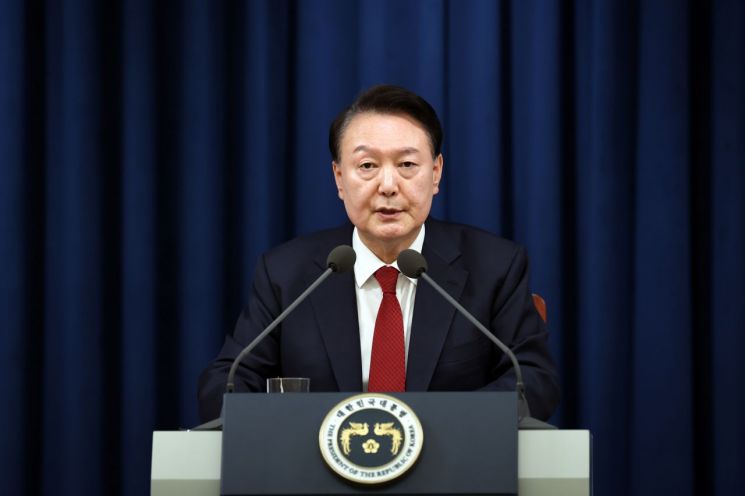
At 10:23 p.m. on the 3rd, President Yoon, after a Cabinet meeting attended by only some ministers, suddenly declared martial law in a public address. The won-dollar exchange rate, which had been below 1,400 won, began to soar, and around 11:40 p.m., when it was fluctuating above 1,440 won, the first F4 meeting was held. Choi Sang-mok, Deputy Prime Minister and Minister of Economy and Finance, who attended the surprise midnight Cabinet meeting, urgently convened the meeting at the Bankers Association Hall in Jung-gu, Seoul, with Lee Chang-yong, Governor of the Bank of Korea, Kim Byung-hwan, Chairman of the Financial Services Commission, and Lee Bok-hyun, Governor of the Financial Supervisory Service, among others.
These leaders put their heads together to minimize the shock the financial markets would face the next day (the 4th) as the won-dollar exchange rate surged to its highest level in over two years and the volatility of virtual asset prices increased. The meeting's content was conveyed mainly through Deputy Prime Minister Choi's remarks. At the meeting, Choi stated, "To respond to potential market instability factors following the declaration of martial law, we will mobilize all possible financial and foreign exchange market stabilization measures, including unlimited liquidity supply," and added, "We will hold F4 meetings daily to maintain a constant crisis management system."
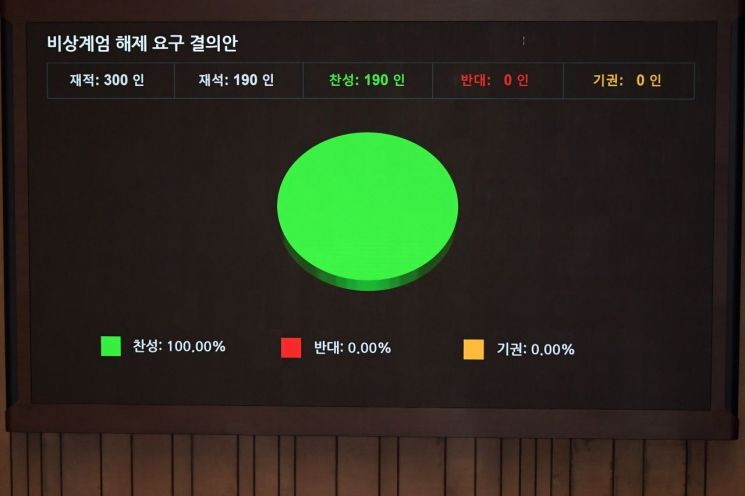
At 1:02 a.m. on the 4th, 190 ruling and opposition lawmakers gathered in the plenary session hall unanimously passed a 'Resolution to Lift Martial Law' while blocking 280 martial law troops who had stormed the National Assembly. Meanwhile, Governor Lee headed to the Financial Supervisory Service after the F4 meeting, which lasted over an hour. At 1:30 a.m., he convened an 'Emergency Financial Situation Review Meeting' with deputy governors and heads of major departments to activate an emergency response system. They agreed to prepare so that necessary market stabilization measures to address financial and foreign exchange market instability factors caused by the martial law declaration could be immediately implemented. They also decided to check the foreign currency funding status of each financial sector and the volatility of the virtual asset market and to promptly share and cooperate with related agencies.
Including Deputy Prime Minister Choi, Chairman Kim, and Governor Lee also issued emergency standby orders to their respective institutions and ordered market monitoring. The Ministry of Economy and Finance centered on the Economic Policy Bureau's Capital Market Division and the International Finance Bureau's Foreign Currency Funding Division, the Financial Services Commission's Financial Policy Bureau's Financial Market Analysis Division, and the Bank of Korea's Financial Market Bureau's Market Coordination Team took the frontline.
The situation began to change rapidly again at 4:26 a.m. Facing increasing demands from the National Assembly to accept the resolution to lift martial law, President Yoon declared the lifting of martial law through an additional address 3 hours and 24 minutes after the National Assembly's resolution. The Cabinet meeting presided over by Prime Minister Han Duck-soo concluded at 4:30 a.m. Although the won-dollar exchange rate and capital market volatility somewhat eased, tension persisted as messages of concern from various governments were conveyed through overseas media. Even the opening of the domestic stock market was uncertain.
Second F4 Meeting Held at 7 a.m. After Martial Law Lifted... Silent on Martial Law-Related Questions
The heads of the economic and financial control towers held the second F4 meeting at 7 a.m. at the Bankers Association, in a completely different phase from the first meeting the previous day. This was 2 hours and 30 minutes after President Yoon declared the lifting of martial law around 4:30 a.m. The leaders appeared with very somber expressions and remained silent in response to reporters' questions as they headed into the meeting room.
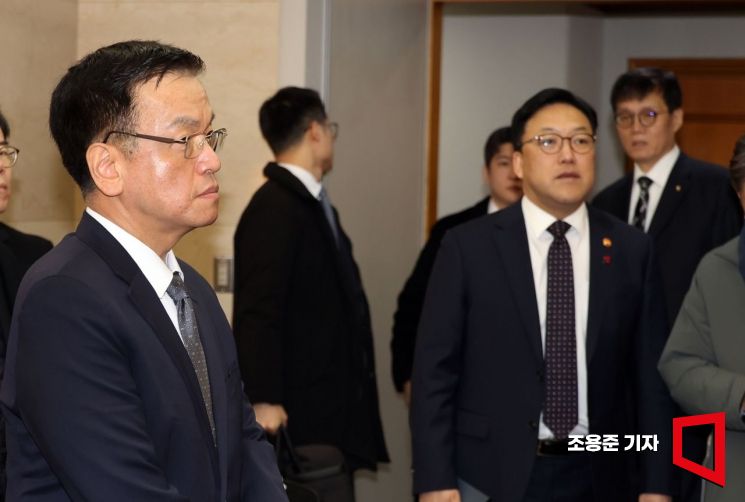 Choi Sang-mok, Deputy Prime Minister and Minister of Economy and Finance (left), Lee Chang-yong, Governor of the Bank of Korea (right), and Kim Byung-hwan, Chairman of the Financial Services Commission (center), are leaving the meeting room with serious expressions after a closed-door emergency macroeconomic and financial issues briefing held on the 4th at the Korea Federation of Banks in Jung-gu, Seoul. Photo by Jo Yong-jun
Thirty minutes after the F4 meeting began, at 7:30 a.m., news broke that the domestic stock market would open normally, and the leaders disclosed the meeting's content, which lasted about an hour, through a pre-prepared press release similar to the previous day. They emphasized that the foreign exchange market and overseas Korean bond market were stabilizing, the won-dollar exchange rate closed at 1,415.8 won, and foreign currency procurement by domestic banks was proceeding smoothly.
They also decided to supply unlimited liquidity to the market until the stock, bond, short-term funds, and foreign currency funds markets fully normalized. Additionally, they agreed to operate a real-time joint government monitoring system to closely watch the financial market situation. Governor Lee told reporters after the meeting, "The foreign currency funding market is moving stably," and added, "We will closely monitor the situation going forward."
Later, at 8:30 a.m., the Financial Services Commission held a 'Financial Situation Review Meeting' where Chairman Kim Byung-hwan met with private financial companies to assess the market situation and discuss future response tasks. The financial authorities immediately activated a 10 trillion won stock market stabilization fund and decided to operate a 40 trillion won bond market stabilization fund and a corporate bond and commercial paper (CP) purchase program for the bond and money markets.
It was also understood that the meeting urged active communication with overseas investors. One participant told Asia Economy in a phone interview, "There was a request for financial companies to actively convey messages to foreign shareholders and investors that they need not worry about Korea's foreign exchange and stock markets."
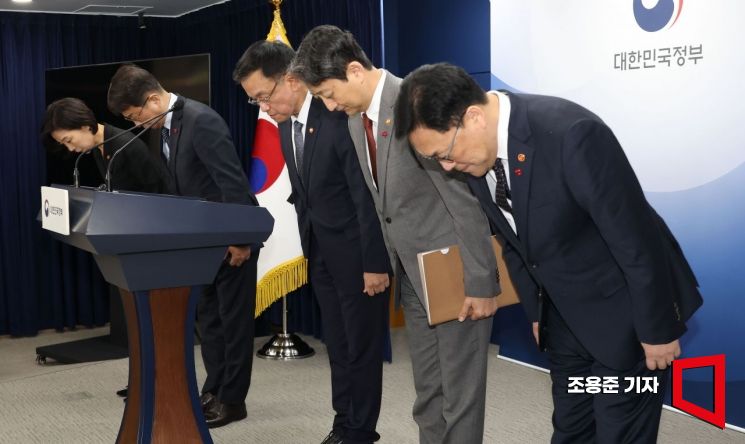 Choi Sang-mok, Deputy Prime Minister and Minister of Economy and Finance, Ahn Deok-geun, Minister of Trade, Industry and Energy, Park Sang-woo, Minister of Land, Infrastructure and Transport, Oh Young-joo, Minister of SMEs and Startups, and Kim Byung-hwan, Chairman of the Financial Services Commission, are greeting at the joint briefing of the emergency economic ministers' meeting held on the 4th at the Government Seoul Office in Jongno-gu, Seoul.
Deputy Prime Minister Choi and Chairman Kim also held an 'Emergency Economic Ministers Meeting' at the Government Complex Seoul at 10 a.m. Without a Q&A session, they announced, "To alleviate concerns about our economic situation, we will closely communicate and promptly share situations with international credit rating agencies, major economic lines such as the U.S., domestic economic organizations, and financial markets," and added, "We will also operate a 24-hour economic and financial situation monitoring task force (TF) to prevent shocks to the real economy."
Around the same time, Governor Lee held an 'Expanded Financial Situation Review Meeting' and decided to hold meetings with overseas investors, including branches of foreign banks. He also announced plans to operate a 24-hour emergency response system until market normalization, hold daily financial situation review meetings, and strictly respond to the spread of false rumors and misinformation exploiting investors' anxiety.
The Governor convened an extraordinary Monetary Policy Committee meeting and decided to increase short-term liquidity supply through non-regular repurchase agreement (RP) purchases. To supply won liquidity, the scope of securities eligible for RP transactions was expanded to include industrial finance bonds, small and medium enterprise finance bonds, export-import finance bonds, special bonds issued by nine public institutions, agricultural finance bonds, fisheries finance bonds, and financial bonds under the Banking Act. The range of institutions eligible for RP transactions was also expanded to include all domestic banks and foreign bank branches, all securities dealers and brokers, and Korea Securities Finance Corporation.
Meanwhile, the schedules of these leaders were consecutively canceled that day. Chairman Kim canceled his visits to the Youth Leap Account Counseling Center and attendance at the Voice Phishing Damage Prevention Best Practices Presentation. Governor Lee also postponed the securities company CEO meeting.
© The Asia Business Daily(www.asiae.co.kr). All rights reserved.
![Clutching a Stolen Dior Bag, Saying "I Hate Being Poor but Real"... The Grotesque Con of a "Human Knockoff" [Slate]](https://cwcontent.asiae.co.kr/asiaresize/183/2026021902243444107_1771435474.jpg)












