KOSPI down 1.44%, KOSDAQ down 1.98%
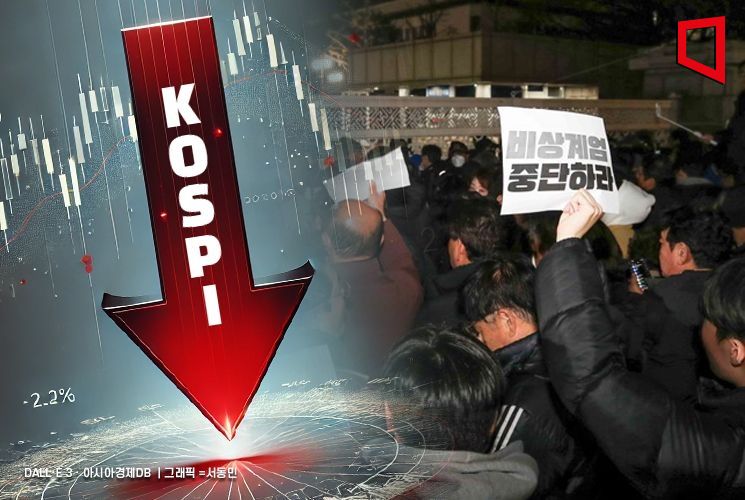
The KOSPI closed lower on the 4th amid the aftermath of President Yoon Suk-yeol's 'martial law situation.' As the continuity of government policies came into question, related stocks also showed a downward trend.
On this day, the KOSPI traded at 2,464.00, down 36.10 points (1.44%) from the previous day. The KOSPI index opened at 2,450.76, down 49.34 points (1.97%), and continued its weakness. Foreigners sold stocks worth 407.8 billion KRW. Individuals and institutions bought stocks worth 338 billion KRW and 19 billion KRW, respectively.
Among the top market capitalization stocks, Kakao (8.50%), Korea Zinc (8.37%), SK Hynix (1.88%), and Kia (0.10%) rose. Most stocks fell, including Shinhan Financial Group (-6.56%), KB Financial Group (-5.73%), Samsung Fire & Marine Insurance (-4.94%), Samsung Life Insurance (-4.40%), NAVER (-3.11%), Hyundai Motor (-2.56%), LG Chem (-2.30%), Celltrion (-2.09%), and LG Energy Solution (-2.02%).
By sector, steel and metal (3.07%) and food and beverage (0.32%) rose. Most sectors declined, including electricity and gas (-9.94%), insurance (-4.54%), construction (-4.53%), machinery (-3.89%), medical precision (-3.56%), distribution (-3.14%), finance (-3.07%), and securities (-2.77%).
Ji-won Kim, a researcher at KB Securities, analyzed, "Foreigners switched to net selling in one day, and all sectors except steel declined. In particular, the drop in finance and utility sectors was prominent." Dae-jun Kim, a researcher at Korea Investment & Securities, expressed concern, saying, "The KOSPI may be exposed to downward pressure. Political and economic uncertainties negatively affect the country's credit rating in the mid to long term. There is a high likelihood that credit rating agencies' outlook on Korea will change due to this situation. The perspective of overseas investors on Korean stocks may also change."
The weakness of stocks related to the government's key policies, such as the 'big whale,' nuclear power, and artificial intelligence (AI) textbooks, was notable. Korea Gas Corporation (-18.8%), POSCO International (-12.6%), BHI (-17.9%), KEPCO Engineering & Construction (-15.8%), and Visang Education (-8.2%) fell amid market doubts about the continuity of related government policies. Despite the year-end dividend season, a large sell-off by foreign institutions and the decline of financial stocks such as KB Financial Group were also confirmed.
However, the KOSPI's decline narrowed compared to the early session. On this day, the Financial Services Commission decided to immediately activate a stock market stabilization fund (Stock Stabilization Fund) and a bond market stabilization fund (Bond Stabilization Fund) totaling 50 trillion KRW if necessary. The Bank of Korea also decided to inject funds directly by purchasing repurchase agreements (RPs) until the market stabilizes. Researcher Ji-won Kim predicted, "Volatility may increase temporarily due to uncertainty, but at the current index level, which is historically low in valuation (price relative to corporate value) and with market stabilization measures, a process of absorbing selling pressure will proceed."
The KOSDAQ index recorded 677.15, down 13.65 points (1.98%) from the previous session. The index opened at 677.59, down 13.21 points (1.91%), and failed to rebound. Foreigners and individuals sold stocks worth 14.8 billion KRW and 0.5 billion KRW, respectively. Institutions bought stocks worth 17 billion KRW.
Among the top market capitalization stocks, Peptron (5.48%), Sinsung Delta Tech (1.16%), Hugel (0.96%), Ligachem Bio (0.85%), and Ligno Industrial (0.51%) rose. Rainbow Robotics (-6.76%), Classys (-4.84%), Samchundang Pharm (-4.13%), EcoPro (-3.39%), ST Pharm (-3.22%), EcoPro BM (-2.83%), and Enchem (-2.27%) declined.
Earlier, President Yoon Suk-yeol declared martial law around 10:30 p.m. the previous day but lifted it six hours later. This was due to the National Assembly passing a resolution to lift martial law with the majority of 190 members present. Subsequently, six opposition parties, including the Democratic Party of Korea, submitted an impeachment motion against President Yoon to the National Assembly. Ahn Cheol-soo, a member of the People Power Party who played a significant role in unifying the opposition during the presidential election, also demanded the president's resignation.
© The Asia Business Daily(www.asiae.co.kr). All rights reserved.

















