Standard & Poor's (S&P) and NICE Credit Rating evaluated that President Yoon Suk-yeol's declaration and lifting of martial law had a negative impact on overseas investors. Although it is not significant enough to immediately lower the national credit rating, there are forecasts that investment funds may withdraw or financing costs may rise.
Kim Eng Tan, Managing Director of the Asia-Pacific Sovereign Ratings Team at S&P Global Ratings, stated on the morning of the 4th at the 'Increased Credit Uncertainty Due to Changes in Geopolitical Situations' joint seminar held at the Fairmont Hotel in Yeouido, Seoul, "The declaration of martial law is seen as a negative shock by many international investors and will negatively affect their decision-making."
He added, "We also need to observe how the global situation will affect Korea going forward. If other countries are relatively more attractive and free of political risks, investors may withdraw from Korea and redirect their investments elsewhere."
Ki Tae-hoon, Executive Director of the Evaluation Policy Division at NICE Credit Rating, said, "Companies may face situations where credit default swap (CDS) premiums rise due to a decline in external creditworthiness related to financing. While the impact may not be significant, we need to monitor how far the political turmoil will continue."
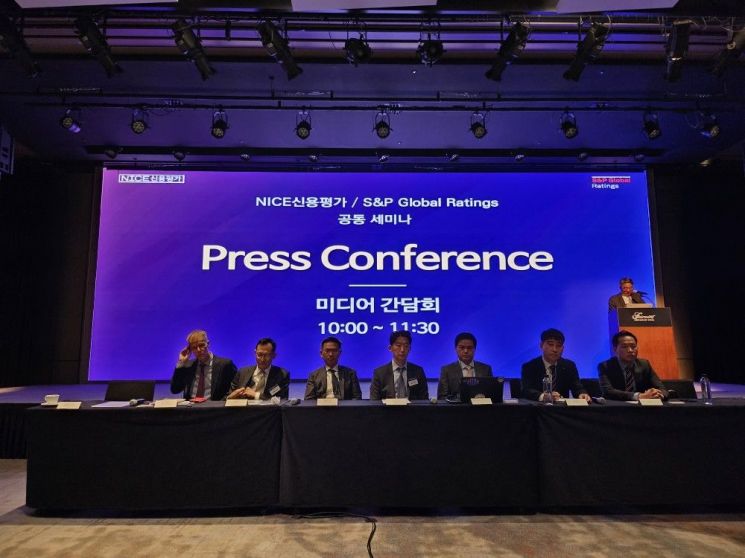
However, there was also analysis that the economic situation resulting from the declaration and lifting of martial law is not severe enough to immediately lower the national credit rating. Managing Director Kim Eng Tan said, "Although there was an unexpected declaration of martial law, it was resolved within a few hours. This indicates that Korea's institutional foundation is sufficiently solid and that it can absorb a tremendous shock and return to normal within a few hours." He added, "Korea's national credit rating is AA, which I believe properly reflects expectations, and practically, there is no significant impact to warrant a downgrade at this time."
Executive Director Lee Hyuk-jun of the Financial Evaluation Division at NICE Credit Rating also explained, "There will be a politically turbulent period for the time being, and the financial market will be affected in the short term. Looking back to the impeachment crisis and early presidential election events in 2016-2017, the market experienced some fluctuations, but interest rates and stock indices returned to normal with a time lag." He continued, "This is fundamentally because Korea's economic fundamentals are strong and domestic and foreign investors have confidence. Investors prioritize fundamentals, so there is no need to be overly shaken."
Experts from both agencies positively evaluated the continuation of the 'Emergency Macroeconomic and Financial Issues Meeting (F4)' from the previous night through the morning of the day. Kim Dae-hyun, Executive Director of Financial Institution Ratings at S&P Global Ratings Asia-Pacific, said, "It is important that the Korean government prioritizes the stability of the financial system. While there may be aspects of more aggressive intervention compared to other countries, it is crucial that financial authorities demonstrate their commitment to stabilizing the market."
© The Asia Business Daily(www.asiae.co.kr). All rights reserved.
![Clutching a Stolen Dior Bag, Saying "I Hate Being Poor but Real"... The Grotesque Con of a "Human Knockoff" [Slate]](https://cwcontent.asiae.co.kr/asiaresize/183/2026021902243444107_1771435474.jpg)
















