[K-Construction, A New Leap] Hyundai Engineering & Construction
Holds the Nation's Most Nuclear Power Plant Construction Records and First Nuclear Export History
Comprehensive Nuclear Power Plant Management System... Initiating Next-Generation Roadmap
Securing and Enhancing Carbon Neutral Core Technologies and Capabilities in SMR and Hydrogen
Hyundai Engineering & Construction is accelerating efforts to secure core field super-gap technologies, expand the energy value chain, and promote high value-added overseas projects. This is to overcome the internal and external crises faced by the construction industry by inheriting and developing the group's unique DNA and core values of 'creativity' and 'challenging spirit.' Based on this, after securing carbon-neutral source technologies such as Small Modular Reactors (SMR) and hydrogen, visible achievements have also been made in the development of new-concept residential products.
Most Domestic Nuclear Power Plant Constructions and First Export... 'Second Renaissance' in Europe
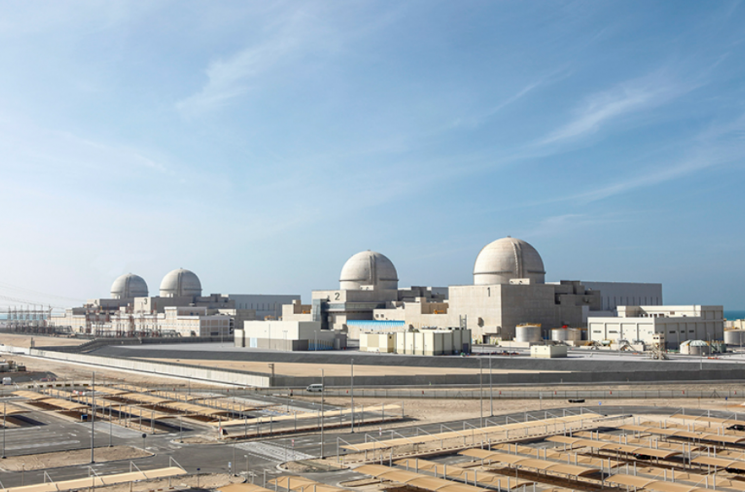 Barakah Nuclear Power Plant, Hyundai Engineering & Construction's first export of a Korean-style nuclear power plant and the first nuclear power plant in the Middle East / Photo by Hyundai Engineering & Construction
As the government reaffirms the restoration of the nuclear power ecosystem and continues its will and support policies to leap forward as a nuclear power nation, Hyundai Engineering & Construction's nuclear power business is also gaining momentum. The related roadmap has been set since 2022. Hyundai Engineering & Construction plans to build a comprehensive nuclear power value chain and leap to become the world's No. 1 'total nuclear power solution provider.'
Among the 36 Korean-type large nuclear power plants domestically and abroad, 24 were built by Hyundai Engineering & Construction. It holds the record as the first domestic construction company to have constructed both pressurized water reactors and pressurized heavy water reactors. Furthermore, based on the portfolio of 'the most domestic nuclear power plant constructions' and 'the first nuclear power plant export,' it has established a management system covering all areas of nuclear power, including SMR, nuclear power plant decommissioning, and spent nuclear fuel treatment. Strategic alliances and collaborations with global companies are also ongoing.
Hyundai Engineering & Construction has been aligned with the development history of K-Nuclear Power. South Korea established a nuclear-related administrative department in 1956 and promulgated the Nuclear Energy Act in March 1958. As the importance of energy security and stable power supply emerged, Korea Electric Power Corporation signed a supply contract in December 1970 for the first domestic nuclear power plant, Kori Unit 1, with Westinghouse of the United States as the main contractor. The 587 MW Kori Unit 1 began construction in November 1971 and started commercial operation in April 1978. This made Korea the 21st country in the world to possess nuclear power plants. However, in the early days of nuclear power plant construction, Korea had to rely entirely on foreign technology, and Hyundai Engineering & Construction began accumulating technology by participating in system construction necessary for reactor operation.
Domestic nuclear power plants entered a new leap forward in the 1980s. As the nuclear power plants under construction were completed one after another, nuclear power became an important part of Korea's power supply. The state-led plan for localization of nuclear power technology also began in earnest. At this time, Hyundai Engineering & Construction achieved the great success of being selected as the main contractor and sole constructor for the Kori Units 3 and 4 projects, which accelerated technology accumulation.
In the 2000s, Hyundai Engineering & Construction was at the center of Korea's nuclear power technology independence era. After solely constructing Hanbit Units 3 and 4, it also achieved the first nuclear power plant export. In December 2009, a consortium consisting of Hyundai Engineering & Construction, KEPCO, Korea Hydro & Nuclear Power, and others was selected as the mega nuclear power plant construction contractor worth 20 billion dollars, beating out France, the United States, Japan, and others. This mega project involves constructing four 1400 MW nuclear power plants in Barakah, west of Abu Dhabi, the capital of the United Arab Emirates (UAE), covering an area four times the size of Yeouido (8 km wide by 1.8 km long). The Barakah nuclear power plant is currently in commercial operation and supplies up to 25% of the UAE's electricity demand. Additionally, Hyundai Engineering & Construction reaffirmed its market influence by signing a contract last year with KHNP for the Shin Hanul Units 3 and 4 project.
There is also the new construction project for the Kozloduy nuclear power plant in Bulgaria, for which an engineering contract was signed last November. Hyundai Engineering & Construction was the only company to meet all the stringent preconditions during the selection process as the preferred negotiator earlier this year, competing against leading global companies such as Bechtel and Fluor. As a result, it received sole parliamentary approval. Hyundai Engineering & Construction stated that the government's decision to restore the nuclear power ecosystem and continuous support measures for K-Nuclear Power were effective, backed by abundant construction experience, excellent technological capabilities, and solid financial soundness.
Recently, the possibility of entering the UK SMR sector has also increased. Hyundai Engineering & Construction, together with Holtec Britain, the UK subsidiary of the US Holtec International, was selected as a final bidder in the SMR technology competitive bidding program led by the UK Nuclear Decommissioning Authority. Team Holtec, which possesses unparalleled nuclear power business capabilities, has built a solid foundation for global cooperation networks and SMR entry through strategic partnerships. Based on the Korea-US technology alliance and global nuclear power partnerships, Team Holtec plans to accelerate efforts to enhance practical capabilities necessary for business execution, such as establishing local supply chains.
Next-Generation Nuclear Power Business Roadmap Launched... Leveraging Korea-US Alliance
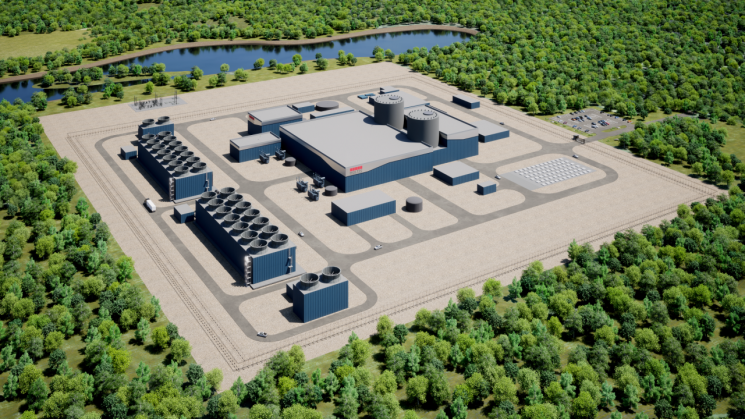 Perspective view of the SMR model being developed by Hyundai Engineering & Construction in collaboration with Holtec International / Photo by Hyundai Engineering & Construction
Hyundai Engineering & Construction's next-generation nuclear power business is gaining momentum thanks to the Korea-US alliance. Last year, the two countries formed a clean energy partnership, defining nuclear energy as a key element in overcoming the climate crisis and achieving carbon neutrality goals. They expanded their relationship from diplomacy and security to an 'advanced technology alliance' including the nuclear power sector.
Starting with the UAE, Hyundai Engineering & Construction began a sprint to promote K-Nuclear Power worldwide. In May 2022, it signed a strategic agreement with Westinghouse, becoming the first domestic company to secure an opportunity to enter the US-style large nuclear power plant (AP 1000) business. By jointly participating in the AP 1000 business, which holds licenses in the US, Europe, and Asia, Hyundai Engineering & Construction's large nuclear power plant business scope is expected to expand further.
In November 2021, Hyundai Engineering & Construction signed an agreement with Holtec International to jointly develop SMR and enter the business together, and in March the following year, they agreed to cooperate on nuclear power plant decommissioning projects. The two companies are jointly developing a universal reactor SMR that can be deployed without regional or environmental restrictions such as deserts or polar regions. The SMR will first be deployed at Holtec's Palisades nuclear power plant site in the US and will also be constructed in Ukraine to rebuild energy infrastructure. After the Ukraine-Russia war, the SMR pilot project's power grid will be connected in Ukraine, with an additional 20 units deployed. Components necessary for nuclear power plant construction will be produced locally.
© The Asia Business Daily(www.asiae.co.kr). All rights reserved.
![Clutching a Stolen Dior Bag, Saying "I Hate Being Poor but Real"... The Grotesque Con of a "Human Knockoff" [Slate]](https://cwcontent.asiae.co.kr/asiaresize/183/2026021902243444107_1771435474.jpg)

















