Government Calls Emergency Economic Ministers' Meeting of 15 Ministries
All Measures to Prevent Market Chaos Will Be Mobilized
Growing Uncertainty... "National Credit Impact Inevitable"
The government has decided to supply unlimited liquidity to ease financial market instability caused by the declaration and lifting of martial law. Additionally, it urgently convened ministers from 15 departments to analyze the economic impact and prepare countermeasures. Experts expressed concerns that this incident will increase South Korea's short-term 'political risk' and negatively affect the country's credit rating.
Government: "Unlimited liquidity supply for the time being"
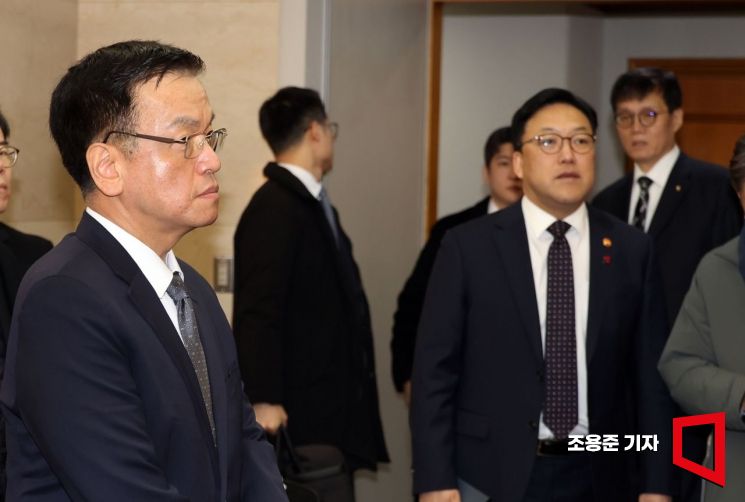 Choi Sang-mok, Deputy Prime Minister and Minister of Economy and Finance (left), Lee Chang-yong, Governor of the Bank of Korea (right), and Kim Byung-hwan, Chairman of the Financial Services Commission (center), are leaving the meeting room with serious expressions after a closed-door emergency macroeconomic and financial issues meeting held on the 4th at the Korea Federation of Banks in Jung-gu, Seoul. Photo by Jo Yong-jun
On the morning of the 4th at 7 a.m., Choi Sang-mok, Deputy Prime Minister and Minister of Economy and Finance, Lee Chang-yong, Governor of the Bank of Korea, Kim Byung-hwan, Chairman of the Financial Services Commission, and Lee Bok-hyun, Governor of the Financial Supervisory Service, held an 'Emergency Macroeconomic and Financial Issues Meeting (F4)' at the Korea Federation of Banks building in Jung-gu, Seoul, and decided to supply unlimited liquidity. This measure will be maintained for the time being until the stock, bond, short-term funds, and foreign exchange markets are fully normalized.
They also emphasized operating a government-wide joint real-time monitoring system to closely watch the financial market situation and swiftly implement all necessary measures to stabilize the market if needed. After the meeting, Governor Lee met with reporters and said, "We hold daily F4 meetings to continuously monitor the situation," adding, "The Bank of Korea's Monetary Policy Committee will also hold a meeting, and under the leadership of the Financial Services Commission chairman, management plans related to private financial companies will be discussed."
A senior government official added, "The Financial Services Commission and the Bank of Korea will mobilize all available means to ensure that liquidity instability absolutely does not occur," and explained, "This decision was promptly made at this morning's F4 meeting."
Deputy Prime Minister Choi also convened an emergency economic ministers' meeting at 10 a.m. that day. Along with ministers from key departments, they are expected to review the economic situation following the declaration and lifting of martial law and examine response measures by sector. Ministers from the Ministry of Education, Ministry of Science and ICT, Ministry of Culture, Sports and Tourism, Ministry of Agriculture, Food and Rural Affairs, Ministry of Trade, Industry and Energy, Ministry of Health and Welfare, Ministry of Environment, Ministry of Employment and Labor, Ministry of Gender Equality and Family, Ministry of Land, Infrastructure and Transport, Ministry of Oceans and Fisheries, Ministry of SMEs and Startups, Office for Government Policy Coordination, and Financial Services Commission attended the meeting. The previously scheduled meeting to announce tailored support measures for small business owners and self-employed individuals was canceled.
On that day, the financial and foreign exchange markets opened normally. The government mentioned that after the lifting of martial law, the foreign exchange market and overseas Korean stock markets are gradually stabilizing. The Ministry of Economy and Finance analyzed that domestic banks' foreign currency funding is also being smoothly rolled over.
Following President Yoon Seok-youl's unexpected declaration of martial law the previous night, major government departments were busy. Deputy Prime Minister Choi convened the F4 meeting at 11:40 a.m., about an hour after the declaration, at the Korea Federation of Banks in Jung-gu, Seoul. Subsequently, the Ministry of Economy and Finance urgently held a first-level executive meeting at the Government Complex Seoul and began discussions. The ministry stated, "As the economic control tower, we plan to manage and monitor the overall economy without wavering," and decided to hold daily first-level executive meetings for this purpose.
Growing uncertainty... "National credit impact inevitable"
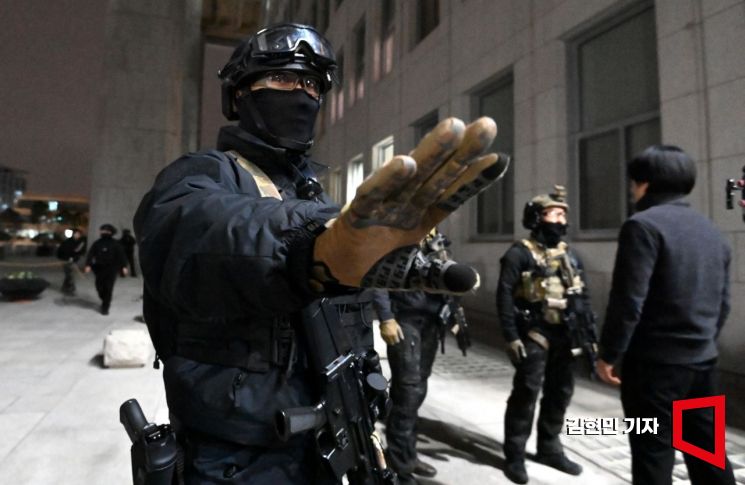 President Yoon Suk-yeol declared martial law on the night of the 3rd, and in the early morning of the 4th, martial law troops are attempting to enter the main building of the National Assembly. Photo by Kim Hyun-min
Although martial law has been lifted and the government is responding to stabilize the financial system, uncertainty is expected to inevitably increase if impeachment proceedings commence.
Kang Sung-jin, professor of economics at Korea University, said, "An unprecedented event occurred that could not happen in a democracy with a per capita income of $35,000," adding, "If the political situation moves into an impeachment phase, political uncertainty will continue until the regime changes, thereby increasing economic uncertainty." He also pointed out, "In the impeachment phase, how much support the ruling party receives will be a variable in resolving the risk."
There were also opinions that corporate management will be affected. With global business environment uncertainty increasing ahead of Donald Trump's second term, the political situation adds to the risk, and the economic damage caused by political risk is expected to be significant. Lee Yoon-soo, professor of economics at Sogang University, diagnosed, "Political uncertainty is not separate from the economy," and "In South Korea's industrial structure, where overseas manufacturers and intermediate goods supply are closely connected, such political instability can immediately impact business activities." He forecasted, "Concerns about uncertainty in our main export items are growing, which may negatively affect corporate management activities and the economy." Furthermore, he suggested that major government-led policy tasks currently pending, such as corporate value-up initiatives, may lose momentum, potentially signaling a red light for government support.
Concerns have also been raised that the declaration of martial law could lead to a decline in external credibility and negatively affect the outlook of the country's credit rating by international credit rating agencies. If the national credit rating is downgraded, it could lead to a sharp drop in government bond prices, causing significant damage to the Korean economy. The three major credit rating agencies?Moody's, Standard & Poor's (S&P), and Fitch?have maintained South Korea's national credit rating as 'stable' for the past 10 years.
© The Asia Business Daily(www.asiae.co.kr). All rights reserved.
![Clutching a Stolen Dior Bag, Saying "I Hate Being Poor but Real"... The Grotesque Con of a "Human Knockoff" [Slate]](https://cwcontent.asiae.co.kr/asiaresize/183/2026021902243444107_1771435474.jpg)












