On the 4th, the legal community largely viewed President Yoon Seok-yeol's recent declaration of martial law as failing to meet the constitutional and legal requirements both substantively and procedurally. However, opinions differ on whether President Yoon, who declared martial law citing the current domestic situation as a national crisis and the need to protect the constitutional order, and then lifted the martial law after about six hours following the National Assembly's demand for its repeal, can be charged with rebellion.
Article 77, Paragraph 1 of the Constitution stipulates martial law as follows: "The President may declare martial law in times of war, armed conflict, or a national emergency equivalent thereto, when it is necessary to respond to military needs or to maintain public peace and order, in accordance with the law."
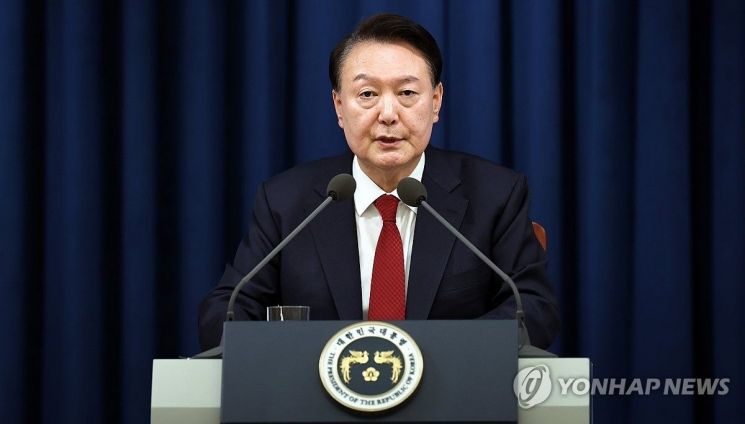 President Yoon Suk-yeol is delivering an emergency special address to the nation on the night of the 3rd at the Yongsan Presidential Office building in Seoul. Photo by the Presidential Office. Yonhap News Agency
In other words, for the President to declare martial law, both substantive conditions?such as the occurrence of "war, armed conflict, or a national emergency equivalent thereto" and the purpose of "responding to military needs or maintaining public peace and order"?and procedural requirements, including notifying the National Assembly, must be fulfilled.
The day before, President Yoon declared martial law by invoking his national emergency powers, citing reasons such as the opposition party's excessive impeachment attempts damaging the essential functions of the judiciary and executive branches and trampling on the constitutional order of the free Republic of Korea. However, the dominant view in the legal community is that the constitutional requirements were not met.
Professor Kim Seon-taek of Korea University Law School pointed out, "Before declaring martial law, a State Council meeting must be held, and a public announcement procedure must be followed when declaring martial law, but none of these procedures were observed. The order of issuing the martial law command by the martial law command headquarters was also reversed."

He added, "In particular, the proclamation includes prohibiting the activities of the National Assembly and local councils, but when martial law is declared, special measures can only be taken by the government or courts, not by the National Assembly. This is clearly illegal."
Article 77, Paragraph 3 of the Constitution states, "When martial law is declared, special measures may be taken concerning the warrant system, freedom of the press, publication, assembly, association, and the authority of the government or courts, as prescribed by law."
The Korean Bar Association also issued a statement early that morning urging the President to immediately lift martial law, stating, "We do not even feel the need to verbally refute the President on whether the current situation qualifies as war, armed conflict, or a national emergency equivalent thereto as described in the Constitution."
The Lawyers for a Democratic Society also released a statement that day, asserting, "President Yoon's declaration of martial law is an exercise of authority that violates the Constitution," and argued, "The reasons given for declaring martial law, such as the National Assembly's impeachment motion, clearly do not meet the requirements for martial law declaration under constitutional and legal interpretation."
However, opinions within the legal community are divided on whether President Yoon can be charged with rebellion. Many believed that if President Yoon had not accepted the National Assembly's demand to lift martial law, that alone would have constituted a constitutional violation and rebellion.
Professor Kim said, "Suspending the activities of the National Assembly or local councils paralyzes constitutional institutions and undermines the constitutional order, akin to the coup during the Yushin era. If martial law had not been lifted promptly despite the National Assembly's demand, it would have violated the Constitution and laws, which itself could constitute rebellion."
Professor Seo Bo-hak of Kyung Hee University Law School stated, "Declaring martial law that does not meet constitutional requirements is itself a violation of the Constitution."
Professor Han In-seop of Seoul National University Law School wrote on his Facebook that the martial law command's proclamation prohibiting the political activities of the National Assembly, the military's deployment to break the National Assembly's windows and enter the building to prevent the Assembly's repeal request, and the police blocking lawmakers' access to the National Assembly constitute rebellion and grounds for the President's impeachment.
© The Asia Business Daily(www.asiae.co.kr). All rights reserved.
![Clutching a Stolen Dior Bag, Saying "I Hate Being Poor but Real"... The Grotesque Con of a "Human Knockoff" [Slate]](https://cwcontent.asiae.co.kr/asiaresize/183/2026021902243444107_1771435474.jpg)

















