The October 26, 1979 Incident Marked the Last Martial Law
Declared 16 Times Since the Government Establishment in 1948
President Yoon Suk-yeol declared martial law on the 3rd but lifted it after six hours, bringing attention to the history of martial law in the Republic of Korea, which has been declared a total of 16 times.
Martial law is an emergency measure that allows the president to mobilize military forces to maintain public order during national crises such as wartime or incidents. It is stipulated in Article 77 of the Constitution of the Republic of Korea.
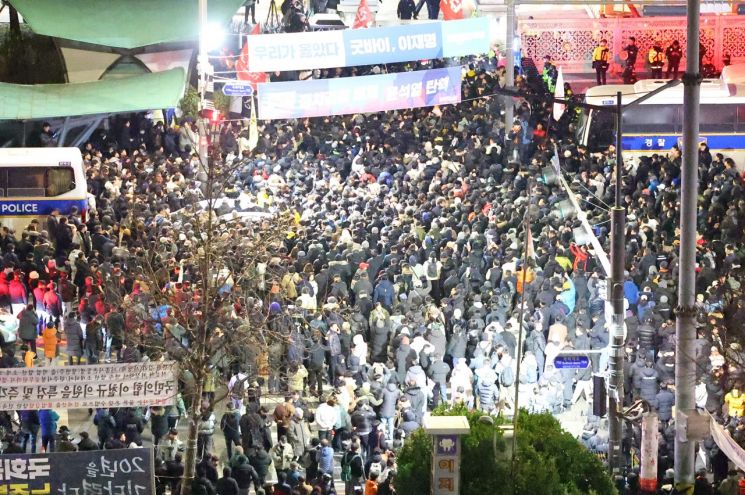
Martial law is further divided into emergency martial law and security martial law. According to the Martial Law Act, the emergency martial law declared by President Yoon can be issued when the country is in a state of war with an enemy or when social order is extremely disrupted. Security martial law is a lower level and can be declared when public security cannot be maintained by general administrative agencies such as the police. When emergency martial law is declared, the martial law commander appointed by the president holds both administrative and judicial authority over the martial law area, and freedoms of the press, publication, assembly, and association are restricted. If deemed necessary for operational reasons, the commander also has the right to destroy or burn citizens' property.
Since the establishment of the government in 1948, martial law has been declared a total of 16 times in the Republic of Korea. Among these, emergency martial law was declared 12 times. The first martial law in constitutional history was declared during the Syngman Rhee administration in October 1948, triggered by the Yeosu-Suncheon Incident. The 14th Regiment of the Republic of Korea Army refused the government's order to suppress the Jeju 4.3 Incident, leading to armed conflict, and former President Syngman Rhee declared martial law in the Yeosu-Suncheon area. The second martial law was declared in November of the same year in the Jeju area during the 4.3 Incident. Later, the first nationwide martial law was declared during the Korean War. During the April 19 Revolution, martial law was also misused to suppress student protests.
This continued under subsequent governments. Former President Park Chung-hee, who seized power through the May 16 military coup in 1961, declared martial law nationwide and lifted it on December 6 of the following year. With 12 days of emergency martial law and 558 days of security martial law, it was the longest-lasting martial law period in Korean history. Later, President Park declared martial law and school closures in response to the June 3 protests opposing the Korea-Japan agreement. Martial law was also declared during the October Restoration, which centered on the presidential indirect election system, and during the Bu-Ma protests.
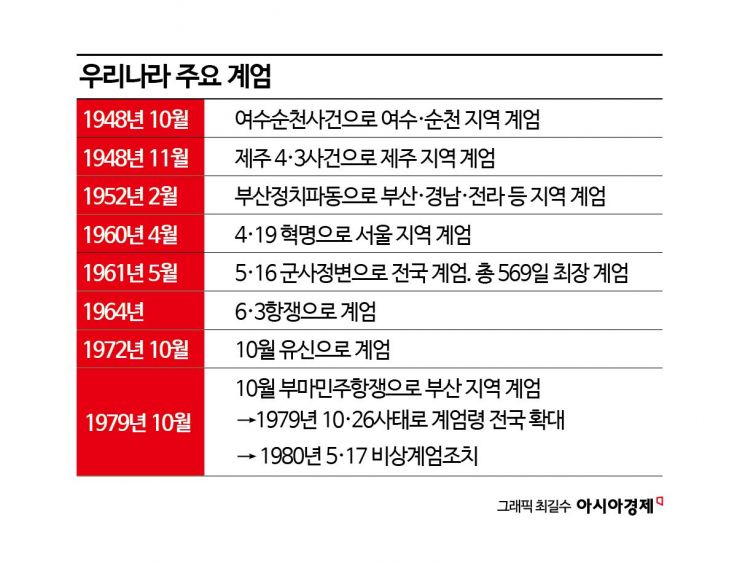
The last emergency martial law was declared immediately after former President Park was assassinated during the October 26 Incident in 1979. Subsequently, the new military regime led by Chun Doo-hwan and Roh Tae-woo, who staged a military coup in 1980, expanded martial law nationwide including Jeju Island and maintained it until 1981. When the May 18 Gwangju Democratization Movement arose in resistance, martial law troops were deployed to violently suppress it, causing public outrage. After the democratization movement, the current constitution, revised in 1987, stipulated procedures for the State Council's review so that martial law cannot be declared solely by the president's decision, and strengthened parliamentary oversight by allowing martial law to be lifted with the approval of the majority of the National Assembly members.
For over 40 years since then, no head of state in the Republic of Korea has declared martial law. Although it was never implemented, there is evidence that it was considered. During the June 10 Democratic Uprising in January 1987, triggered by the torture death of martyr Park Jong-cheol, the Chun Doo-hwan regime reportedly considered using martial law for violent suppression. However, due to public resistance and pressure from the United States deeming martial law inappropriate, the Chun Doo-hwan regime eventually accepted constitutional amendments for direct presidential elections.
During the Park Geun-hye administration, rumors about considering martial law also surfaced. Initially dismissed as mere rumors, it was confirmed to be true when detailed documents from the Republic of Korea Army's Defense Security Command (Counterintelligence Command) were disclosed.
© The Asia Business Daily(www.asiae.co.kr). All rights reserved.
![Clutching a Stolen Dior Bag, Saying "I Hate Being Poor but Real"... The Grotesque Con of a "Human Knockoff" [Slate]](https://cwcontent.asiae.co.kr/asiaresize/183/2026021902243444107_1771435474.jpg)

















