SK, HD Hyundai and Major Groups Hold Emergency CEO Meeting
Review Risks Including Sharp Exchange Rate Rise
Business Community: "Market Stabilization Measures Needed"
The business community is on edge over President Yoon Seok-yeol's midnight declaration of martial law. Although the martial law was lifted just six hours after being declared, concerns have grown over increased economic uncertainty, such as the sharp rise in the exchange rate. Major companies urgently convened executive meetings on the 4th to assess the situation, showing a sense of urgency. A debate on the amendment to the Commercial Act, which was to be led by Lee Jae-myung, leader of the Democratic Party of Korea, with business leaders and investors, was also canceled.
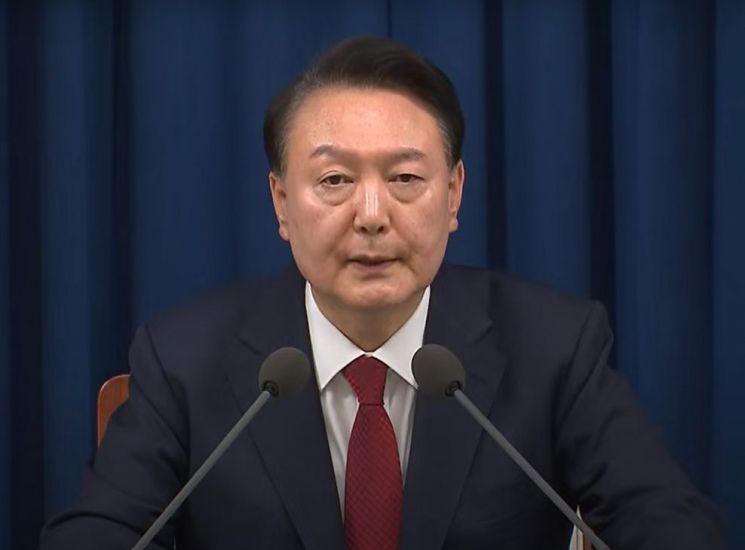 President Yoon Suk-yeol is announcing the lifting of the emergency martial law at the Yongsan Presidential Office in the early morning of the 4th. Photo by Yonhap News
According to the business community, major companies convened emergency executive meetings from the morning to grasp the situation and discuss response measures. HD Hyundai held an emergency executive meeting around 7:30 a.m., focusing on closely examining potential future economic conditions and agreeing to establish response strategies for each company. Kwon Oh-gap, chairman of HD Hyundai, said, "As domestic and international situations are expected to move rapidly, each company’s presidents must have an awareness equivalent to an emergency management situation," and urged, "Please focus on reviewing financial risks such as the exchange rate." He added, "In production sites such as shipbuilding, please pay even more attention to adhering to principles and regulations to prevent safety accidents."
SK also convened an executive meeting that day. Although the lifting of martial law made the possibility of a meeting uncertain, the top management gathered to assess the impact. Samsung monitored the situation overnight through on-duty staff.
Hyundai Motor, LG Group, as well as POSCO, Doosan, and Korean Air did not hold separate management meetings. However, Korean Air closely monitored the safety of nighttime flights. A Korean Air official explained, "Basically, we operate a 24-hour system and can switch to an emergency response system in real time depending on the situation."
Some companies switched to remote work. LG Electronics, located just 1.6 km from the National Assembly, recommended remote work for employees at its headquarters. Airports also initiated emergency responses. Incheon International Airport Corporation convened executives to hold an emergency countermeasure meeting that day.
The main agenda item at the emergency meetings was the exchange rate. After President Yoon’s martial law announcement, the exchange rate surged to 1,430 won per dollar. According to the business community, export-import companies received numerous inquiries from overseas partners regarding contracts overnight. They also assessed the possibility of labor strikes. The Korean Confederation of Trade Unions (KCTU) held a press conference of its Central Executive Committee at 8 a.m. and gathered members in the Seoul metropolitan area at Gwanghwamun Square at 9 a.m.
A business community official said, "We are monitoring the ripple effects such as the exchange rate and the KCTU general strike," adding, "It is understood that many inquiries came from overseas partners to export-import companies." He further explained, "It is not an extreme situation like contract cancellations; buyers contacted us to inquire whether contracts will proceed as scheduled."
The political circle abruptly canceled the debate on the amendment to the Commercial Act with business leaders and investors, which was scheduled to be held at the National Assembly main building in Yeouido, Seoul, that morning. A Democratic Party official said, "Right now, no activities other than the plenary session of the National Assembly are possible."
A senior official from an economic organization said, "In the short term, market stabilization is necessary," adding, "It is an important time to ensure that production, logistics, and exports are not disrupted and to build stability and trust through communication with overseas buyers and others."
© The Asia Business Daily(www.asiae.co.kr). All rights reserved.

















