Coupang and Webtoon Entertainment Decline
Won-Dollar Exchange Rate Temporarily Surpasses 1440 Won
Volatility Expected to Persist Due to Korean Political Instability
Wall Street Says "Higher Risk Premium Needed"
Following President Yoon Suk-yeol's declaration of martial law, Korean companies listed on the New York Stock Exchange all saw their stock prices fall on the 3rd (local time). The won-dollar exchange rate also surpassed 1,440 won for the first time in over two years. Although President Yoon lifted the martial law in the early hours of the 4th, just one day after its declaration, which helped reduce stock losses and slightly stabilize the exchange rate, concerns remain that volatility in Korean assets will continue due to domestic political instability.
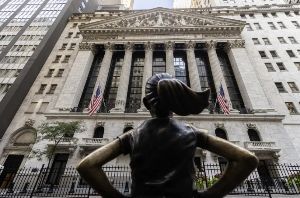
On that day, Korean-related stocks on the New York stock market all declined. The MSCI Korea Exchange-listed fund (EWY) ETF, which tracks Korean companies, fell 1.64%. The Franklin FTSE Korea ETF also dropped 1.06%.
By individual stocks, Coupang fell 3.7%. Webtoon Entertainment declined by 1.03%.
Other domestic companies traded on the New York Stock Exchange in the form of American Depositary Receipts (ADR) also fell across the board. POSCO Holdings dropped 4.36%, while KT and KB Financial showed declines of 0.39% and 1.67%, respectively.
When President Yoon declared martial law in an emergency address on the night of the 3rd, Korean-related stocks on the New York Stock Exchange plummeted sharply at the start of trading that day. After President Yoon accepted the National Assembly's request and lifted the martial law in the early hours of the 4th, the decline was partially reduced, but the stock price drop could not be prevented. Among the three major U.S. stock market indices that day, the S&P 500 and Nasdaq indices rose slightly, hitting record highs.
The value of the Korean won also declined. As of 4:46 p.m. that day, the won-dollar exchange rate stood at 1,415.9 won, up 0.85% from the previous day. Earlier that morning, it had surpassed the 1,440 won level for the first time in two years and two months since October 2022, but it has somewhat stabilized since President Yoon lifted the martial law.
Wall Street is paying close attention to South Korea's political instability. Mark Ledger Evans, an analyst at Ninety One, said regarding President Yoon's declaration and lifting of martial law, "This will clearly raise long-term concerns for Korean investments," adding that "a higher risk premium will be required for Korean assets."
Earlier, Choi Sang-mok, Deputy Prime Minister and Minister of Economy and Finance, convened an emergency macroeconomic and financial issues meeting to review the financial market situation in response to President Yoon's declaration of martial law and to prepare countermeasures. Deputy Prime Minister Choi stated, "To respond to potential market instability factors that may arise after the declaration of martial law, we will mobilize all possible financial and foreign exchange market stabilization measures, including unlimited liquidity supply."
© The Asia Business Daily(www.asiae.co.kr). All rights reserved.

















