HD Hyundai Heavy, Presentation on Current Status of Water Electrolysis Technology
Plan to Produce Hydrogen Combined with Offshore Plants
Utilizing AEM for Direct Use of Seawater
Establishing Hydrogen Ecosystem from Production to Transport and Storage
HD Hyundai is promoting the development of technology to produce hydrogen using offshore wind power and seawater. The plan is to complete the hydrogen ecosystem by combining water electrolysis technology with the group's proprietary technological capabilities.
On the 3rd, Lee Sang-don, head of the Hydrogen Energy Research Lab at HD Hyundai Heavy Industries, stated at the "Hydrogen Economy and Korea's Hydrogen Technology Symposium" held at Amoris Yeoksam in Gangnam-gu, Seoul, "We are envisioning a big picture of producing hydrogen by combining a water electrolysis system with offshore plants and utilizing electricity generated from offshore wind power."
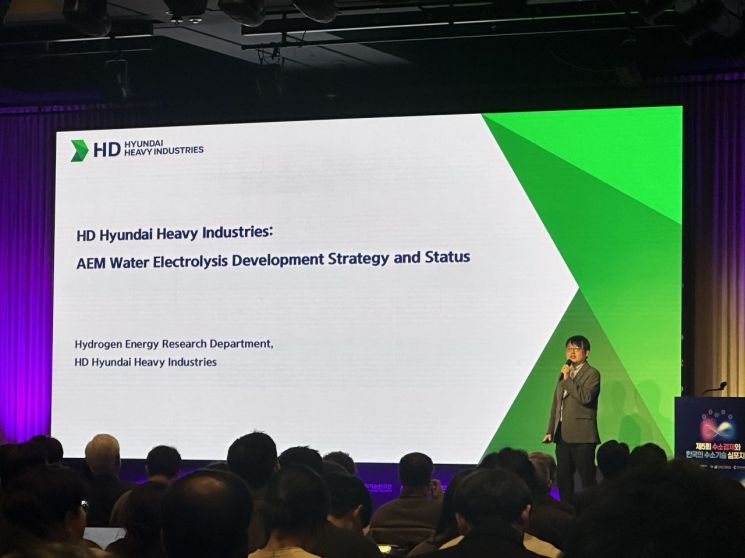 Lee Sang-don, Head of the Hydrogen Energy Research Lab at HD Hyundai Heavy Industries, is presenting the development status and strategy of HD Hyundai Heavy Industries' anion exchange membrane water electrolysis at the "Hydrogen Economy and Korea's Hydrogen Technology Symposium" held on the 3rd at Amoris Yeoksam in Gangnam-gu, Seoul. Photo by Lee Sung-min
HD Hyundai Heavy Industries began developing water electrolysis technology to produce hydrogen (H₂) by electrolyzing water (H₂O) in 2021. This is part of HD Hyundai's "Hydrogen Dream 2030 Roadmap" announced the same year, aiming to complete a group-level hydrogen ecosystem including hydrogen production (HD Hyundai Heavy Industries), transportation and storage (HD Korea Shipbuilding & Offshore Engineering, HD Hyundai Oilbank).
Lee explained, "We are planning a plant that directly produces hydrogen offshore using offshore wind power and transports it to land via hydrogen carriers," adding, "The transported hydrogen will be stored or partially reused for power generation, establishing an overall value chain."
Since HD Hyundai was not a frontrunner in water electrolysis technology development, it chose the anion exchange membrane (AEM) method, which has been relatively less researched, instead of the conventional alkaline (AEC) and polymer electrolyte membrane (PEM) technologies. The AEM method is a technology that produces hydrogen by promoting electrochemical reactions through the movement of anions within the electrolyte via an anion exchange membrane.
Particularly, attention was paid to the fact that the AEM system can directly utilize seawater. Because AEM selectively transports anions, it has relatively high resistance to chloride ions contained in seawater. In other words, chloride in seawater poses less risk of damaging catalysts or membranes.
Ultimately, HD Hyundai plans to commercialize AEM water electrolysis technology in the form of marine plant equipment and packages. It also intends to expand into fuel cell businesses utilizing hydrogen, linked with hydrogen and ammonia engines.
© The Asia Business Daily(www.asiae.co.kr). All rights reserved.

















