"We will strive to move away from investments focused on prime offices and incorporate competitive assets such as mid-sized offices in the Gangnam area (GBD) and data centers to be included in the global REIT benchmark 'FTSE EPRA Nareit.'
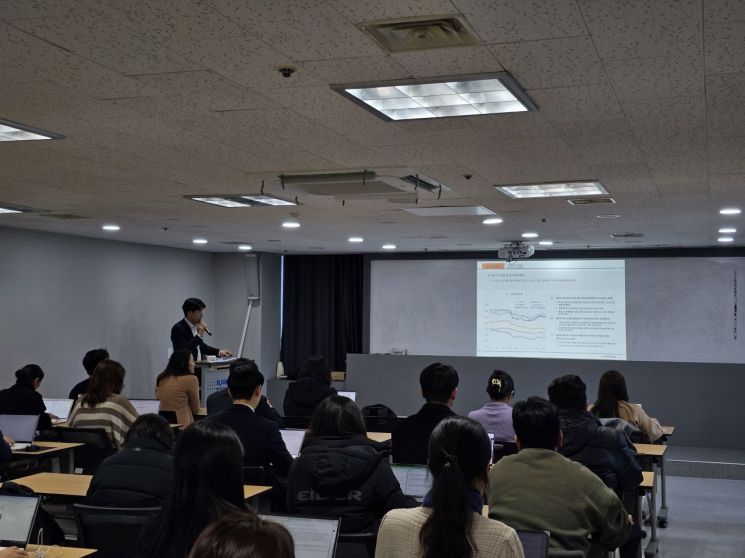 Cha Eon, Head of REITs Investment Division at Hanwha Asset Management, is seen giving a presentation at the "Hanwha Entrusted Management Real Estate Investment Company (hereinafter Hanwha REITs) Operation Plan" seminar held on the 3rd at the Korea REITs Association located in Yeouido, Seoul. Photo by Yoo Hyun-seok
On the 3rd, Chae On, head of the REIT Investment Division at Hanwha Asset Management, stated at the 'Hanwha Entrusted Management Real Estate Investment Company (hereinafter Hanwha REIT) Operation Plan' seminar held by the Korea REITs Association, "We will minimize rights offerings and raise funds through corporate bonds, etc., to create leverage effects and maximize profit growth."
Hanwha REIT recently conducted a rights offering worth 380 billion KRW to purchase the Janggyo-dong Hanwha Building. The Janggyo-dong Hanwha Building is a prime office with a total floor area of approximately 25,000 pyeong, located just a 2-minute walk from Euljiro 1(il)-ga Station, a key area in downtown Seoul, with a 100% occupancy rate. Hanwha Group uses it as its headquarters building.
This amount fell short of the initially planned 473.6 billion KRW. Hanwha REIT issued 40 billion KRW worth of electronic short-term bonds (jeondanchae) to cover the shortfall in the rights offering funds. Since the bonds were successfully issued at a slightly lower interest rate compared to the rate at the time of issuance in August this year, there is reportedly no significant financial burden.
Regarding concerns about overhang from the securities firms holding forfeited shares, the company plans to minimize market shocks as much as possible. The subscription rate during Hanwha REIT's rights offering was low, resulting in many forfeited shares. The final forfeited shares amounted to 21,575,120 shares, accounting for 12% of the total shares. These were underwritten by Korea Investment & Securities, NH Investment & Securities, Hana Securities, SK Securities, and Hanwha Investment & Securities.
Chae said, "After discussions with the securities firms that acquired the forfeited shares, we are considering over-the-counter trading to avoid impacting the stock price," adding, "Major shareholders who did not participate in the rights offering will also consult with the underwriting securities firms to take over shares when their financial situation improves, thereby minimizing the overhang issue."
He also presented a goal to improve the credit rating from the current A+ to AA- by strengthening financial soundness. Since the Janggyo-dong Hanwha Building, a 'prime office,' has been newly incorporated as an asset, the plan is to enhance financial soundness and raise the credit rating by one notch. An improved credit rating will enable fund procurement under more favorable conditions.
Recently, most listed REITs have continued to decline, trading below their initial public offering prices. In particular, Hanwha REIT's closing price fell from 4,749 KRW on September 24 to 3,405 KRW the day before. Chae cited three reasons for the recent decline in Hanwha REIT's stock price: △ retreating market expectations for interest rate cuts due to the US presidential election and other factors △ the largest rights offering in the listed REIT market △ some investors' non-participation in the rights offering.
He explained that the election of Trump as president raised expectations of tax cuts and fiscal deficits, which increased inflationary pressure, pushing interest rates higher and negatively affecting REIT investment sentiment. Additionally, Hanwha Asset Management analyzed that in the second half of this year alone, rights offering volumes from seven companies were supplied, and institutional investors engaged in arbitrage by selling existing shares to participate in new shares, increasing volatility.
Chae said, "Most major REITs conducted rights offerings in the second half of this year, which seems to have caused supply-demand issues," adding, "The outflow of funds from the domestic stock market also appears to have had an impact."
However, Hanwha Asset Management emphasized that if Hanwha REIT pays the planned annual dividend of 270 KRW at the current stock price level, the dividend yield would exceed 7%, making it an attractive investment price range. Chae said, "Hanwha REIT has a higher dividend yield compared to other REITs, including high-dividend exchange-traded funds (ETFs)," adding, "Looking at these aspects, one can see how high Hanwha REIT's dividend yield is and how much the stock price has fallen." He further added, "If the temporarily elevated interest rates stabilize, it will be possible to improve REIT profitability through reduced funding costs in the future."
© The Asia Business Daily(www.asiae.co.kr). All rights reserved.
![Clutching a Stolen Dior Bag, Saying "I Hate Being Poor but Real"... The Grotesque Con of a "Human Knockoff" [Slate]](https://cwcontent.asiae.co.kr/asiaresize/183/2026021902243444107_1771435474.jpg)
















