Content Promotion Agency OTT Usage Trends Announced
Increased Demand for Free and Ad-Supported Plans
Growth in Algorithm-Based Short-Form Viewing
Due to the subscription service fee increase, the proportion of Netflix users decreased by about 6 percentage points compared to the previous year, while free video services like YouTube increased by 7 percentage points.

The Korea Creative Content Agency held the 'Broadcasting Video Leaders Forum Public Seminar' on the 29th of last month and announced the results of the '2024 Online Video Service (OTT) Usage Behavior Survey.' The agency conducted one-on-one face-to-face surveys with about 5,000 people nationwide from June to August. This was the second survey conducted following last year, and this year the scope was expanded to include not only paid OTT but also free OTT services including FAST (Free Ad-supported Streaming TV).
According to the survey results, as OTT subscription fees have been raised consecutively recently, the usage rate of free services has relatively increased. Compared to last year, the usage rate of free OTT rose from 78.2% to 85.1%, while the usage rate of paid OTT slightly declined from 55.2% to 53.4%. In particular, the usage rate of Netflix, the undisputed number one, dropped by 5.6 percentage points from 50% last year to 44.4% this year.
Other OTT platforms such as TVING (13.2%→17%), Coupang Play (10.9%→14.8%), and Disney Plus (8.8%→10.1%) saw an increase in usage rates compared to last year, benefiting from a spillover effect.
The average monthly expenditure of paid OTT users decreased from 12,005 KRW last year to 10,500 KRW this year, confirming that users have tightened their wallets compared to a year ago. Among the reasons for subscribing to OTT services, the proportion of respondents who answered "because the subscription fee is reasonable" also dropped from 14.8% last year to 12.6% this year.
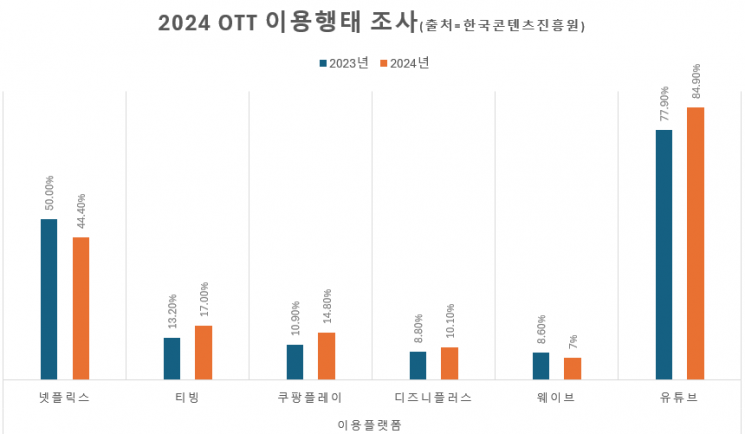
This year, YouTube usage rate increased by 7 percentage points from 77.9% last year to 84.9%, indicating that most OTT users watch YouTube (including Premium). The free FAST channels Samsung TV Plus and LG Channel, included in the survey for the first time this year, showed usage rates of 0.3% each.
Among Netflix and TVING subscribers, 24.6% use ad-supported plans, and 85.2% of them expressed their intention to continue using the ad-supported plans. This means that users are generally satisfied with watching ads in exchange for reducing subscription fees.
The preferred video content among paid OTT users was movies (81.1%), dramas (68.5%), and entertainment/variety shows (57.6%) in that order. When asked about the criteria for selecting content, "theme and subject (content)" was the highest at 77%. Notably, the proportions of "newness (35.6%)", "popularity ranking (33.3%)", and "algorithm recommendations (20.6%)" increased compared to the previous year.
Regarding short-form content, 69.6% of the total respondents used it, with a tendency for higher usage rates among younger age groups. When asked why they watch short-form content, most answered that it allows them to watch multiple videos in a short time (68.4%) and to utilize spare time (59.7%).
Interestingly, 54.2% answered that they watch short-form content because interesting videos play continuously, which can be interpreted as users watching content automatically played by algorithms rather than actively selecting content themselves.
Professor Choi Se-jung of Korea University’s Department of Media Studies said, "The emergence of consumer demand to offset costs by watching ads is an important change from an industry perspective," adding, "It can be seen as a new opportunity for OTT platforms and the advertising market, which have had limited advertising revenue, to achieve a win-win." Kim In-ae, senior researcher at the Korea Creative Content Agency, forecasted, "Although the current usage rate of FAST channels is minimal, the increasing trend in free OTT usage suggests potential for future growth."
© The Asia Business Daily(www.asiae.co.kr). All rights reserved.


















