Syrian Government Forces Weakened, Various Areas Seized
Rebels Led by HTS... "Extremist Forces"
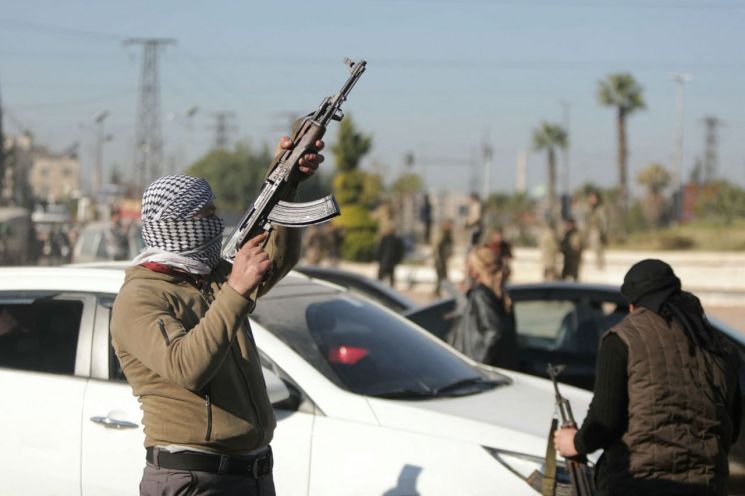 On the 30th of last month (local time), Syrian rebel forces entering Aleppo, the second largest city in Syria, fired their guns into the air after entering the city. Photo by AFP and Yonhap News.
Taking advantage of the weakening of Hezbollah, which had been supporting the Syrian government forces, due to clashes with Israel, Syrian rebel forces have seized major cities, making the Middle East situation even more unpredictable. In particular, the Islamic extremist armed group leading the rebels, 'Hayat Tahrir al-Sham (HTS),' is known to be a faction that split from the notorious militant organization Islamic State (IS). There are growing concerns that civilian casualties will increase as HTS enforces Islamic law and imposes forced taxation in the territories it occupies.
Syrian Rebel Group HTS Seizes Cities Including Aleppo and Hama
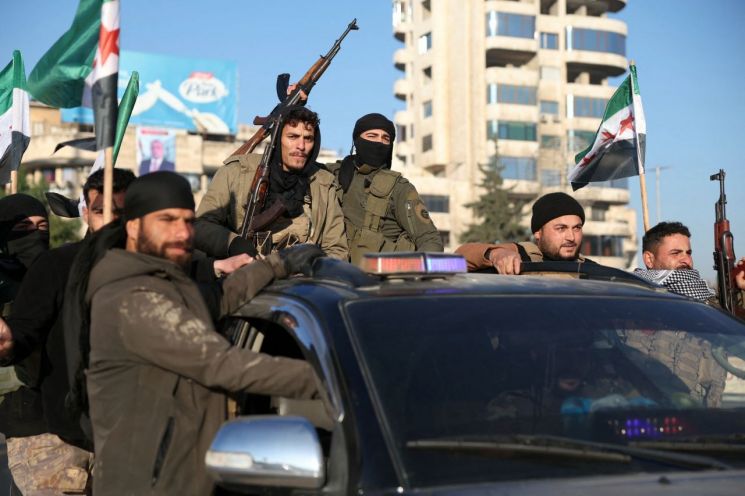 On the 30th (local time), Syrian rebel fighters used vehicles to enter the city center of Aleppo. Photo by AFP and Yonhap News.
According to the British BBC on the 2nd (local time), Syrian rebels led by HTS claimed to have captured the central Syrian city of Hama on that day. On the 30th of last month, HTS announced that it had reoccupied Aleppo, Syria's second-largest city, after eight years. HTS is expanding its occupied areas mainly around the outskirts of Syria's capital, Damascus.
The Syrian civil war, which began in 2011 and has continued for 14 years, had been in a stalemate due to the military support from Russia, Iran, and Hezbollah to the Al-Assad government forces, which blocked rebel movements. However, Hezbollah recently fell into a near-collapse state due to clashes with Israel, and after signing a 60-day ceasefire agreement with Israel, external support weakened, relatively weakening the Syrian government forces. HTS took advantage of this gap to successfully regroup the rebels and launched attacks on major cities, regaining momentum. After capturing Aleppo, HTS also took control of key strongholds in the northwest of Idlib province.
Russia and Iran, which support the Al-Assad regime, are strengthening their military support out of concern that the Syrian government forces might be pushed back. The Russian military announced that, in cooperation with the Syrian government forces, it conducted airstrikes on major rebel strongholds, killing about 300 rebel militants. The Iranian government is also reported to have supported the Syrian government forces with hundreds of combat troops through pro-Iranian armed groups within Syria.
Split from IS and Al-Qaeda, Independent Under Extremist Terrorist Organization
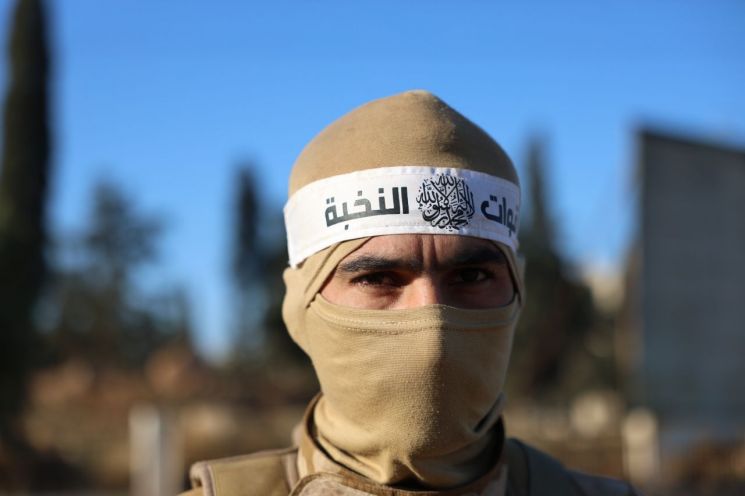 On the 30th of last month (local time), members of the Syrian rebel group Hayat Tahrir al-Sham (HTS), which took control of Aleppo. Photo by EPA and Yonhap News.
The international community is concerned that civilian casualties will increase as the Islamic extremist armed group HTS takes control of large parts of Syria and imposes oppressive rule. According to The New York Times (NYT), HTS was formed alongside IS during the Syrian civil war in 2011 and originally operated as an IS-affiliated group. However, it split from the IS leadership in 2013 due to conflicts and subsequently operated under Al-Qaeda, another Middle Eastern terrorist organization, until 2017.
Since 2017, HTS began to change its organizational character by allying with moderate Islamic armed groups, severing ties with Al-Qaeda, and operating independently. They receive tacit support from the Turkish military in the Idlib region, which borders Turkey, and according to NYT, they obtain energy resources such as gas, weapons, military uniforms, and food through Turkish support.
However, the expansion of their power is expected to increase civilian harm within the Syrian rebel-held territories. HTS continues to govern according to Sunni Islamic law in the areas it occupies, does not tolerate dissenting opinions, and expands its funding through forced taxation. Syria is a multi-religious country with 72% Sunni Muslims, 13% Shia and other sects, and 10% Christians, and NYT points out that there is growing resistance to the enforcement of Sunni law.
© The Asia Business Daily(www.asiae.co.kr). All rights reserved.
![User Who Sold Erroneously Deposited Bitcoins to Repay Debt and Fund Entertainment... What Did the Supreme Court Decide in 2021? [Legal Issue Check]](https://cwcontent.asiae.co.kr/asiaresize/183/2026020910431234020_1770601391.png)