50,000 Sign Petition Urging Disclosure of Violent Criminal's Identity
JTBC 'Sageon Banjang' Host Personally Posts, Drawing Attention
"Mosaic-Covered 'A-ssi' Is No Longer Needed"
A national petition urging the ‘unconditional disclosure of personal information of heinous criminals’ has been forwarded to the relevant standing committee of the National Assembly for review. The petition is known to have been posted directly by Yang Won-bo, a reporter and host of JTBC’s ‘Incident Commander,’ drawing attention.
 Last March, JTBC's 'Sageon Banjang' revealed the face and name of Ryu Mo (28), who brutally murdered his fianc?e by stabbing her 191 times with a weapon. JTBC broadcast screen
According to the National Assembly’s public consent petition website on the 3rd, the petition titled ‘A Call for Comprehensive, Unconditional Disclosure of Heinous Criminals’ Personal Information,’ posted on the 1st of last month, received over 50,000 endorsements and was referred the day before to the relevant standing committee, the Legislation and Judiciary Committee. Petitions referred to the relevant committee undergo review by the Petition Review Subcommittee, which then decides whether to submit the matter to the plenary session. If submitted and adopted at the plenary session, necessary measures will be taken by the National Assembly or the government.
Reporter Yang, who posted the petition, stated, “I want unconditional disclosure of heinous criminals’ personal information. No matter how brutal the murderer is, or how heated public opinion becomes, the current system where the prosecution and police decide whether to disclose the identity means we cannot know who they are. The mosaic-covered ‘Mr. A’ is no longer necessary.”
He added, “South Korea is an exceptionally favorable country for bad guys because there is almost no risk of their personal information being revealed,” and “Take serial killer Yoo Young-chul as an example. His personal information was never ‘officially’ disclosed by authorities. It only spread unofficially.” He continued, “Since the Supreme Court ruling in 1998, South Korea has become an ‘advanced country for perpetrators’ human rights.’ That ruling established that disclosing personal information could lead to claims for damages,” and “Not only ordinary citizens but also the media had to remain silent. It was also the year when broadcasts and newspapers began to be covered with mosaics,” he pointed out.
He also criticized the police’s Personal Information Disclosure Review Committee standards. Yang said, “Even with the same type of case, sometimes information is disclosed, and sometimes it is not,” and “They say they disclose ‘at the request of the victim’s family,’ but sometimes they ignore the request even if it is made. They themselves cannot clearly explain the difference.” He added, “Major countries like the U.S. and Japan specify a few cases where disclosure is not allowed, and otherwise disclose the information. South Korea is the opposite. It requires all four specific conditions to be met for disclosure. It is a system designed to avoid disclosure,” he argued.
According to the police, the current criteria for disclosure of personal information are: ▲ The means of the crime were brutal and caused significant damage ▲ There is sufficient evidence to believe the suspect committed the crime ▲ Disclosure is necessary for the public interest, such as guaranteeing the public’s right to know, preventing recidivism, and crime prevention ▲ The suspect does not fall under the category of a juvenile under the Youth Protection Act.
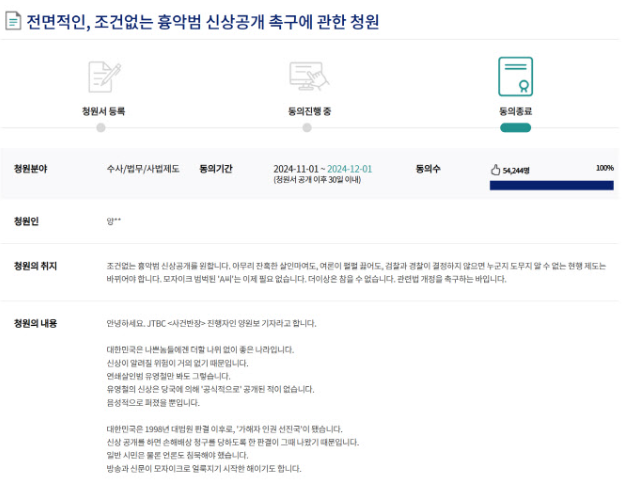
Yang emphasized, “What we must protect is not the perpetrator’s human rights, but the human rights of the victims and all of us who could become victims,” and “The mosaics covering heinous criminals must be removed. Any anonymity covering their names must be lifted. Comprehensive disclosure of heinous criminals’ personal information can suppress new crimes and also have the added effect of social punishment against them.”
In March, on ‘Incident Commander’ hosted by Yang, the personal information including the name and face of Ryu (28), who brutally murdered his fianc?e by stabbing her 191 times with a weapon, was disclosed. At that time, Ryu was sentenced to 17 years in prison in the first trial, and during the first appeal hearing, the victim’s family pleaded for a severe punishment, saying “He must receive a proper sentence.” Ultimately, in April, the second trial overturned the original sentence and sentenced Ryu to 23 years in prison.
© The Asia Business Daily(www.asiae.co.kr). All rights reserved.


















