Opposition Party Holds Budget Committee Meeting to Approve 4.1 Trillion Won Budget Cut
Negotiations Possible but Budget Approval Uncertain
For the first time in history, a ‘reduced budget bill’ with cuts only and no increase in the government budget proposal was submitted to the National Assembly plenary session. Although the possibility of negotiations between the ruling and opposition parties and the government is being discussed, there is also a chance that the ‘reduced budget bill’ will be processed. Why has the opposition party taken such an unprecedented ‘hardline’ stance?
On the 2nd, the Democratic Party of Korea hinted at the possibility of negotiations with the government and ruling party, while mentioning the possibility of processing a budget bill of 673.3 trillion won, which is 4.1 trillion won less than the government’s proposed budget of 677.4 trillion won. The possibility of the opposition party processing the budget bill, which had never materialized even in a minority ruling party situation, has become higher than ever before.
① A Decision to Restore the National Assembly’s Budget Deliberation Rights
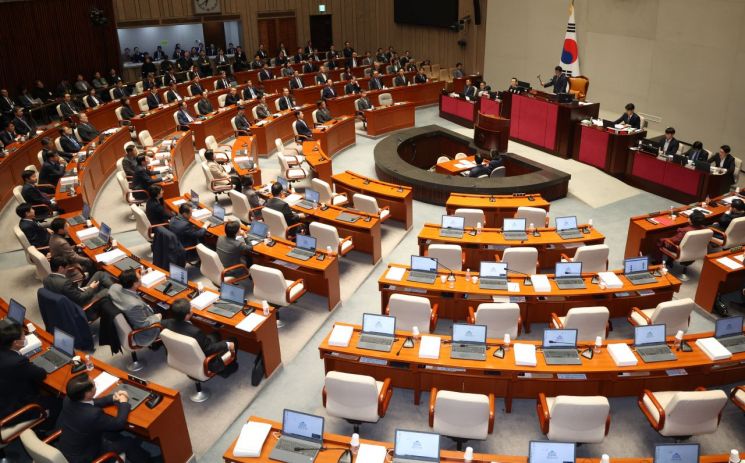
In this regard, the opposition party explains that this is a decision to restore the National Assembly’s budget deliberation rights, which had become nominal. Heo Young, a Democratic Party member and the party’s budget committee secretary, said on MBC Radio, “Until the 2nd, the legal deadline for the budget bill, the government and the presidential office were active regarding cuts (which are within the National Assembly’s deliberation rights), but regarding increases (which require government consent), they relied on the automatic submission clause and delayed until the end without giving concrete answers.” He added, “Despite the existence of the Budget and Accounts Committee, the old practice of nullifying a month of hard negotiations between the ruling and opposition parties by a one-day difference needs to be broken. We decided to keep the legal deadline and process the agreed-upon cuts to demonstrate the National Assembly’s deliberation rights.” Earlier, the opposition party passed a revision to the National Assembly Act in the plenary session, allowing the budget and tax bills to be deliberated even after the legal deadline. However, the government has mentioned the president’s ‘reconsideration request right (veto power)’ citing the possibility of delays in the budget bill. From the opposition party’s perspective, this is interpreted as a show of force to pressure the government.
The ruling and opposition parties have already expressed considerable opinions regarding increases during discussions at the Budget and Accounts Committee’s budget adjustment subcommittee. A committee official said, “Both sides have presented substantial opinions on increases. If additional negotiations between the ruling and opposition parties proceed, we will discuss this part.”
② A Foothold for Next Year’s Supplementary Budget
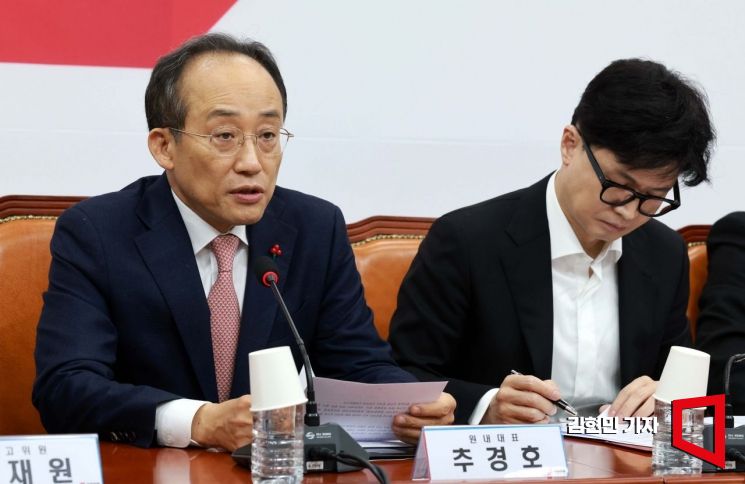 Chu Kyung-ho, floor leader of the People Power Party, is speaking at the Supreme Council meeting held at the National Assembly on the 2nd. Photo by Kim Hyun-min
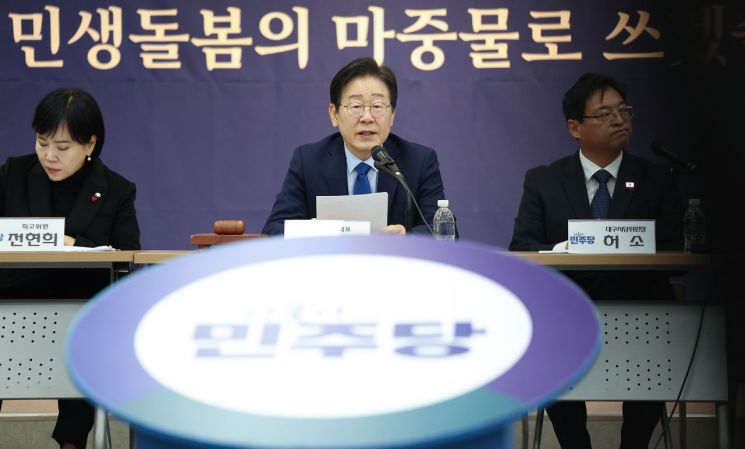
More fundamentally, this also serves as a card to pressure the formation of next year’s supplementary budget. The opposition party points out that the economic outlook for next year is not good, and although the government officially denied it, it has hinted at a supplementary budget. When the possibility of a supplementary budget was debated last month, the presidential office stated, “We do not exclude an active role for fiscal policy including a supplementary budget, but the timing has not been set for early next year.” As the government considers an active fiscal policy shift, the possibility of preparing an additional budget to supplement this year’s budget, which emphasizes fiscal soundness, has increased. Lee Jae-myung, the Democratic Party leader, said at a supreme council meeting held in Daegu, “A complete shift in economic policy direction is absolutely necessary,” adding, “There must be a fundamental change in the government’s role.”
③ Shaking the Yoon Administration with the Budget
There is also analysis that by cutting special activity expenses for major investigative agencies, the opposition intends to clearly show where ‘power’ lies in government agencies after the general election. They aim to shake the government, which has shown a passive stance amid President Yoon Seok-yeol’s declining approval ratings. Whether the opposition party will resolve the budget bill through negotiations or exert its power with the reduced budget will more clearly reveal its intentions. Earlier, on the 30th of last month, Kim Min-seok, a Democratic Party supreme council member, said at the ‘Kim Geon-hee and Yoon Seok-yeol Condemnation and 5th National Action Day’ event, “Let’s settle this within six months.”
In political circles, it is expected that the ruling and opposition parties will continue additional negotiations to avoid a crisis, setting June 10 as the deadline for processing. The opposition is pressuring through various negotiation channels, but the government and ruling party are demanding the withdrawal of the reduced budget. On the same day, Choo Kyung-ho, floor leader of the People Power Party, said at the supreme council meeting, “The Democratic Party should apologize to the people, government, and ruling party for the forced passage of the Budget and Accounts Committee and withdraw the reduced budget bill,” adding, “If the forced passage is used as leverage to intimidate the government into accepting unreasonable budget increase demands from the opposition, they should abandon such tricks altogether.”
© The Asia Business Daily(www.asiae.co.kr). All rights reserved.
![Clutching a Stolen Dior Bag, Saying "I Hate Being Poor but Real"... The Grotesque Con of a "Human Knockoff" [Slate]](https://cwcontent.asiae.co.kr/asiaresize/183/2026021902243444107_1771435474.jpg)


















