[K-Construction, A New Leap] DL E&C
Driving Eco-Friendly New Businesses to Secure Revenue Sources
Investment in SMR Technology Leader X-Energy
CCUS Specialist 'CarbonCo' Enters Canadian Market
DL E&C has embarked on securing new growth engines through eco-friendly new businesses. In particular, it is focusing all its efforts on small modular reactors (SMR), recognized as the next-generation eco-friendly energy source, and carbon capture, utilization, and storage (CCUS), a core technology for carbon neutrality. Recently, by participating in a fertilizer plant project in Canada, it has established a foothold for entering the North American blue (clean) ammonia market.
"Discovering SMR Plant Business... Building a Hydrogen Value Chain"
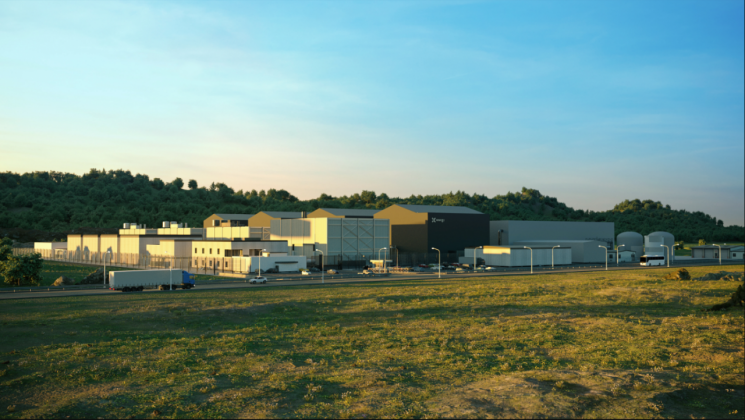
DL E&C is collaborating with the U.S. SMR developer X-energy to develop SMR plant businesses. X-energy’s SMR technology is highly versatile, applicable not only for power generation but also across various industries. DL E&C plans to enter the global market by linking its own plant business with X-energy’s SMR technology.
X-energy is recognized as a leader in the generation IV non-light water reactor SMR field, applying a new coolant instead of water. It is especially regarded as the most advanced developer in the high-temperature gas sector. DL E&C, which declared its entry into the SMR business in 2022, decided on a strategic investment in X-energy in January last year. DL E&C invested 20 million USD (approximately 25 billion KRW) to acquire convertible bonds issued by X-energy.
The representative model under development by X-energy, the ‘Xe-100,’ consists of four modules each with a single capacity of 80 MWe, totaling a power generation capacity of 320 MWe. It uses high-temperature helium gas as a coolant. The nuclear fuel, the size of a tennis ball, is triple-coated and does not melt even at 1800°C. Additionally, the high heat of about 600°C generated during operation can be used as a heat source for industrial plants, providing advantages in securing diverse demand beyond power supply.
X-energy’s SMR technology has been recognized for its safety and economic feasibility, receiving large-scale funding support (1.2 billion USD) from the U.S. government and continuously attracting private investments. Product development is underway with a commercialization target set for 2029. In October this year, it signed a large-scale investment agreement with Amazon. Amazon plans to fund 500 million USD to support X-energy and purchase electricity from future SMR power plants to supply its data centers.
In particular, DL E&C is expanding its eco-friendly new business portfolio through the SMR business. The high heat exceeding 600°C generated during SMR operation can be utilized for producing hydrogen and ammonia, other eco-friendly energy sources. DL E&C has experience in designing and constructing reforming and by-product hydrogen production plants domestically and internationally. Notably, it successfully completed the world’s largest Madain ammonia plant project in Saudi Arabia, which produces ammonia from natural gas. Currently, it is promoting hydrogen production and infrastructure projects with the South Australian government and Uljin County.
DL E&C is also making efforts to target the seawater desalination plant market. In October last year, DL E&C signed a memorandum of understanding (MOU) for mutual cooperation to apply SMR to desalination plants with the Saudi Water Desalination Company (SWCC), which operates the world’s largest seawater desalination facility. DL E&C and SWCC agreed to jointly seek optimal solutions and collaborate on research for clean hydrogen and ammonia production models utilizing SMR to create added value.
SMR has strengths in various aspects such as safety, flexibility, and economic feasibility compared to other energy sources, while emitting no carbon dioxide. DL E&C expects that carbon neutrality of desalination plants through SMR will accelerate in the future. Furthermore, it plans to expand its eco-friendly new business portfolio by building a hydrogen value chain linked to the SMR business.
Active CCUS Business through Establishment of 'CarbonCo'... First Export Achievement
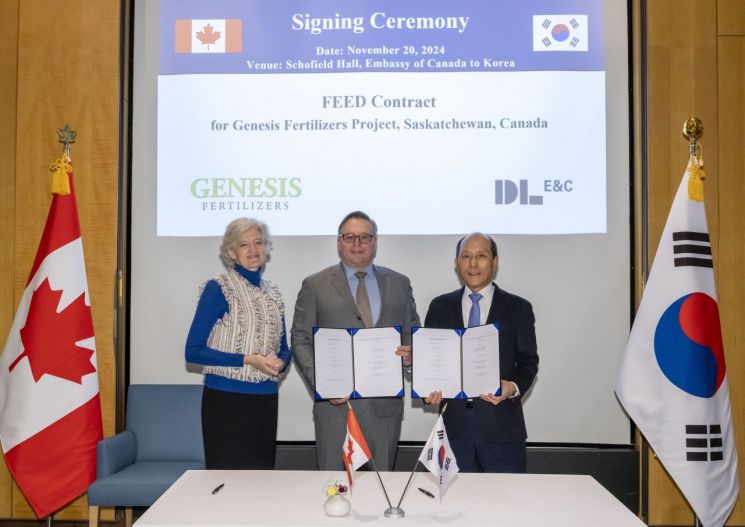 Tamara Mohini, Canadian Ambassador to Korea (from left), Jason Mann, CEO of Genesis Fertilizers, and Yoo Jae-ho, Head of DL E&C Plant Business Division, are posing for a commemorative photo after signing a contract for the Canada fertilizer plant project on the 20th of last month. / Photo by DL E&C
DL E&C is also actively promoting the CCUS business. CCUS is recognized as a core element of carbon neutrality and has recently attracted attention. DL E&C is expanding its business leveraging its basic design experience and differentiated competitiveness for CCUS facilities with an annual capacity of 1 million tons. Since the 2010s, it has participated in a project capturing and storing up to 80,000 tons of carbon dioxide annually from the Boryeong thermal power plant, and in 2022, it established CarbonCo, a CCUS technology specialist company. It is also developing a business model in Indonesia with a state-owned power company to capture carbon dioxide and store it in offshore gas fields.
Last month, CarbonCo entered the Canadian blue ammonia market by signing a 'technology licensing agreement for a fertilizer plant project' with Canadian fertilizer company Genesis Fertilizers. Once completed, the plant will process 1,500 tons of blue ammonia per day and produce approximately 1.05 million tons of fertilizer annually. This is the first time a domestic company has exported CCUS technology to a large-scale overseas project.
Additionally, it is developing 'mineral carbonation' technology to store carbon dioxide in depleted mine tunnels after production ends. Mineral carbonation is a technology that uses carbon dioxide to produce calcium carbonate or magnesium carbonate. Securing large-scale domestic storage sites for stable carbon dioxide storage not only contributes to achieving the '2030 Nationally Determined Contribution (NDC)' greenhouse gas reduction targets but also draws attention for recycling industrial by-products.
A DL E&C official stated, "We are mobilizing all company capabilities to promote differentiated eco-friendly businesses," adding, "Our strategy is to discover eco-friendly businesses and secure future growth engines in line with the global trend of strengthening carbon neutrality and environmental, social, and governance (ESG) management."
© The Asia Business Daily(www.asiae.co.kr). All rights reserved.


















