Chinese Ministry of Commerce Agency Emphasizes Korea-China Supply Chain Cooperation
Reason for Reaching Out to Korea... Aimed at Countering Trump's Second Term
"China Will Retaliate Against Any Policy Trump Introduces"
A think tank under the Chinese government proposed strengthening Korea-China supply chain cooperation and resuming negotiations for a Korea-China-Japan Free Trade Agreement (FTA). Based on the improving trend in Korea-China relations, including the activation of high-level exchanges, this is interpreted as a move to counter the 'Trump 2nd term' in the U.S., which has signaled trade pressure.
Qi Weixi, Vice President of the China Academy of International Trade and Economic Cooperation (CAITEC) under the Ministry of Commerce, met with the Korean Ministry of Foreign Affairs press corps in Beijing on the 25th of last month and stated, "Korea and China are accelerating the second phase of FTA negotiations while deepening practical cooperation under the broad framework of the Regional Comprehensive Economic Partnership (RCEP). We expect this to play an active role in promoting free trade in the Asia-Pacific region."
Chinese Ministry of Commerce Think Tank: "Let's Reach Agreement on Phase 2 of FTA"
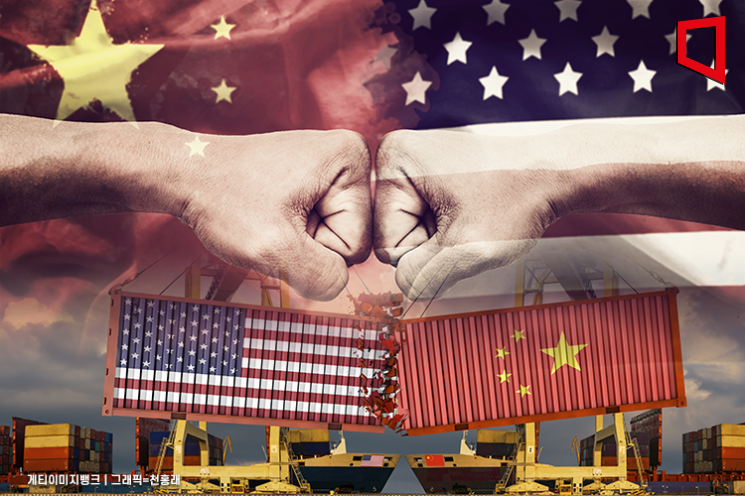
The Korea-China FTA, which came into effect in December 2015, mainly covered the goods sector. Despite several criticisms, including low openness rates, it was positively evaluated for securing a significant trade surplus in trade with China. Subsequently, the two countries agreed to resume the second phase of negotiations in May this year to expand mutual openness to the services sector. If the negotiations conclude successfully, market accessibility is expected to increase in areas such as culture, tourism, law, and finance.
Vice President Qi said, "We must accelerate efforts to reach an agreement in the second phase of negotiations," adding, "China is expected to expand the opening of service trade and lay a good foundation for Korea-China service trade cooperation." He particularly emphasized, "We hope to promote Korea-China-Japan FTA negotiations and jointly build a multilateral trade system in the Asia-Pacific region." The Korea-China-Japan FTA negotiations have been suspended since November 2019.
Korea and China have recently been actively engaging in high-level exchanges. President Xi Jinping's visit to Korea is also being discussed in connection with next year's Asia-Pacific Economic Cooperation (APEC) summit. Notably, China surprised many by announcing visa exemption measures for Korean nationals, further warming the thawing mood between the two countries.
However, concerns remain on the Korean side about the possibility of China weaponizing resources such as rare earth elements and urea solution. Vice President Qi responded to such concerns by stating, "In industrial and supply chain cooperation, there is a mutual interdependence," arguing that resource weaponization would not benefit China.
Trump Signals 'Pressure on China'... "Will Counter Any Policy"
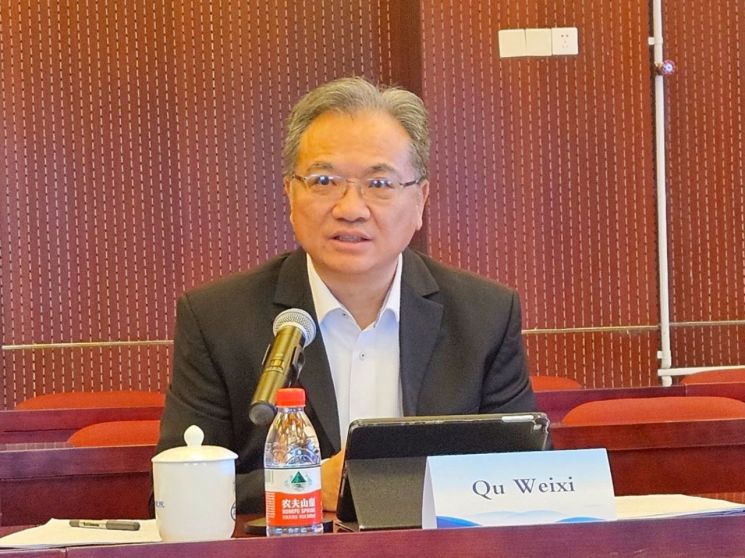 Qu Wei Xi, Deputy Director of the China Academy of International Trade and Economic Cooperation (CAITEC) under the Ministry of Commerce of China, recently answered questions during a meeting with the Korean Ministry of Foreign Affairs press corps in Beijing. Photo by the Ministry of Foreign Affairs joint press team
The background behind China's push to accelerate improvements in Korea-China relations appears to be the upcoming 'Trump administration' set to take office in January next year. President-elect Donald Trump has signaled strong 'economic sanctions' against China.
When asked about responses to a second Trump term, Vice President Qi emphasized, "Whatever policies come out of the U.S., we will respond with countermeasures." He referred to a U.S. research institute report stating that if the U.S. raises tariffs on China, it would harm the American middle and lower classes more, adding, "There are no winners in a trade war."
He was reserved about specific responses. He said, "Even during Trump's first term, many promises made to the people were not fulfilled after the government took office," adding, "It is currently unpredictable, and Trump himself may adjust policies in the future, so we will have to respond again when policies are announced."
© The Asia Business Daily(www.asiae.co.kr). All rights reserved.


















