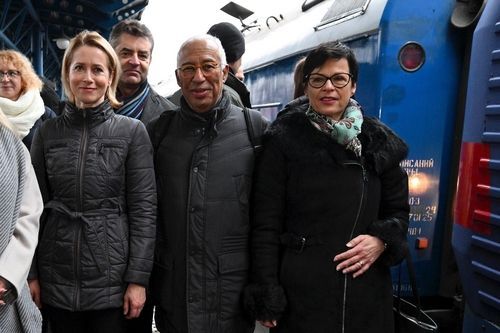
Senior European Union (EU) officials made a surprise visit to Kyiv, Ukraine, on the first day of the new leadership's inauguration on the 1st (local time). This is analyzed as an intention by the EU to express firm support for Ukraine ahead of the launch of the second Trump administration.
According to the EU, Ant?nio Costa, President of the European Council, Kaja Kallas, High Representative for Foreign Affairs and Security Policy, and Maro? ?ef?ovi?, Commissioner for Enlargement and Neighbourhood Policy, met with Ukrainian President Volodymyr Zelensky in Kyiv that day.
EU officials discussed ways to expand EU support so that Ukraine can defend itself. President Zelensky requested the EU to support Ukraine's accession to the North Atlantic Treaty Organization (NATO) and the expanded use of long-range weapons received from the West.
The visit by senior EU officials to Ukraine took place amid growing uncertainty over the U.S. policy toward Ukraine ahead of the launch of the second Trump administration next month. The meeting between high-ranking EU representatives and President Zelensky on the first day of their term is interpreted as a kind of message from the European camp to Trump, who has expressed skepticism about supporting Ukraine and has pledged a swift end to the war through negotiations with Russia.
President Costa externally represents the positions of the 27 EU member states, Kallas serves as the equivalent of a foreign minister, and Commissioner ?ef?ovi?, also a minister-level official, oversees the accession process for new EU member states, including Ukraine, within the European Commission, the EU's executive branch.
After the meeting with President Zelensky, President Costa emphasized at a joint press conference, "We have been with Ukraine since the first day of Russia's invasion and will continue to stand with them."
High Representative Kallas said, "The EU must persuade Trump that negotiating with 'transactional language' and abandoning Ukraine would harm U.S. interests." She added, "There have been several ceasefires between 2014 and 2022, but what we have seen is that Russia did not respect the ceasefire conditions and waged more wars," warning that "if Russia wins the Russia-Ukraine war, China, North Korea, and Iran will be emboldened."
Meanwhile, on the 3rd and 4th, foreign ministers of the 32 NATO countries will hold their final ministerial meeting ahead of the launch of the second Trump administration. Ukrainian Foreign Minister Andriy Yermak is expected to attend this foreign ministers' meeting. Prior to the meeting, on the 29th of last month, Minister Yermak sent a letter requesting that the NATO foreign ministers decide on the "invitation to join," the first step in Ukraine's NATO accession process, at this meeting.
However, member states such as the U.S. and Germany, which are opposed, worry that deciding on the invitation to join would mean the start of the NATO accession process and could potentially drag NATO into a direct confrontation with Russia. Even if a consensus is reached at a principled level, there is speculation that the meeting may only reaffirm disagreements among member states, given that the decision could be overturned once the second Trump administration takes office.
© The Asia Business Daily(www.asiae.co.kr). All rights reserved.

















