Over 700,000 Visitors... Reaffirming International Status
Record Largest Scale with Pavilions from 31 Countries
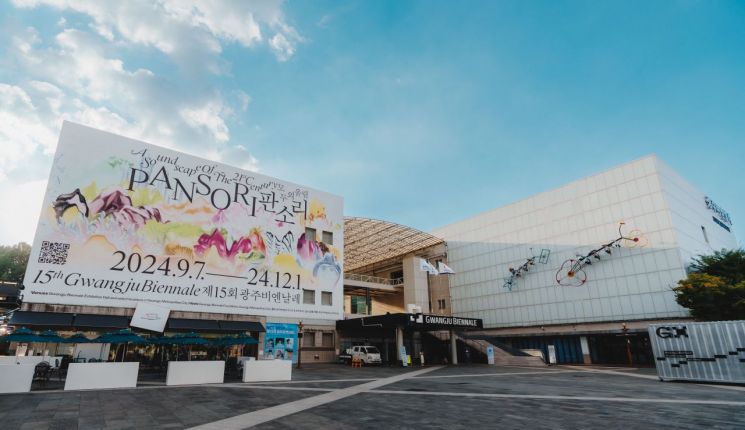
The 15th Gwangju Biennale concluded its 86-day grand journey on the 1st.
Marking the 30th anniversary of the founding of the Gwangju Biennale, this year’s event transformed the entire city of Gwangju into a vast art museum through the main exhibition and pavilion exhibitions from 31 countries.
The Gwangju Biennale Pavilion, featuring participation from 31 countries and cultural institutions across six continents, was held on the largest scale ever. The approximately 350 works presented by 206 artists (teams) across 23 exhibition spaces in Gwangju showcased unique and diverse appeals, addressing themes such as each country’s climate crisis, nature and humanity, community, capitalism, loneliness, and the social role of care.
The main exhibition of the Gwangju Biennale, which combined sound and visual elements to present various contemporary artworks, along with the pavilions highlighting the unique cultural arts of each country, attracted a total of about 700,000 visitors. This represents an approximately 35% increase compared to the 14th Gwangju Biennale held last year. The proportion of foreign visitors also rose by about 7%, reaffirming its status as an international art event.
The main exhibition, directed by Nicolas Bourriaud, a French art theorist and curator renowned worldwide for his work on “relational aesthetics,” was themed “Pansori - the Soundscape of the 21st Century” and featured 224 works by 72 artists from 30 countries at the Biennale Exhibition Hall in Yongbong-dong and nine exhibition spaces in Yangnim-dong.
The main exhibition was praised for expanding the world’s perception of contemporary environmental changes through synesthetic visual and auditory experiences across three sections: ▲Larsen effect ▲Polyphony ▲Primordial sound. It connected the regional characteristic of Pansori, a traditional Korean music genre, with world-class contemporary art exhibitions, drawing aesthetic discourse into a relational space shared by humans, animals, spirits, machines, climate, and organisms.
Visits by prominent figures from the international art world were also notable. These included directors from major overseas cultural and art institutions such as the Guggenheim Museum in New York, New Museum in New York, Mori Art Museum in Japan, ZKM Museum in Germany, MoMA PS1 in New York, M+ Museum in Hong Kong, Art Basel Hong Kong representative, Asia Society Museum in New York, HAM Helsinki Art Museum, and executives from the International Committee for Modern and Contemporary Art Museums.
Representatives from embassies of countries participating in the Gwangju Biennale Pavilion, including New Zealand, Poland, Peru, Sweden, Argentina, Switzerland, and China, also visited, establishing the event as a platform for cultural and artistic exchange and promotion between nations.
Meanwhile, on the same day at 6 p.m., Gwangju City held a closing ceremony at the Geosigi Hall of the Gwangju Biennale Foundation, attended by about 250 people including Lee Sang-gap, Vice Mayor for Culture and Economy, Park Yang-woo, CEO of the Gwangju Biennale Foundation, docents, operational staff, and sponsors.
© The Asia Business Daily(www.asiae.co.kr). All rights reserved.
![Clutching a Stolen Dior Bag, Saying "I Hate Being Poor but Real"... The Grotesque Con of a "Human Knockoff" [Slate]](https://cwcontent.asiae.co.kr/asiaresize/183/2026021902243444107_1771435474.jpg)
















