Concerns Over Economic Slowdown Grow Amid Base Rate Cut
US Additional Tariffs and Semiconductor Subsidy Sanctions
Market Shock from Complex Factors
Goldman Sachs Changes Korea Stock Market Weight from Overweight to Neutral
The KOSPI plunged nearly 2% on the 29th, falling to the 2450 level. Despite the Bank of Korea's surprise rate cut the previous day, concerns over the domestic economic slowdown and the Trump administration's announcement of additional tariffs led to strong selling by foreign investors.
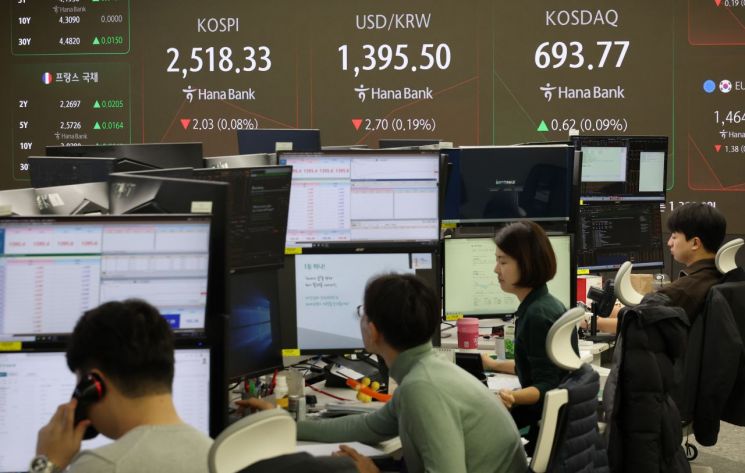
According to the Korea Exchange, the KOSPI closed at 2,455.91, down 48.76 points (1.95%) from the previous trading day. The index opened at 2,496.93, down 7.74 points (0.31%) from the previous close, and widened its losses during the session. It even dropped more than 2.3% intraday, falling to as low as 2,446.96.
Although the Bank of Korea unexpectedly cut the base interest rate for the second consecutive time in 15 years the day before, the market reaction was cold. Rather, the rate cut raised concerns about a possible economic slowdown, weakening investor sentiment. Additionally, the Trump administration's announcement of additional tariffs and further semiconductor subsidy sanctions also affected market sentiment.
In the KOSPI market, foreign investors sold a net 748.3 billion won, dragging the index down. Institutions and individuals bought net amounts of 28 billion won and 590.4 billion won respectively, but it was insufficient to defend the index.
Kang Jin-hyuk, a researcher at Shinhan Investment Corp., said, "The U.S. market was closed for Thanksgiving overnight, and the Biden administration's additional semiconductor regulations on China, concerns over domestic economic sluggishness, and yen appreciation collectively pulled the index down." He added, "There were concerns about downside risks to the economy at the Monetary Policy Committee meeting the previous day, and the October industrial activity report showed simultaneous declines in production, consumption, and investment, expanding those concerns. Additionally, Japan's November core CPI exceeded market expectations, leading to yen strength, which contributed to the KOSPI falling below the 2,500 mark."
Na Jeong-hwan, a researcher at NH Investment & Securities, said, "With recent declines in trading volume in the domestic stock market, there was no entity to absorb the 200 billion won net selling by foreign investors early in the session, resulting in a large drop in stock prices." He noted, "Although U.S. policies on tariffs, semiconductor regulations, and subsidy reductions are not yet finalized, they have worsened investor sentiment and caused foreign capital outflows." Na predicted that risks related to Trump's cabinet appointments and trade conflicts are likely to continue for some time.
Most of the top market capitalization stocks showed declines. Samsung Electronics (-2.34%), SK Hynix (-0.74%), Samsung Biologics (-2.50%), Hyundai Motor (-0.23%), and KB Financial Group (-1.84%) all fell. In particular, secondary battery stocks such as LG Energy Solution (-5.22%), POSCO Holdings (-4.40%), LG Chem (-6.89%), and Samsung SDI (-6.43%) experienced significant drops.
The KOSDAQ index closed at 678.19, down 16.20 points (2.33%) from the previous trading day. The index opened at 694.24, down 0.15 points (0.02%), and the intraday losses widened to over 2%.
In the KOSDAQ market, foreign investors sold a net 19.9 billion won, while institutions and individuals bought net amounts of 10 billion won and 113 billion won respectively.
Most of the top market capitalization stocks such as Alteogen (-7.44%), EcoPro BM (-6.37%), EcoPro (-5.35%), HLB (-2.45%), Rigachem Bio (-3.92%), Hugel (-2.99%), and Classys (-5.97%) declined.
Meanwhile, global investment bank Goldman Sachs downgraded its investment opinion on the Korean stock market for next year from 'overweight' to 'neutral.' In its "Asia Pacific Portfolio Strategy" report released that day, Goldman Sachs stated, "South Korea's macroeconomy is expected to face greater difficulties next year due to dollar strength and tariff uncertainties," adding, "As South Korea's export and industrial production growth slows, economic growth is projected to decelerate." The KOSPI target was set at 2,750 points.
© The Asia Business Daily(www.asiae.co.kr). All rights reserved.
![Clutching a Stolen Dior Bag, Saying "I Hate Being Poor but Real"... The Grotesque Con of a "Human Knockoff" [Slate]](https://cwcontent.asiae.co.kr/asiaresize/183/2026021902243444107_1771435474.jpg)











