K-Wave, Travel Stocks Rise on China-Driven Tailwind
'Market Cap 10 Trillion' Hana Tour's Corporate Value Mentioned at 20 to 30 Trillion
With the spread of K-Wave (Hallyu) and improved relations with China, travel stocks are being re-evaluated, and the sale process of Hana Tour is progressing smoothly.
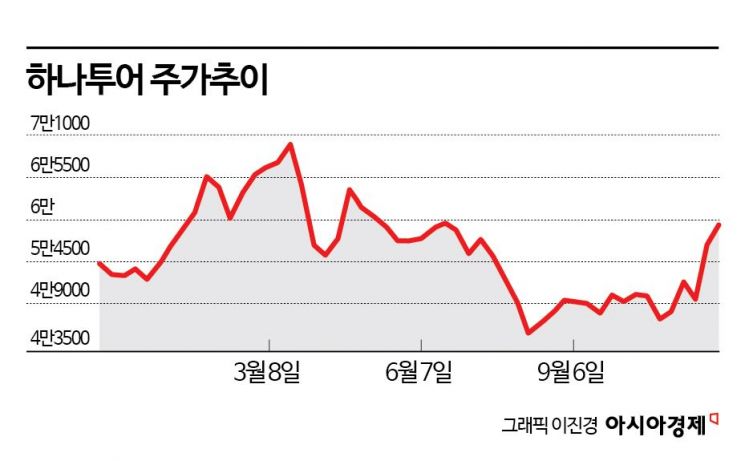
According to the financial investment industry on the 2nd, Hana Tour, the leading company in the travel industry, saw its stock price rise more than 30% from the low point in August (44,150 KRW) as of the previous trading day. On the 29th of last month, the closing price was 59,500 KRW.
Currently, Hana Tour's market capitalization is just under 1 trillion KRW. Industry experts estimate Hana Tour's corporate value to be around 2 to 3 trillion KRW. This figure is calculated by comprehensively reflecting the market capitalization levels of listed companies in the same industry and financial figures such as EBITDA.
Many domestic and foreign investors are showing interest in the sale of Hana Tour's management rights. Hana Tour's largest shareholder, IMM PE, holds a 16.68% stake through a special purpose company. The current sale target is a 27.7% stake, which includes the transfer of management rights. This includes shares held by related parties such as Chairman Park Sang-hwan (6.53%) and Vice Chairman Kwon Hee-seok (4.48%). IMM PE has selected Citi Global Markets Securities as the lead manager for the sale and is proceeding with the sale process.
Besides IMM PE, Hana Tour's major shareholders include the National Pension Service (6.63%), treasury shares (3.42%), and other minor shareholders. Last year, the company recorded sales of 411.6 billion KRW and an operating profit of 34 billion KRW. This year, up to the third quarter, it earned an operating profit of 37.3 billion KRW, with an annual operating profit forecast of 54.2 billion KRW (according to securities firms' estimates).
Accordingly, Hana Securities and Hyundai Motor Securities have each raised Hana Tour's target stock price by 5,000 KRW to 70,000 KRW and 72,000 KRW, respectively. Hana Tour records the highest profit margin in the travel industry. Despite profitability being reduced due to the T-Mef unsettled incident and price competition caused by a slowdown in overseas travel reservations, its performance is on an upward trend. In addition to this base effect, the steady increase in overseas travelers is expected to further boost performance next year.
Hana Tour's cumulative number of package tour customers in the third quarter was 1.56 million, a 70.4% increase compared to the same period last year. The number of customers sent in October was 190,000, higher than the third quarter average of 165,000 during the peak season, indicating positive trends for the fourth quarter and next year's reservations. Hana Tour, which has a high proportion of Chinese customers among its package tour clients, predicts a 30-40% increase in Chinese reservations next year. Hana Tour plans to use more than 200 billion KRW in cash assets, mainly through its overseas subsidiaries, to invest locally and strengthen inbound and global outbound operations.
Meanwhile, travel stocks have recently been on an upward trend beyond recovery. Modetour also recovered above the 10,000 KRW mark after hitting its annual low of 8,980 KRW last month. Redcap Tour surged more than 25% from its annual low of 7,050 KRW. The reason for the rise is the continued expectation of a travel boom driven by China. On the 1st, the Chinese government included South Korea as a unilateral visa-free country starting from the 8th, allowing holders of ordinary passports to enter China visa-free for 15 days for business, travel/tourism, and visiting relatives or friends. Subsequently, China extended the visa-free stay period from the current 15 days to 30 days, increasing expectations for expanded travel demand to China.
Inbound travel demand to Korea has also surged rapidly due to the influence of Hallyu. Foreigners visiting Korea have traditionally booked through overseas online travel agencies such as Booking.com, Agoda, and Expedia. Recently, the number of users utilizing mobile apps and web services offered by domestic travel companies has significantly increased. The travel industry expects the domestic inbound tourism market to grow further. According to Korea Tourism Statistics, the number of foreign tourists visiting Korea in the first half of this year was 7,701,407, a 73.8% increase compared to the same period last year.
© The Asia Business Daily(www.asiae.co.kr). All rights reserved.
![Clutching a Stolen Dior Bag, Saying "I Hate Being Poor but Real"... The Grotesque Con of a "Human Knockoff" [Slate]](https://cwcontent.asiae.co.kr/asiaresize/183/2026021902243444107_1771435474.jpg)











