Democratic Party 'National Bureau Revival TF' and Policy Chairman Jin Seong-jun Hold Meeting
26 Business Leaders Including Presidents of 4 Major Groups Attend Economic 7 Organizations
Strong Opposition to Expanded Fiduciary Duty, Cumulative Voting, and Separate Election of Audit Committee Members
On the 29th, seven economic organizations, excluding the Korea Economic Association, met with the Democratic Party's Stock Market Revitalization Task Force (Director-General Revival TF), which is leading the legislative discussions on the Commercial Act amendment bill, to convey the business community's concerns and proposals regarding the bill. The business community has opposed all three key provisions of the Democratic Party's adopted Commercial Act amendment bill: expanding the duty of loyalty of directors from the 'company' to 'company and shareholders,' the mandatory cumulative voting system, and the separate election of audit committee members.
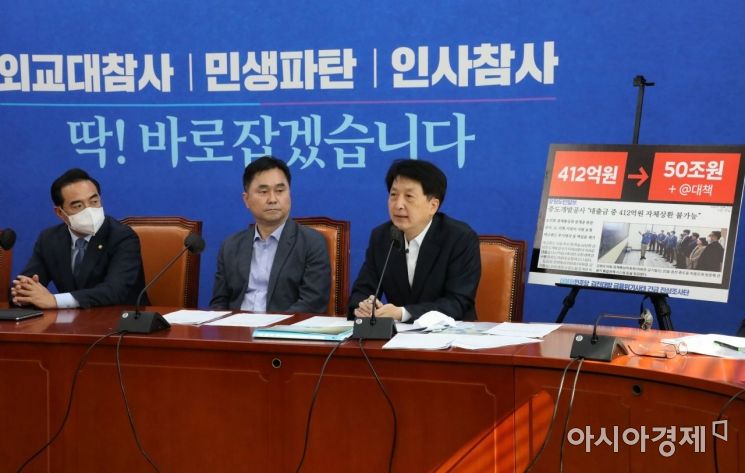 O Gi-hyeong, the secretary of the Democratic Party's 'Kim Jin-tae-led Emergency Financial Crisis Investigation Team,' is attending and speaking at the 'Kim Jin-tae-led Emergency Financial Crisis Investigation Team Meeting' held on the 28th at the National Assembly Floor Leader's Office. Photo by Yoon Dong-ju doso7@
On this day, the seven economic organizations, including the Korea Chamber of Commerce and Industry (KCCI), held a meeting with the Director-General TF at the KCCI building in Jung-gu, Seoul. From the Democratic Party, Jin Sung-jun, the Policy Committee Chair, Lee Jung-moon, the Senior Deputy Chair of the Policy Committee, and lawmakers Oh Ki-hyung and Kim Nam-geun attended. From the economic organizations, seven representatives including vice presidents and heads of departments participated from KCCI, the Korea Employers Federation, the Korea International Trade Association, the Korea Federation of Small and Medium Business, the Korea Federation of Mid-sized Enterprises, the KOSDAQ Association, and the Korea Listed Companies Association. Traditionally, the Korea Economic Association, which has led corporate governance discussions among economic organizations, was excluded. From the corporate side, seven people attended, including Park Seung-hee, President of Samsung Electronics; Lee Hyung-hee, Chair of Communications at SK SUPEX Council; Kim Dong-wook, Vice President of Hyundai Motor Company; and Ha Beom-jong, President of LG Corporation. A public debate between the business community and Democratic Party leader Lee Jae-myung is scheduled for the 4th of next month.
The meeting was arranged after the Democratic Party's Director-General Revival TF proposed it to the Korea Chamber of Commerce and Industry. Previously, on the 14th, the TF adopted the Commercial Act amendment bill, which strengthens governance regulations such as expanding the duty of loyalty of directors, as the party's official stance. Senior Deputy Chair Lee Jung-moon introduced the amendment bill as the representative sponsor. Lee Jae-myung, leader of the Democratic Party, pledged to pass the Commercial Act amendment bill during the regular National Assembly session.
The business community opposes all three key provisions of the amendment bill. They argue that if the bill passes, it will cause confusion in management activities due to the proliferation of shareholder lawsuits and could be exploited as a tool for hostile takeovers by hedge funds.
First, the business community opposes the provision that expands the duty of loyalty of directors from the company to shareholders, arguing that shareholders will file excessive lawsuits against directors depending on corporate dividend policies and short-term stock price trends. They also point out that the concept of 'shareholder interests' is ambiguous, and the scope of directors' responsibilities becomes too broad, causing directors to hesitate in making important management decisions such as medium- to long-term investments that carry significant risks of worsening financial indicators, ultimately lowering corporate competitiveness (corporate value).
They also oppose the mandatory cumulative voting system for listed companies. The cumulative voting system grants voting rights equal to the number of directors to be appointed per share of stock. The business community fears this could lead to hostile takeovers by external forces such as activist funds and opposes it. A representative case is the 2018 demand by the U.S.-based activist hedge fund Elliott Management for mandatory cumulative voting during its attack on Hyundai Motor Group. Furthermore, the business community believes that activist funds and minority shareholders could interfere with normal corporate management activities alongside the duty of loyalty provisions.
Additionally, they opposed the provision to increase the number of separately elected audit committee members from the current one to two. The separate election system for audit committee members limits the voting rights of major shareholders to 3% regardless of their shareholding when electing audit committee members. The business community worries that external forces could dominate the audit committee with members favorable to them, narrowing the scope of directors' management activities. This could cause disruptions in new business projects and risks of corporate confidentiality breaches. Audit committee members have the authority to audit directors' execution of duties and investigate financial status. Increasing the number of separately elected audit committee members reduces major shareholders' influence and raises the risk of external forces taking control of the audit committee.
The business community believes that if the Commercial Act amendment bill containing these three provisions passes, it could infringe on the board of directors' inherent authority over asset disposal and transfer, borrowing, appointment and dismissal of key executives, and establishment and relocation of branches. The original reason for the value-up (corporate value enhancement) policy was the controversy over minority shareholders' interests being harmed due to the decline in parent company value following the split listing of LG Energy Solution. Therefore, the business community argues that only the provisions related to valuation should be amended.
Currently, under Article 176 of the Enforcement Decree of the Capital Market Act, the merger ratio for listed companies is based on the market price (current stock price). The proposal is to calculate it based on fair value reflecting asset value and income value. For example, in advanced industries such as semiconductors, electric vehicles, and biotechnology, although massive investments are required and current stock prices and financial indicators may be low, future growth potential is high. Switching to fair value calculation can prevent undervaluation of corporate value.
Meanwhile, the business community expressed agreement with Financial Supervisory Service (FSS) Governor Lee Bok-hyun's remarks that amending the Capital Market Act would be more reasonable following the government's stance. Earlier, Financial Services Commission Chairman Kim Byung-hwan appeared on a current affairs program on the 24th and said, "We need to examine the negative impact of the Commercial Act amendment bill on corporate management and the capital market."
On the 28th, after a meeting with chairpersons of eight bank holding companies' boards at the Bankers' Hall in Jung-gu, Seoul, Governor Lee told reporters, "It is desirable to establish a mechanism to secure appropriate valuation when there are mergers or splits," and "In the case of physical splits, there should be a mechanism for parent company shareholders to share the listing gains." A business community official said, "We agree with Governor Lee's remarks advocating for 'targeted supplementation' of the Capital Market Act rather than a full revision of the Commercial Act."
© The Asia Business Daily(www.asiae.co.kr). All rights reserved.

















