"Biggest Increase Before Car Import Tariff Reduction"
"Economists Point to Macroeconomic Factors"
Concerns have arisen that Donald Trump, the President-elect of the United States known as the "Tariff Man," may impose additional tariffs on South Korea after taking office due to trade imbalances. However, a report has emerged stating that the Korea-US Free Trade Agreement (FTA) is not the direct cause of the increase in the US trade deficit with South Korea. The analysis suggests that the worsening trade balance is not due to low tariffs.
The US Congressional Research Service (CRS) revealed this in a report titled "Korea-US FTA and Bilateral Trade Relations" on the 28th (local time).
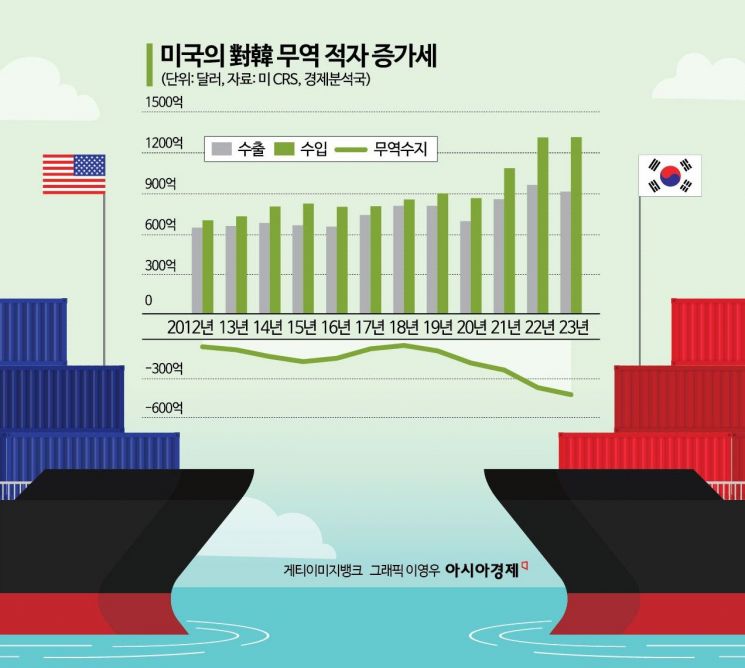
The report stated that regarding the Korea-US FTA, which came into effect in 2012, "The US trade deficit with South Korea has shown fluctuations," noting that "it increased initially after the FTA took effect, then decreased from 2015 to 2018, and subsequently increased again." It added, "Many economists believe that tariff reductions under the FTA did not significantly contribute to the increase in the bilateral trade deficit."
The report explained using the automobile industry, which was the most contentious issue during the FTA negotiations, as an example. Automobiles accounted for about 35% of goods exported from South Korea to the US last year. Under the FTA, the US eliminated the 2.5% tariff on passenger cars in 2016. The tariff on light trucks was originally scheduled to be phased out gradually but was renegotiated during the first Trump administration in 2019 and extended until 2041.
The report stated, "Automobile imports, which constitute a significant portion of the increase in US imports since the FTA took effect, grew fastest during 2011-2015, before the 2.5% automobile tariff was reduced under the Korea-US FTA." It continued, "Although automobile trade was one of the most debated issues during the initial FTA negotiations, major US-based automobile companies supported the agreement," and noted that "South Korean automobile manufacturers have made investments in the US, including a $5.4 billion electric vehicle and battery plant in Georgia."
Regarding the US trade deficit with South Korea, the report said, "Some analysts argue that the FTA contributes to the US trade deficit," but also explained that "others, including some economists, view macroeconomic factors such as national savings rates and investment rates as the main drivers of the bilateral trade balance."

During his campaign, Donald Trump repeatedly pledged to impose universal tariffs of 10-20% on all imports and 60% on imports from China. Later, on the 25th, he announced tariffs of 25% on imports from Mexico and Canada and 10% on imports from China. These three countries are the US's top three trading partners.
As Trump targets Canada, the US's closest ally and a member of the United States-Mexico-Canada Agreement (USMCA), as his first tariff target, concerns about tariffs on South Korea are growing. This is because South Korea's trade surplus with the US has reached record levels. According to CRS, last year the US exported $91.3 billion to South Korea and imported $132 billion from South Korea.
There is particular speculation that Trump may use tariffs as a diplomatic bargaining chip for issues such as defense cost-sharing. In fact, he has cited issues like drugs and illegal immigration for imposing tariffs on Mexico and Canada, and the fentanyl problem for tariffs on China.
© The Asia Business Daily(www.asiae.co.kr). All rights reserved.


















