Dollar Selling → Focused Buying of Domestic Stocks... Part of Asset Rebalancing
Domestic Stocks Below Target Weight... 17 Trillion KRW Buying Capacity Exists
Pension Funds Net Buy 2.2 Trillion KRW in November... Largest Since COVID Crash

This year, the National Pension Service (NPS), which had consistently sold off in the domestic stock market, has changed its position and begun active net buying. This is part of the year-end 'asset rebalancing' (adjusting the allocation ratios of managed assets by asset class). For the NPS, whose top priority is improving returns, it is also interpreted that the current domestic stock market is considered attractive in terms of price.
The NPS's asset rebalancing has also drawn attention overseas. On the 28th, major foreign media reported, "In recent weeks, the NPS has been selling dollars in the foreign exchange market to defend the depreciation of the Korean won," adding, "This appears to be related to tactical hedging or portfolio rebalancing." A financial investment industry insider familiar with the NPS's internal affairs said, "In fact, the pension fund has recently been actively buying relatively discounted domestic stocks," and "For the time being, overseas investments are on pause, and there is almost no demand for foreign exchange."
Dollar Selling → Korean Won → Domestic Stock Buying... 'Asset Rebalancing'
According to foreign media and the foreign exchange industry, the NPS sold dollars around the 1,400 KRW per USD exchange rate. The exact scale of the sales is unknown but is estimated to be a substantial amount. The NPS's principle is not to disclose investment strategies that influence the market externally. As the world's third-largest pension fund impacts the foreign exchange market, there is overseas attention on the reasons behind this.
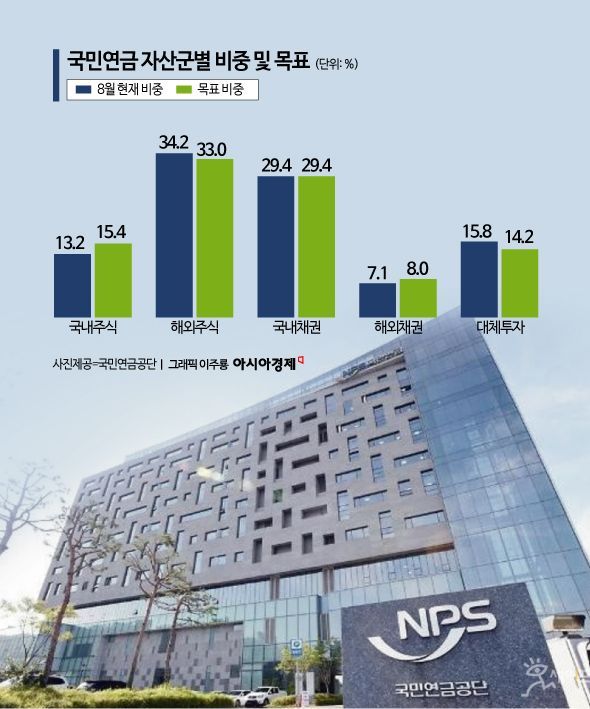
The most convincing reason for the sudden dollar selling is asset rebalancing. The NPS tends to manage asset class weights as close as possible to target ratios by the end of each year according to pre-established plans. As of August, domestic stocks accounted for 13.2% of the NPS's asset allocation. This is far below this year's target ratio of 15.4%. In monetary terms, this amounts to about 17 trillion KRW. The current ratio is at the lower bound of the strategic asset allocation tolerance range (±3.0 percentage points). This means there is room for additional buying. Meanwhile, overseas stocks (34.2%) and alternative investments (15.8%), which are expected to be on pause for the time being, are 1.2 and 1.6 percentage points above their target ratios, respectively.
Largest Net Buying by Pension Fund in 56 Months... From 'Main Adversary' to 'Relief Pitcher'
The NPS net sold a total of 528.4 billion KRW in the domestic stock market from January to September. This fact was revealed through the national audit, and individual investors criticized the NPS as the 'main adversary' of the domestic stock market. However, by completely reversing its position from selling to buying at year-end, it is expected to inject vitality into the sluggish KOSPI. From the NPS's perspective, this is an investment to maximize returns by buying when asset prices fall, but for the overall market, it acts as a 'relief pitcher.'
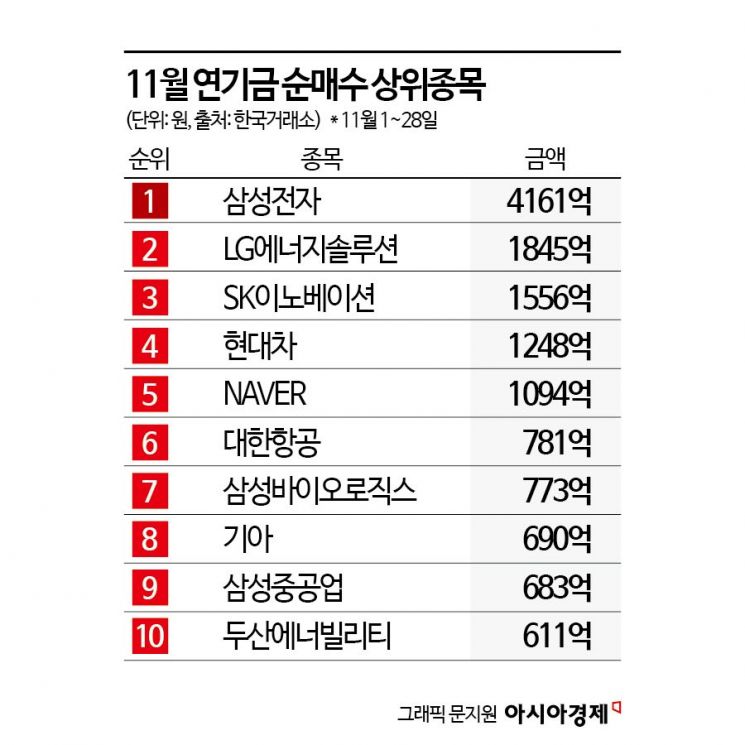
Signs that the NPS is actually increasing its domestic stock ratio have also been detected. According to the Korea Exchange, 'pension funds, etc.' net bought 2.2217 trillion KRW in the KOSPI market from November 1 to 28. This is the largest scale of net buying by pension funds in 56 months since March 2020, the 'COVID crash' period, when net buying was 3.0286 trillion KRW. According to the Korea Exchange, 'pension funds, etc.' refers to public institutions under the government or local governments. The NPS, the largest institutional investor in Korea, accounts for a very large portion.
The stocks most net bought by pension funds in November were Samsung Electronics (416.1 billion KRW), followed by LG Energy Solution (184.5 billion KRW), SK Innovation (155.6 billion KRW), Hyundai Motor (124.8 billion KRW), and NAVER (109.4 billion KRW). Except for SK Innovation, all are large-cap stocks within the top 10 by market capitalization. The warmth of pension fund buying has spread across large-cap stocks. On the other hand, Hanwha Ocean (-69.0 billion KRW), Korea Zinc (-63.1 billion KRW), Samsung SDI (-54.9 billion KRW), Hyundai Rotem (-42.1 billion KRW), and Isu Petasys (-41.4 billion KRW) ranked 1st to 5th in net selling. Coincidentally, Korea Zinc and Isu Petasys share the commonality of having been involved in controversy over a 'surprise rights offering' plan.
© The Asia Business Daily(www.asiae.co.kr). All rights reserved.