First Bronze Spoon from Gaya Tombs Confirmed
Efforts to Manage Unregistered Gaya Heritage in Changnyeong County
Changnyeong-gun, Gyeongnam Province, will hold an expert advisory meeting and an on-site public session for the ‘Urgent Excavation Survey of the Wangmi Village Tomb in Wangsang-ri, Daeji-myeon, Changnyeong’ at the excavation site on December 2.
This excavation survey was selected for the 2024 National Heritage Agency’s urgent excavation project for buried heritage and was conducted by the county through a commission to the Oriental Culture Research Institute.
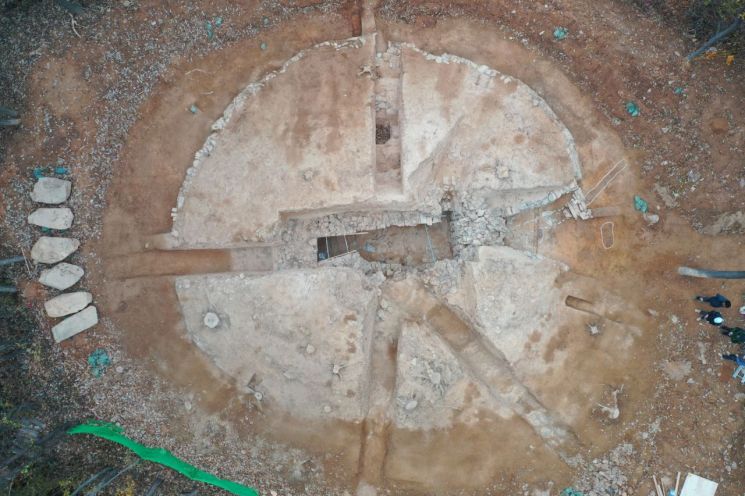 Aerial view of the Wangmi Village survey area in Wangsalli, Changnyeong. Provided by Changnyeong County.
The Wangmi Village Tomb in Wangsang-ri, Daeji-myeon, Changnyeong, is a large-scale tomb constructed alone on a small mountain behind Wangmi (Wangmyo, Wangmoe) Village, which gave the village its name. It is a symbolic tomb of the area.
The Wangmi Village Tomb in Wangsang-ri was confirmed to be a horizontal stone chamber tomb (a cave-style stone chamber tomb) built during the late period of the Byeonhan Gaya’s fall (mid-6th century). The stone chamber measures 570 cm in length, 230 cm in width, and 210 cm in height, with a rectangular floor plan. The passageway and tomb path leading to the entrance of the chamber are 560 cm long and flare out like a trumpet toward the outer edge of the mound.
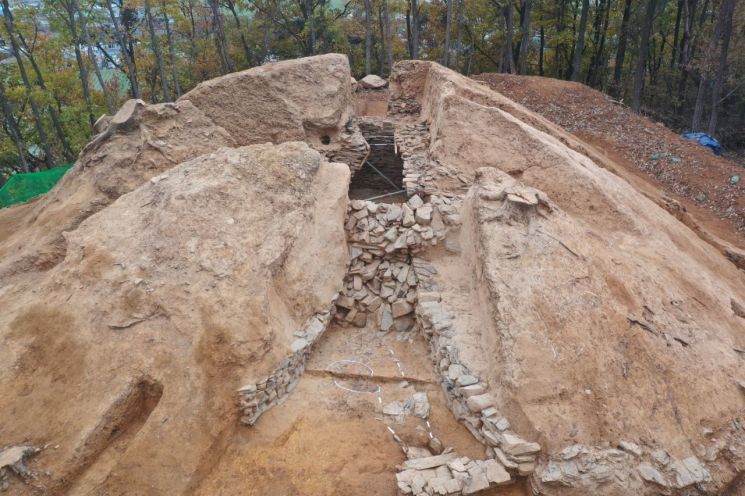 A panoramic view of the stone chamber in Wangmi Village, Wangsalli, Changnyeong. Provided by Changnyeong County.
The entrance of the stone chamber was sealed with stones, and based on the closure pattern and soil layers at the entrance, it is understood that no additional burials were made.
Six large stone lids covered the top of the chamber, which was sealed with clayey soil and gravel on top of the stone lids. The mound covering the chamber has a diameter of 17 m and a height of 4.3 m, making it one of the largest among Gaya tomb clusters.
Excavated artifacts include pottery (a jar with a foot ring, a footed plate, and a lid), ironware (small knives, axes), horse gear (horse harness decorations), shell ornaments, and, for the first time in a Gaya tomb, a bronze spoon was confirmed.
The bronze spoon confirmed this time is the first to be found in a Gaya tomb, and cases of bronze spoons found in tombs from the Three Kingdoms period are rare, with examples only from the Baekje King Muryeong’s Tomb, Silla’s Geumgwanchong Tomb, Cheongju Sinbong-dong tomb cluster, and Nonsan Pyojeong-ri tomb cluster.
Notably, the tombs where spoons were found belonged to representative kings of the Three Kingdoms period, so the Wangmi Village Tomb is also presumed to be the grave of a person belonging to the highest ruling class of Byeonhan Gaya.
According to records from the Three Kingdoms period, Byeonhan Gaya was absorbed into Silla around 555, when Haju was established. The Wangmi Village Tomb is a solitary tomb constructed apart from the main tomb clusters of Changnyeong at the end of Byeonhan Gaya’s fall, such as the Changnyeong Gyodong and Songhyeon-dong tomb clusters, and is expected to provide important data on the process of Silla’s unification of Gaya.
A county official stated, “The Wangmi Village Tomb in Wangsang-ri, Changnyeong, was an unregistered heritage site and had not been managed until now, but through this public project, the investigation was carried out and good results were obtained,” adding, “We will also strive to manage unregistered Gaya heritage in the Changnyeong area by securing national and provincial funding in the future.”
© The Asia Business Daily(www.asiae.co.kr). All rights reserved.
![Clutching a Stolen Dior Bag, Saying "I Hate Being Poor but Real"... The Grotesque Con of a "Human Knockoff" [Slate]](https://cwcontent.asiae.co.kr/asiaresize/183/2026021902243444107_1771435474.jpg)

















