Power Outages and Water Supply Disruptions in Mapo District Amid Continuous Heavy Snow
Blackouts in Yeomni, Gongdeok, Seongsan-dong; Water Supply Cut in Changjeon-dong
Power Outages Also Continue in Hwaseong and Yongin Due to Heavy Snow
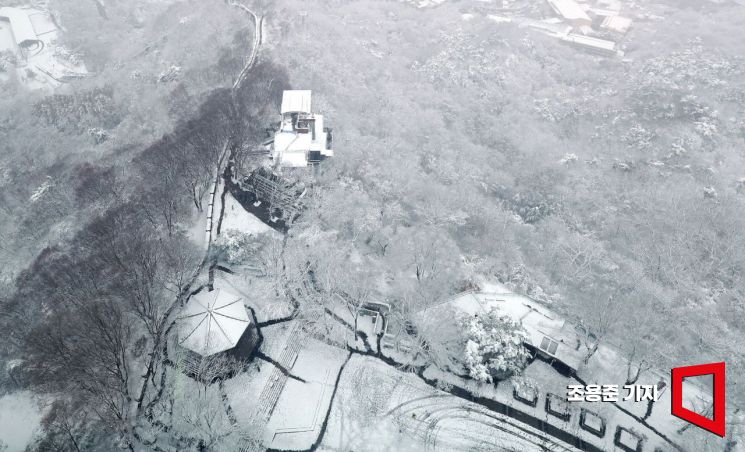 On the 27th, when a heavy snowfall of up to 20cm fell in Seoul, Namsan and the Paldakjeong Pavilion, viewed from Namsan N Tower in Jung-gu, Seoul, were covered in white snow. Photo by Jo Yong-jun
On the 28th, the second day of heavy snowfall, power outages and water supply disruptions are occurring in parts of Seoul and Gyeonggi Province.
According to Korea Electric Power Corporation (KEPCO), power outages were reported in some areas of Seoul around 6 a.m. that day. Power was cut off to a total of 750 households due to outages in Yeomni-dong, Gongdeok-dong, and Seongsan-dong in Mapo-gu, and as of around 8:20 a.m., 68 households were still without power.
Power outages also occurred one after another in the Gyeonggi area. KEPCO stated that power outages occurred around 2 a.m. in Naeri, Bongdam-eup, Hwaseong-si, and around 4 a.m. in Hongbeom-ri, Seosin-myeon, and restoration work was underway. Additionally, in Seocheon-dong, Giheung-gu, Yongin, power outages occurred around 7 a.m. in two apartment complexes, causing inconvenience to about 1,200 households.
A KEPCO official explained, "There are places where power outages occurred due to problems with utility poles or power lines caused by heavy snowfall," adding, "Restoration is difficult because manpower and equipment access are limited due to the heavy snow." KEPCO is conducting restoration work while compiling the causes of outages and the exact number of affected households.
Water supply disruptions due to heavy snowfall also occurred in Changjeon-dong, Mapo-gu. According to the Seoul Arisu Headquarters, water supply was cut off to 270 households in the Changjeon-dong area of Mapo-gu from 3 a.m. to 7:30 a.m. that day. It was investigated that the water outage occurred due to a power outage caused by a fallen tree breaking the electric line connected to the water reservoir. Restoration work has now been completed.
Following the previous day, another heavy snowfall overnight caused snow accumulation exceeding 40 cm in the metropolitan area. As of 8 a.m. on the 28th, the snowfall measurements were 47.5 cm in Baegam-myeon, Cheoin-gu, Yongin, Gyeonggi; 43.0 cm in Suwon; 42.4 cm in Geumjeong-dong, Gunpo; 41.2 cm in Gwanak-gu, Seoul; and 40.7 cm in Manan-gu, Anyang, Gyeonggi. Suwon recorded the highest snowfall not only in November but also throughout the winter since weather observations began in 1964. Suwon had already accumulated about 30 cm of snow the previous day, and with additional snowfall overnight, the total exceeded 40 cm.
The snowfall measured at the Seoul Meteorological Observatory in Jongno-gu, the standard for snowfall in Seoul, was 28.6 cm as of 8 a.m. This amount of snow accumulation is rare not only in November but throughout the winter in Seoul. In Gangwon Province, snowfall was recorded as 30.30 cm in Daehwa-myeon, Pyeongchang; 27.8 cm at Chiaksan, Wonju; and 25.7 cm in Cheongil-myeon, Hoengseong. In Chungcheong Province, snowfall was 39.1 cm in Jincheon (National Meteorological Satellite Center) and 23.9 cm in Geumwang-eup, Eumseong. In Honam, it was recorded as 24.2 cm in Jinan, 23.6 cm in Jangsu, and 22.8 cm in Deogyusan, Muju.
© The Asia Business Daily(www.asiae.co.kr). All rights reserved.

















