Excavation at Sadang-ri... Rare Curved Celadon
Gokseong Taeansa Treasury and Suncheon Hwangcheonseong Signboard Announced
Jeollanam-do announced on the 28th that it has officially designated the Gangjin Celadon ‘大平명’ embossed pomegranate flower pattern bowl, excavated from the Gangjin Sadang-ri kiln site of early Goryeo celadon production, as a provincial cultural heritage. Additionally, it has announced the preliminary designation of the Gokseong Taeansa temple bell, the collection of historical records of Taeansa, and the signboards of Hwanseonjeong Pavilion in Suncheon.
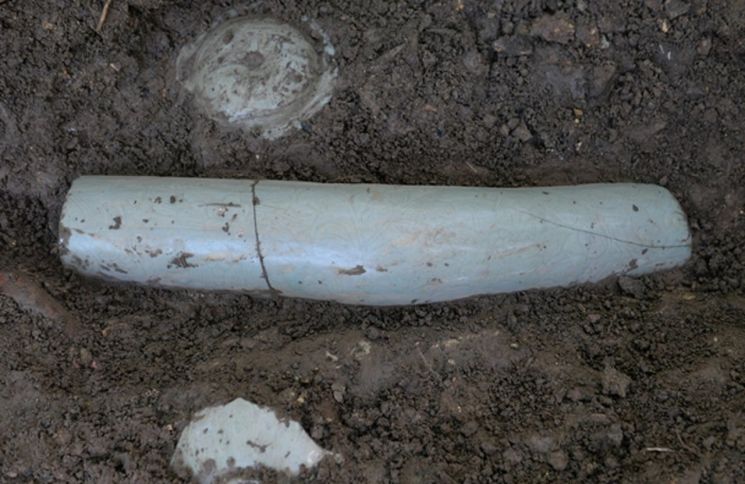 The appearance at the time of excavation of Gangjin Celadon 'Daepyeongmyeong' incised interpretation floral pattern tile. Provided by Jeonnam Province
The Gangjin Celadon ‘大平명’ embossed pomegranate flower pattern bowl is a rare curved celadon excavated from the Sadang-ri kiln site, a major celadon production area in Gangjin. This form has not been confirmed domestically until now, making it extremely rare.
The outer surface of the celadon is decorated with pomegranate flower patterns (海石榴華文 / camellia flower motif) and thunder patterns (雷文), showcasing beautiful and excellent carving techniques. The inner surface bears the incised inscription ‘大平,’ which holds very high artistic and academic value.
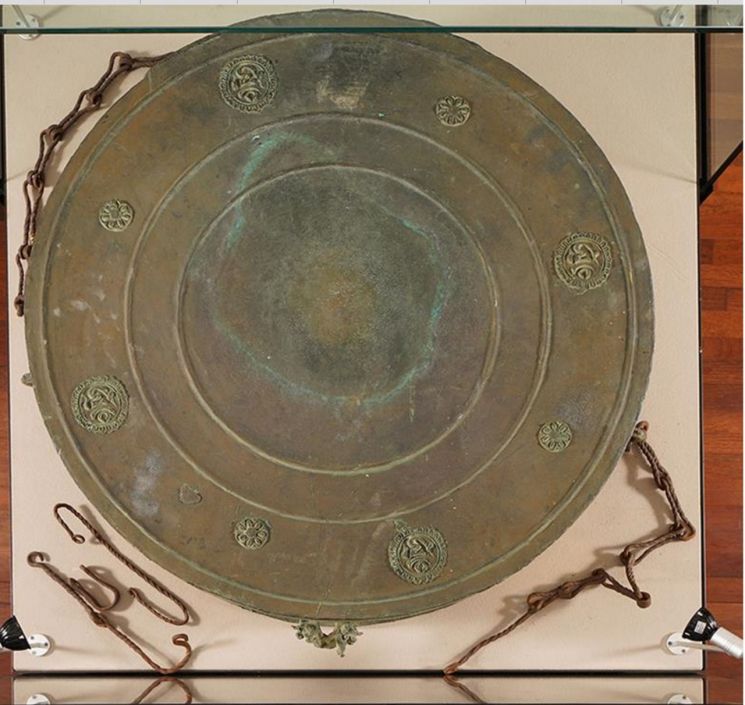 Gokseong Taeansa Temple Geumgo, designated as a cultural asset by Jeonnam Province. Provided by Jeonnam Province
The Gokseong Taeansa temple bell (谷城 泰安寺 金鼓 / iron drum) is one of the ritual implements used in temple ceremonies. The side engraving reveals the production date (1770), the temple where it was enshrined, and the maker. Its large size, sculptural beauty, and expressive patterns give it high value in Buddhist craft history and historical designation.
The collection of historical records of Gokseong Taeansa (谷城 泰安寺 事蹟記 一括) consists of manuscripts related to Taeansa, spanning from the late Joseon period to modern times. These documents provide information on the history of each hall of Taeansa, the successive head monks, Buddhist ceremonies of the era, and temple management, offering significant historical and academic value from the perspectives of Buddhist cultural history and local community society.
The signboards of Hwanseonjeong Pavilion in Suncheon (順天 喚仙亭 懸板) consist of two plaques inscribed with the pavilion’s name. Hwanseonjeong was built in 1543 by Sim Tong-won, the governor of Suncheon Dohobu during the Joseon Dynasty, as a space for rest and official affairs. The plaques were written by Bae Dae-yu in 1613 and Lee Beom-jin, the governor of Suncheon, in 1886. Each plaque features bold and lively calligraphy in a large size, possessing outstanding calligraphic, historical, and artistic value.
Kim Ji-ho, head of the Cultural Resources Division of Jeollanam-do, said, “The Gangjin Celadon ‘大平명’ embossed pomegranate flower pattern bowl is a rare heritage with no current excavation cases, so we will pursue its designation as a national heritage in the future. We will continue to investigate various cultural resources to preserve them for future generations.”
Jeollanam-do plans to designate the cultural heritages announced for preliminary designation as tangible cultural heritages after collecting opinions from various sectors during the 30-day announcement period and conducting a final review by the Cultural Heritage Committee.
© The Asia Business Daily(www.asiae.co.kr). All rights reserved.
![Clutching a Stolen Dior Bag, Saying "I Hate Being Poor but Real"... The Grotesque Con of a "Human Knockoff" [Slate]](https://cwcontent.asiae.co.kr/asiaresize/183/2026021902243444107_1771435474.jpg)












