Gyeonggi Yongin 41.3cm, Seoul Gwanak 36.5cm
Bidirectional Train Delays on Suin-Bundang Line During Morning Commute
Seoul experienced the heaviest snowfall in November in 117 years, causing significant inconvenience to citizens, especially in transportation. Local governments increased the number of buses and subways in operation, but train delays occurred due to accumulated snow.
According to the Central Disaster and Safety Countermeasures Headquarters of the Ministry of the Interior and Safety on the 28th, as of 5 a.m., the highest 24-hour snowfall amounts were mostly concentrated in the Seoul metropolitan area. Gwanak, Seoul recorded 36.5 cm of snow, Seongbuk, Seoul 22.4 cm, Yeonsu, Incheon 23.4 cm, and Yongin, Gyeonggi 41.3 cm.
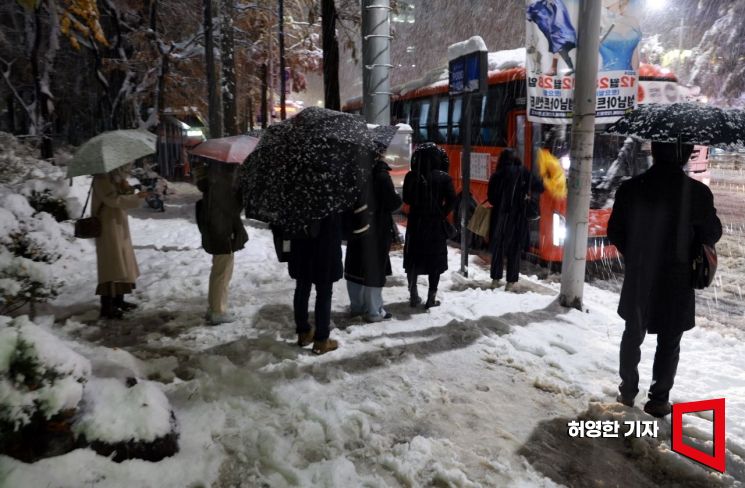 On the 28th, after a night of heavy snowfall in the central region, residents are waiting for the bus at a bus stop in Seongnam-si, Gyeonggi-do, on their way to work early in the morning. Photo by Heo Young-han
With heavy snowfall concentrated in Seoul and Gyeonggi, where the resident and floating populations are large, commuters complained of inconvenience. On this day, trains on both directions of the Suin-Bundang Line were partially delayed. Snow accumulated on the tracks and in the train depot, requiring snow removal operations. Air and sea routes were also blocked. Passenger ships on 76 routes with 99 vessels, including the Incheon-Baengnyeong route, were suspended, and 93 flights were canceled.
Local governments and Korea Railroad Corporation (KORAIL) increased the number of buses and trains in operation. Seoul City extended the peak commuting hours by 30 minutes from the previous day to increase public transportation frequency. KORAIL also decided to operate additional metropolitan subway trains: 6 on Line 1, 2 on the Gyeongui-Jungang Line, 1 on the Gyeongchun Line, and 1 on the Gyeonggang Line, totaling 10 additional runs.
Due to the heavy snow, residents in the Gyeonggi area had to evacuate to village halls and other shelters. A total of 56 people from 36 households stayed in temporary housing facilities or relatives’ homes. Firefighting activities related to safety measures and rescues due to the heavy snow totaled 1,280 cases.
From the afternoon of the 26th until the morning of this day, 71,639 tons of snow removal agents were spread on roads nationwide. A workforce of 14,937 people and 6,900 pieces of equipment were deployed for snow removal operations. The Ministry of the Interior and Safety and local governments urged citizens through disaster messages to "refrain from outdoor activities and driving, and to use public transportation during commuting hours."
© The Asia Business Daily(www.asiae.co.kr). All rights reserved.

















