"Possibility of Being Caught Off Guard in Renegotiations with Trump"
Some Advocate Caution... Considering 'Toxic Clauses' as Variables
As the possibility arises that the Trump administration's second term may reconsider semiconductor subsidy payments, semiconductor companies such as Samsung Electronics and SK Hynix, which have decided to invest in the United States, are closely monitoring the situation.
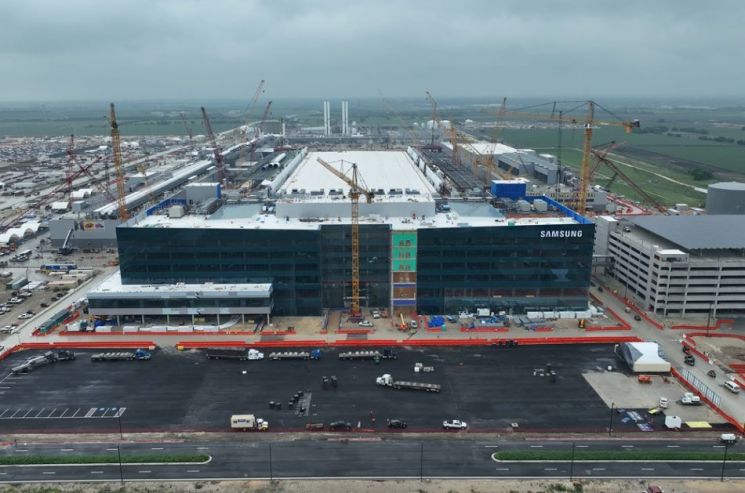 Samsung Electronics' foundry (semiconductor contract manufacturing) plant being built in Taylor, Texas, USA. Provided by Samsung Electronics
According to industry sources on the 28th, Samsung Electronics and SK Hynix have not yet received any subsidies from the U.S. federal government. They have signed a Preliminary Memorandum of Transaction (PMT) regarding subsidy payments and are currently negotiating. Under the PMT agreement, Samsung Electronics is set to receive $6.4 billion (approximately 9 trillion KRW), and SK Hynix will receive $450 million (approximately 630 billion KRW) in subsidies, up to $500 million (approximately 700 billion KRW) in government loans, and up to a 25% tax credit. Samsung Electronics plans to invest a total of $45 billion (approximately 63 trillion KRW) by 2030, including its foundry (semiconductor contract manufacturing) plant in Texas, while SK Hynix intends to invest about $3.87 billion (approximately 5.4 trillion KRW) to build an advanced packaging production base for AI memory in West Lafayette, Indiana.
What semiconductor companies are concerned about is the possibility of a regime change without receiving the subsidies. Vivek Ramaswamy, who is expected to lead the Department of Government Efficiency (DOGE) in the Trump administration's second term, stated on X (formerly Twitter) on the 26th (local time), "The Biden administration is accelerating spending before the transition," and added, "I will recommend that auditors closely examine these last-minute contracts."
It is uncertain whether domestic companies will reconsider their local investments if the Trump administration withdraws subsidy payments. However, in a press conference at the Korea Chamber of Commerce and Industry Jeju Forum last July, SK Chairman Chey Tae-won said, "If the U.S. government does not provide subsidies, it will be an issue that needs to be reconsidered." If the subsidy payments fall through after the Trump administration takes office, the likelihood of reconsideration increases. An industry insider said, "We will closely monitor the situation until the Trump administration's second term begins in January next year and before any specific statements regarding subsidies are made."
There is also an opinion that, like Intel, even if the Biden administration does not provide the full amount of subsidies promised, companies should receive at least some of it first. Earlier, the U.S. Department of Commerce announced on the 26th that it would provide Intel with up to $7.865 billion (approximately 11 trillion KRW) in direct subsidies, which is less than the initially agreed amount of $8.5 billion (approximately 12 trillion KRW).
Experts generally agree that negotiations should be concluded during the Biden administration's term, especially since Trump has indicated he might impose semiconductor tariffs. It is considered unwise to attempt renegotiation of subsidies by emphasizing the "strategic value" of Korean companies to the U.S. government after the Trump administration takes office. Jinwook Beom, a professor in the Department of Electronic Engineering at Sogang University, said, "Although Trump could change his stance after taking office, he has shown a very negative attitude toward subsidy payments so far. Therefore, if Samsung and SK meet the subsidy receipt conditions set by the Biden administration and have the capacity to negotiate, it is better to receive the subsidies quickly, even if the amount is reduced." He added, "If renegotiations are attempted after the Trump administration takes office, the U.S. might involve not only the Department of Commerce and companies but also both governments, and could raise difficult issues such as defense cost-sharing, which companies would find hard to handle."
There is also advice to refer to the case where the Biden administration included "poison clauses" such as excess profit sharing, submission of financial indicators like cash flow, restrictions on share buybacks, local worker hiring, and mandatory daycare installation when creating the 'CHIPS and Science Act (CSA).' The Trump administration might suddenly switch to providing subsidies but add stronger poison clauses than the Biden administration. In such a case, the more companies take conspicuous actions to secure subsidies during the Trump administration's term, the weaker their negotiating power might become. Possible poison clauses that the Trump administration could propose include ▲ installation of the latest node process equipment at local U.S. factories ▲ extensive technical know-how covering legacy (older) nodes ▲ worker hiring requirements.
Shin Hyun-chul, a professor in the Department of Semiconductor Systems Engineering at Kwangwoon University and the next president of the Semiconductor Engineering Society, said, "Even during the Biden administration's term, Samsung and SK decided to receive subsidies not necessarily because they absolutely need them for U.S. investments, but to reduce trade uncertainties." He added, "Before the Trump administration's second term negotiation strategies and poison clauses become concrete, companies should adopt 'strategic ambiguity' to keep the negotiation table open even after the Trump administration takes office, rather than acting rashly."
© The Asia Business Daily(www.asiae.co.kr). All rights reserved.
![Clutching a Stolen Dior Bag, Saying "I Hate Being Poor but Real"... The Grotesque Con of a "Human Knockoff" [Slate]](https://cwcontent.asiae.co.kr/asiaresize/183/2026021902243444107_1771435474.jpg)
















