Democratic Party Lawmaker Lee Kang-il's Bill Announcement
Assemblymen Jo Seung-rae, Min Byung-duk, Kim Yong-man, etc.
Hold Public Hearing to Gather Public Opinion
Lee Says "Government Neglects Investigation Responsibility"
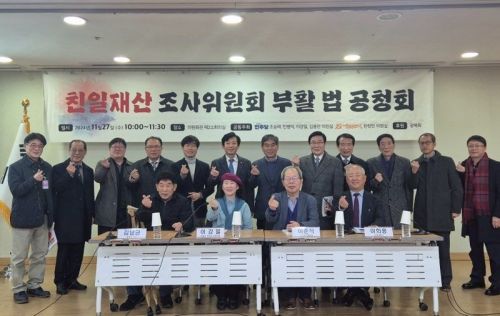 On the 27th, Lee Kang-il, a member of the Democratic Party of Korea, and attendees are taking a commemorative photo at the "Public Hearing on the Revival Act of the Pro-Japanese Property Investigation Committee" held at the National Assembly Members' Office Building. Photo by Lee Kang-il's office
Voices have emerged in the National Assembly calling for the resumption of efforts to locate the assets of pro-Japanese anti-national collaborators and transfer them to the state.
On the 27th, at the National Assembly Members' Office Building, Lee Kang-il, a member of the Democratic Party of Korea who co-hosted the “Public Hearing on the Revival of the Pro-Japanese Property Investigation Committee Act,” said in his opening remarks, “While the government neglects its responsibility, descendants of pro-Japanese collaborators are selling off pro-Japanese assets, changing ownership, and cleverly hiding their properties,” adding, “The Pro-Japanese Property Investigation Committee must be urgently revived.” The hearing was jointly hosted by Lee and Democratic Party members Jo Seung-rae and Kim Yong-man, as well as Social Democratic Party member Han Chang-min, with support from the Liberation Association.
Lee is preparing to propose the “Special Act on the National Attribution of Assets of Pro-Japanese Anti-National Collaborators.” This law would allow the investigation committee’s activity period to be extended based on the committee members’ decisions and introduce provisions to provide incentives to citizens who discover pro-Japanese assets. According to Lee’s office, the investigation committee, established during the Roh Moo-hyun administration in 2005, tracked and uncovered land totaling 13 million square meters (worth about 200 billion KRW) belonging to 168 pro-Japanese collaborators.
Since the investigation committee’s activities ended in 2011, there has been no state-led effort to recover pro-Japanese assets for 14 years. However, the Liberation Association and civic groups argue that there are still more pro-Japanese assets to be reclaimed. According to data submitted by the Liberation Association and others to the Ministry of Justice in September this year, the Liberation Association newly discovered five pro-Japanese properties, Cheongju City one, and Seodaemun District one, totaling 8,603 square meters (worth about 2.4 billion KRW).
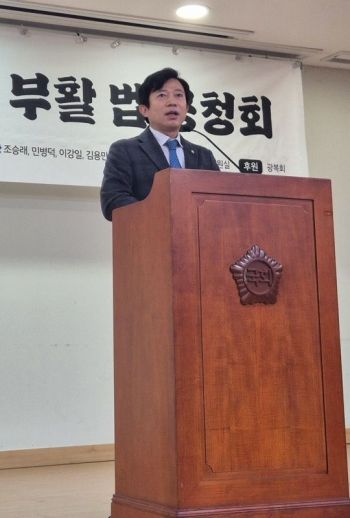 On the 27th, at the National Assembly Members' Office Building, Lee Kang-il, a member of the Democratic Party of Korea, is giving a greeting speech at the public hearing on the "Revival Act of the Pro-Japanese Property Investigation Committee." Photo by Lee's office
In response, Lee said, “Despite this situation, the Ministry of Patriots and Veterans Affairs claiming that there have been no state-led discoveries of pro-Japanese assets is a serious dereliction of duty that calls into question the very existence of the ministry,” emphasizing, “Recovering pro-Japanese assets is itself a process of purging pro-Japanese collaborators, and it must serve as a warning to the New Right and new pro-Japanese factions who distort history by showing that justice is alive.”
At the hearing, Lee Joon-sik, former director of the Independence Hall, who gave the keynote presentation, defined “pro-Japanese” as a historical term encompassing traitors, national betrayers, anti-national actors, collaborators with Japan, war criminals, pro-Japanese elements, and pro-Japanese fascists. He explained, “Pro-Japanese collaborators are those who, from around the 1905 ‘Eulsa Treaty’ until liberation on August 15, 1945, actively cooperated with Japanese imperialism’s infringement on national sovereignty, colonial rule, and aggressive wars, causing direct or indirect physical, material, or psychological harm to our nation or other peoples.”
Lee also stated, “During the Lee Myung-bak administration, following advisory committee meetings stipulated by law, a petition was submitted to the president requesting the establishment of a permanent organization to handle various issues in modern and contemporary Korean history, including the purge of pro-Japanese collaborators, but it was not accepted.”
He stressed, “Future efforts to purge pro-Japanese collaborators should reveal and document the realities of those who escaped state-led purges, and our society must always remember and reflect on the history of pro-Japanese collaboration, ultimately leading to reflective historical education that prevents the shameful history of pro-Japanese collaboration from ever repeating.”
He further urged the resumption of the investigation committee’s activities, saying, “After liberation, the land owned by pro-Japanese collaborators should have become state property, but there are still many cases where the land is recorded as owned by the Government-General of Joseon.”
© The Asia Business Daily(www.asiae.co.kr). All rights reserved.


















