1st Trial Not Guilty → Overturned to Guilty in 2nd Trial
Operating Expenses of External Consignment Agency Paid with School Funds
"False Entry in 'Student Field Training' Report" Judgment
Jang Je-guk, president of Dongseo University, was convicted for spending operating expenses of external entrusted institutions, which should have been borne by the school corporation, from the school fund accounting.
Previously, the first trial court judged it as a 'legitimate expenditure from the school fund accounting' and acquitted President Jang, but the verdict was overturned in the second trial, and the Supreme Court found no issue with the second trial's judgment.
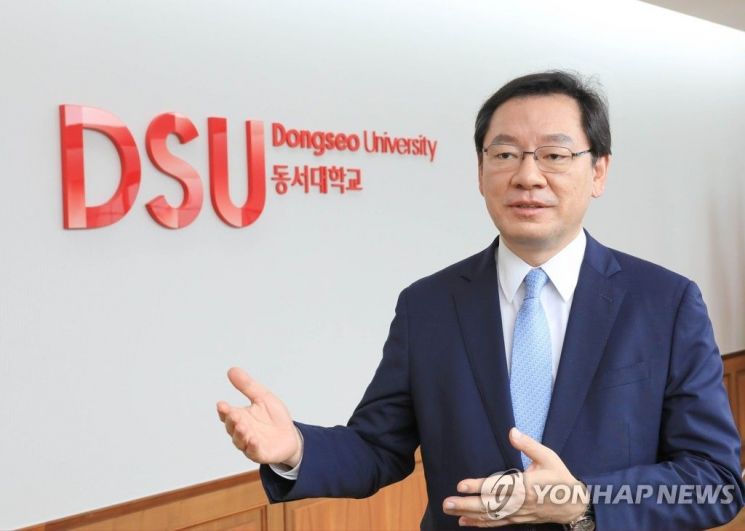
According to the legal community on the 27th, the Supreme Court's 3rd Division (Presiding Justice Lee Heung-gu) upheld the original ruling that sentenced President Jang, who was indicted for violating the Private School Act, to a fine of 20 million won. President Jang is the elder brother of former People Power Party lawmaker Jang Je-won.
The court stated the reason for dismissing President Jang's appeal, saying, "There is no error affecting the judgment such as overturning the first trial court's acquittal on the charges in this case, failing to conduct necessary hearings for the second trial's recognition of guilt, violating the rules of logic and experience, exceeding the limits of free evaluation of evidence, misunderstanding the admissibility of evidence, the principle of trial-centeredness, the principle of direct examination, or the legal principles regarding the establishment of the crime of violating the Private School Act."
President Jang was prosecuted on charges of spending 245 million won, which should have been borne by the school corporation, from the school fund accounting?funded by tuition fees and other sources?for operating expenses of a senior welfare center and a youth counseling welfare center with which the university had entrusted operation contracts.
This case arose when the Ministry of Education conducted a comprehensive audit of Dongseo University and the Dongseo Academy, the school corporation operating the university, in April 2020, publicly disclosed the audit results in December of the same year, and reported President Jang to the prosecution.
The prosecution charged President Jang without detention, alleging that Dongseo Academy improperly used tuition fees disguised as students' practical training fees for operating expenses of external entrusted institutions.
Article 29 (Separation of Accounts) Paragraph 1 of the Private School Act stipulates that "the accounts of a school corporation shall be divided into accounts belonging to the schools it establishes and manages and accounts belonging to the corporation's business." Paragraph 2 of the same article states that the "accounts belonging to the schools" can be divided into school fund accounts and affiliated hospital accounts, and that "donations received by the school, tuition fees, and other payments shall be treated as income of the school fund account and managed in a separate account."
Paragraph 6 of the same article prohibits transferring or lending income or property belonging to the school fund account to other accounts. Violation of this is punishable under Article 73-2 (Penalties) of the same law by imprisonment for up to two years or a fine of up to 20 million won.
In court, President Jang's side argued that the expenditures in question were for students' practical training, volunteer work, and employment education, and thus were legitimate expenditures from the school fund accounting.
The first trial court acquitted President Jang.
Judge Baek Gwang-gyun of the Western Branch of Busan District Court, who presided over the first trial, stated, "The issue in this case is whether the expenditure in question is a legitimate expenditure from the school fund accounting, specifically whether it falls under the expenditure items of the school fund account as defined in the Enforcement Decree of the Private School Act, such as 'expenses for facilities and equipment directly necessary for school education,' 'student education guidance expenses,' or 'other expenses directly necessary for school education.' If the expenditure falls under these items, it is a legitimate expenditure from the school fund accounting and not subject to punishment."
Based on various reports and evidence, the court judged that actual education such as field trips and on-site training for students took place at the entrusted institutions where the school fund accounting was spent.
Judge Baek also noted, "Among the two entrusted institutions' operating budgets recorded in the accounting books, the portion covered by the school fund accounting was only 1-2% of the total budget. Considering the participation of thousands of students annually in the educational process, the amount per student is only a few tens of thousands of won, which is a reasonable level as reimbursement for the actual costs of time, personnel, and facility use to partially use the entrusted institutions' functions for educational purposes."
He even added, "On the contrary, it seems necessary to reimburse even greater costs for thorough education."
Judge Baek stated, "Since the entrusted contract in this case only stipulates that 'the burden should be covered by the corporation's transfer funds' and 'if the entrusted party agrees to bear its own share, it must faithfully fulfill it,' the corporation as the entrusted party can cover and spend the burden from internal accounting items such as the school fund accounting as needed."
He continued, "Even if the prosecution's claim is accepted that the clause should be interpreted as an obligation to cover the burden only from accounts other than the school fund accounting of the corporation, violating it may be grounds for civil liability but clearly does not create or justify criminal liability under the principle of legality."
Judge Baek said, "The method of a school corporation entrusting and operating social welfare institutions, which are community facilities mainly budgeted and supported by local governments, for the purpose of student practical training, volunteer work, and employment, and supplementing about 1-2% of the budget to use them as educational venues for students, is itself a desirable cooperative system where schools and local governments collaborate to contribute to society."
He added, "It also complements the blind spots of university education, which can easily become theoretical, and provides invaluable opportunities for students who will lead the future to directly help and care for socially vulnerable people with their own hands and feet, fostering responsibility and cooperation. Therefore, it should be widely encouraged as a model, not prohibited or even punished from the outset, and it should never be treated otherwise for the development of our nation and society."
At the end of the judgment, Judge Baek quoted the timeless philosopher Confucius, saying, "Confucius, thousands of years ago, already penetrated the essence of learning by saying, 'Learning without thought is labor lost; thought without learning is perilous' (學而不思則罔, 思而不學則殆)."
However, the second trial court's judgment was completely different.
Based on testimonies and evidence from related parties, the court judged that the practical training described in the reports did not actually take place.
The court pointed out that ▲the activity logs attached to the practical training result reports were not written by students who actually did practical training but by those who volunteered, according to testimonies, and ▲even looking at the separately managed corporate transfer fund account details, except for small expenditures such as refreshments for students who came for on-site practical training, there was no money actually spent on practical training. The court stated, "According to official documents, hundreds of students are recorded as having done practical training at the welfare facilities every year, but it is difficult to find materials supporting that a corresponding number of students actually performed practical training."
It added, "Considering the number of people, affiliated departments, practical training hours, and frequency recorded in the official documents, it is also difficult to see the missing documents as mere omissions of actual practical training activities."
The court criticized, "Although some official documents include practical training lists, they are merely Excel tables without any signatures or seals, making it difficult to guarantee their authenticity. Considering testimonies from related parties, it appears that the lists were arbitrarily created by receiving student lists and class schedules from the school despite no actual practical training taking place."
Regarding President Jang's responsibility, the court judged, "Although the practical work of operating the welfare facilities entrusted to the school corporation was carried out by staff, the defendant seems to have been aware of the fact that the school corporation should bear the corporate transfer funds according to the entrusted contract and that the money was spent from the school fund accounting."
Furthermore, the court stated, "The defendant, as the university president overseeing school affairs and ultimately responsible for expenditures from the school fund accounting, especially considering that he served as the university's vice president from around 2007 to February 2011 and as president from around March 7, 2011, to the present, it is reasonable to conclude that the defendant was aware of and involved in the approval of expenditures from the school fund accounting."
Regarding sentencing, the court pointed out, "The crime involved the university president transferring and spending costs (corporate transfer funds) that should have been paid from accounts other than the school fund accounting from income belonging to the school fund accounting, which consists of students' tuition fees. Considering the method and circumstances of the crime, the amount transferred, and the defendant's position, the culpability is not light."
It added, "Such a crime causes indirect and structural damage by reducing the basic funds for private university operation that should be used for student education, thereby hindering the sound and transparent development of private schools, infringing on students' right to learn, and becoming a factor for tuition fee increases, which is highly condemnable."
However, the court took into account favorable factors such as the illegal 245 million won transferred from the school corporation being reimbursed to restore the university's loss, President Jang committing the crime while entrusting external institutions based on active proposals from professors, and that President Jang did not seek personal gain.
The Supreme Court also found no problem with the second trial court's judgment.
© The Asia Business Daily(www.asiae.co.kr). All rights reserved.


















