Overnight, heavy snowfall in Seoul, Gyeonggi, and Gangwon caused traffic congestion on the morning commute and major roads. Seoul subway extended rush hour operations by 30 minutes.
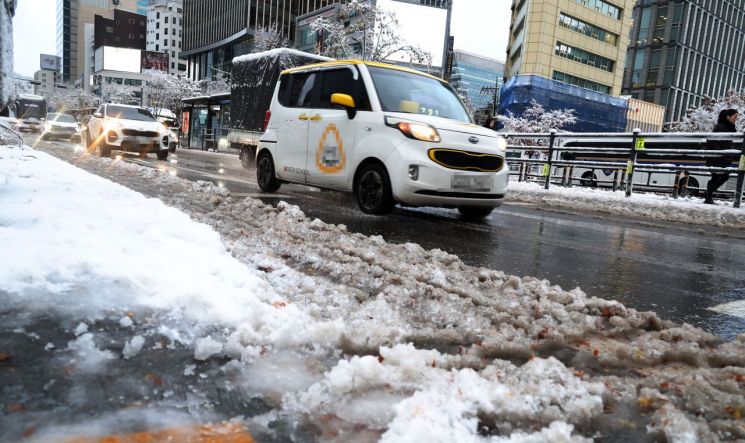 On the 27th, when heavy snow fell across Seoul, vehicles moved along the slushy road where the snow piled up on Sejong-daero in Jongno-gu, Seoul was melting. Photo by Jo Yong-jun
According to the Korea Meteorological Administration, police, and Yonhap News on the 27th, multiple traffic accidents occurred on roads mainly in the northern Gyeonggi area, such as the Guri-Pocheon Expressway and the Seoul Metropolitan Area 1st Ring Expressway, due to the heavy snowfall that morning. Around 6:10 a.m., an SUV and a cargo truck collided near the Namyangju Tunnel on the Guri-Pocheon Expressway in Byeollae-myeon, Namyangju-si, heading toward Seoul. Although there were no casualties, the accident caused partial road closures, resulting in traffic congestion during the morning commute. Police believe the accident happened as vehicles slipped on snow accumulated on the road while exiting the tunnel. The police and Seoul Northern Expressway Co., Ltd. are managing the accident by controlling some lanes and conducting snow removal operations. Earlier, around 5:50 a.m., a cargo truck overturned on the road between Nogosan 2 Tunnel and Yangju Tollgate on the Seoul Metropolitan Area 1st Ring Expressway.
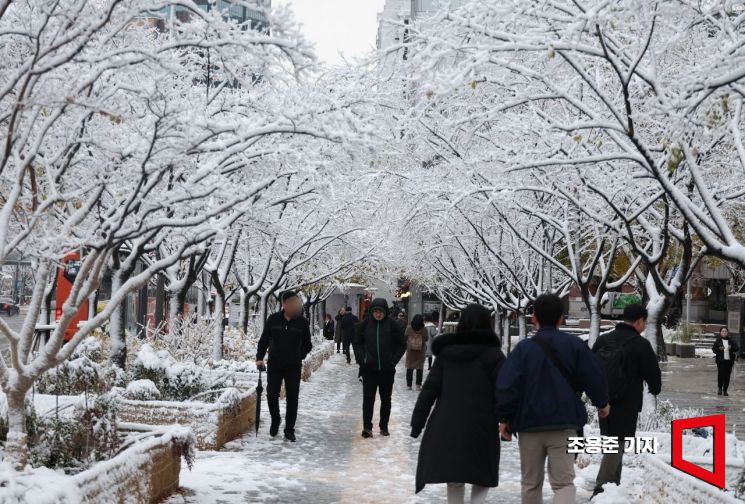 On the 27th, when heavy snow fell across Seoul, office workers were commuting along the snow-covered road on Sejong-daero in Jongno-gu, Seoul.
About 20 cm of heavy snow fell across various parts of Seoul overnight. A heavy snow warning was issued throughout Seoul that day. A heavy snow alert was issued for the northeastern districts including Nowon-gu, Seongbuk-gu, Jungnang-gu, Gwangjin-gu, Dongdaemun-gu, Dobong-gu, Gangbuk-gu, and parts of Seongdong-gu. Some northeastern areas such as Seongbuk-gu and Gangbuk-gu recorded snowfall exceeding 20 cm. As of 7 a.m., the snowfall amounts were 20.6 cm in Seongbuk, 20.4 cm in Gangbuk, 16.4 cm in Dobong, and 16.0 cm in Eunpyeong. The weather observation station in Songwol-dong, Jongno-gu, recorded 16.5 cm. Accordingly, the city elevated snow removal emergency operations to level 2 from 7 a.m., coordinating with autonomous districts and related agencies to respond to the snow. Four roads?Inwangsan-ro, Bukaksan-ro, Samcheongdong-gil, and Waryong Park-gil?are currently closed. Seoul subway lines 1 through 8 extended morning rush hour operations by 30 minutes until 9:30 a.m.
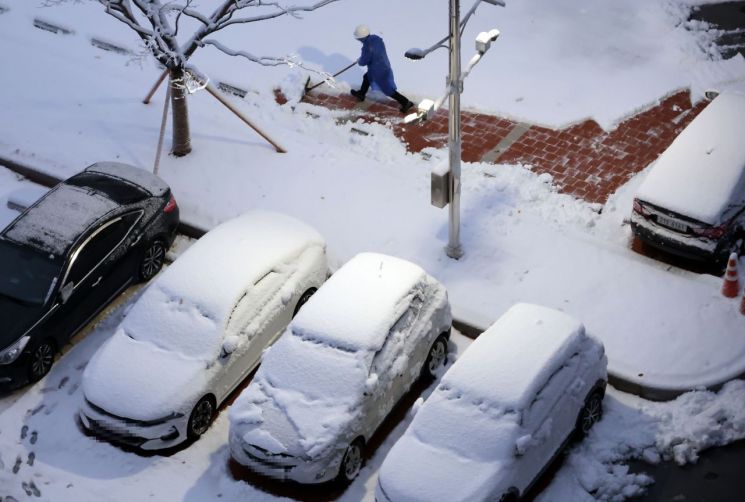 On the 27th, when heavy snow fell across Seoul, officials from a building in Jongno-gu, Seoul, were conducting snow removal work early in the morning. Photo by Jo Yong-jun
A heavy snow warning was issued for inland and mountainous areas of Gangwon, where about 20 cm of snow accumulated in various places. Snow is currently falling in most areas, with snowfall rates of 1 to 3 cm per hour mainly in inland and mountainous regions. The Korea Meteorological Administration forecasted that by the 28th, the central and southern mountains will receive 10 to 20 cm (with some areas over 30 cm), inland and northern mountains 5 to 15 cm (with some areas over 20 cm), and about 1 cm along the East Coast. Overnight snowfall combined with temperatures dropping below freezing has turned some roads into icy surfaces, causing vehicles to slow down on the morning commute and pedestrians to walk cautiously, showing more careful behavior than usual.
The Chiaksan National Park Office has closed all 14 hiking trails, and Seoraksan, Odaesan, and Taebaeksan National Parks have partially closed trails, restricting access to 67 trails in the province’s national parks. The Korea Meteorological Administration urged, "Visibility rapidly decreases in areas with rain or snow, and snow accumulation will be significant in many places. Drivers must reduce speed when operating vehicles, and hikers should be especially cautious to prevent safety accidents."
© The Asia Business Daily(www.asiae.co.kr). All rights reserved.



















