Seoul Hanok Policy Symposium
Experts: "Hanok Preservation and Management Needed"
"Expand Public Buildings in Hanok Style"
"Consider Ways for Citizens to Enjoy Hanok"
"How can we harmoniously incorporate modern changes and traditional values into Hanok villages?"
Experts participating in the ‘2024 Hanok Policy Symposium - Building the 100-Year Future of Seoul Hanok Villages,’ held on the 26th at the Eunpyeong Hanok Village Han Culture Experience Center, focused on the potential use of Hanok as residential spaces.
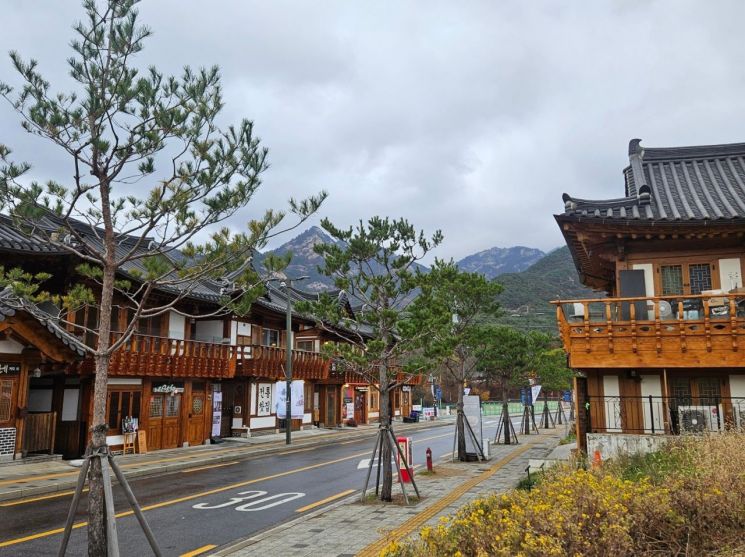
This symposium was organized as a forum for Hanok architects, landscape architects, urban scholars, and experts to discuss and share concerns and challenges related to the creation of Hanok villages. Hosted by the Seoul Metropolitan Government’s Hanok Architecture Asset Division, the event was attended by Kim Hyosu, Seoul’s Hanok Village Chief Planner; Woo Dongseon, President of the Korean Architectural History Society (Professor at Korea National University of Arts); architect Jo Jeonggu (CEO of Guga Urban Architecture Office); landscape architect Kim Bongchan (CEO of The Garden); and former Hanyang University professor Tomii Masanori, among others.
Seoul Mayor Oh Se-hoon, following the establishment of Eunpyeong Hanok Village within Eunpyeong New Town in 2008, is currently promoting a project centered on creating and expanding Hanok villages by district through last year’s ‘Seoul Hanok 4.0 Re-creation Plan.’ The plan envisions revitalizing traditional Hanok housing styles across Seoul into usable residential spaces. This event was also planned with the aim of elevating Hanok as a representative architectural form of Seoul, creating an attractive cityscape to present to the global market.
Previously, Seoul selected new Hanok village sites last year. This reflects Mayor Oh’s policy direction to select more than 10 Hanok village sites over the next decade to expand Hanok residential culture and related industries. The ‘Hanok Village Site Selection Committee’ identified areas including ▲252-8 Amsa-dong, Gangdong-gu (70,244㎡) ▲543-2 Banghak-dong, Dobong-gu (21,146㎡) ▲San 96-4 Dobong-dong, Dobong-gu (35,859㎡) ▲San 123-13 Suyu-dong, Gangbuk-gu (19,840㎡) ▲1082 Jegi-dong, Dongdaemun-gu (141,695㎡) ▲35 Bulgwang-dong, Eunpyeong-gu (22,623㎡), among others.
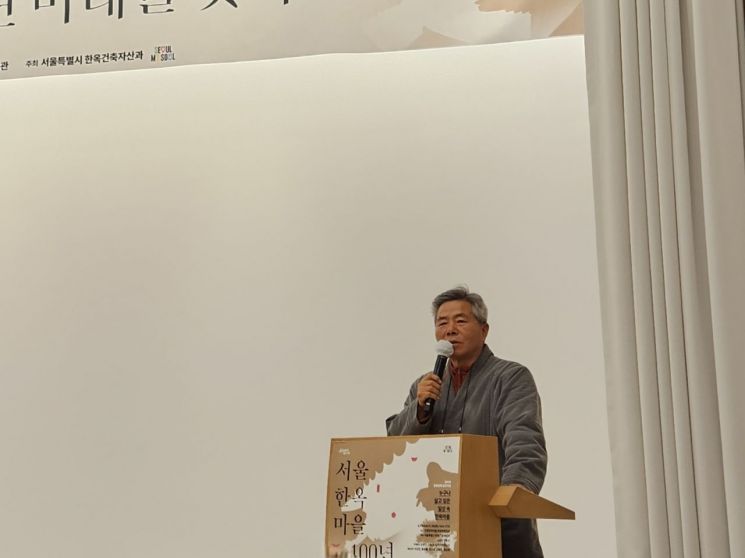 Kim Hyosu, Chief Planner, is presenting at the '2024 Hanok Policy Symposium - Building the 100-Year Future of Seoul Hanok Village' held on the 26th at the Eunpyeong Hanok Village Han Culture Experience Center. Photo by Park Juni.
Experts agreed on the need for preservation and management of Hanok. Chief Planner Kim stated, "Hanok has been continuously disappearing in modern times," adding, "We need to preserve and manage Hanok to some extent." Furthermore, he said, "If Hanok becomes established as a lifestyle pattern, we might be able to create a wonderful city where the present and past coexist." In fact, Seoul is undertaking various attempts to expand the concept of Hanok. The city offers various incentives for modern buildings that reinterpret Hanok, aiming to strengthen urban competitiveness through Hanok.
President Woo also emphasized in his keynote speech, "What direction can maintain traditional identity while satisfying the lifestyle and desires of modern people?" He stressed, "If this is resolved, Hanok can become a core space."
Solving Tourism Issues and Creating 'Places to Live'
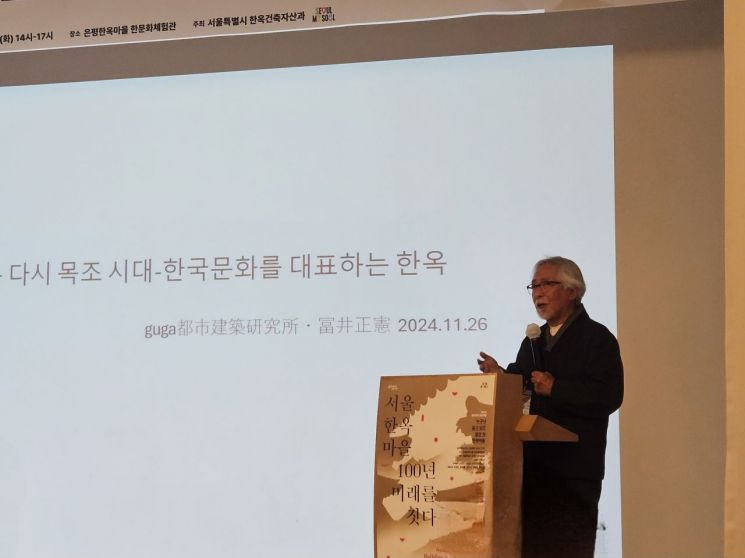 Former Hanyang University professor Masanori Domi is presenting at the "2024 Hanok Policy Symposium - Building the 100-Year Future of Seoul Hanok Village," held on the 26th at the Eunpyeong Hanok Village Han Culture Experience Center. Photo by Junyi Park.
Various ideas were also proposed to utilize Hanok as practical residential spaces. Seoul judged that the previously selected sites have been severely neglected or damaged as weekend farms and cultivation areas, with poor infrastructure and parking issues, necessitating environmental improvements and related administrative procedures. Additionally, to expand the concept of Hanok, various attempts are underway, including providing incentives for modern buildings that reinterpret Hanok.
Seoul plans to relax construction and review standards to allow freer Hanok construction. Of the current 73 Hanok construction review criteria, 44 will be eased or abolished. Specifically, 33 review criteria related to structure, windows, roof tiles, eaves length, courtyard upper structures, and courtyard height differences will be relaxed, and 11 items such as furniture arrangement, window frames, and gates will be abolished. For small-scale Hanok under 33㎡, review standards such as facade proportions, roof height, and eaves length will be eased.
Architect Jo, who designed the Eunpyeong Hanok Village Han Culture Experience Center, said, "To resolve the severe tourism issues in Bukchon Hanok Village and harmonize residential stability, I envisioned a structure separating visitor and resident areas," adding, "Public architecture harmonizing with Hanok, like the Yeonhwajeong Library in Jeonju, needs to be actively introduced."
Landscape architect Kim, who designed the garden at ‘Amore Seongsu,’ said, "Do many gardens around us preserve the unique beauty that only Korea has?" He emphasized the need to introduce beautiful trees that harmonize well with Hanok. The design of gardens and Hanok should not damage existing natural landscapes. Former professor Tomii Masanori, a master of wooden architecture and former professor at Kanagawa University and Hanyang University, stated, "The 21st century will see the return of wooden architecture," emphasizing, "We need to create Hanok-style communal housing where citizens with limited resources can enjoy living in Hanok."
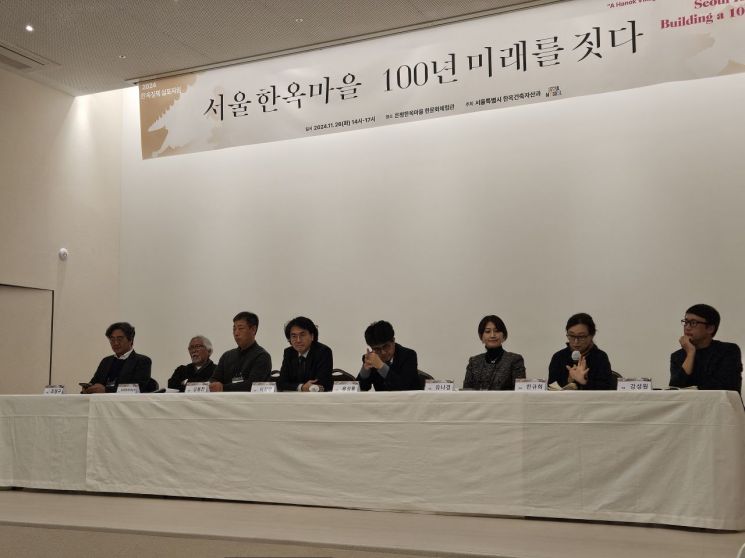 On the 26th, panelists are engaged in a discussion at the '2024 Hanok Policy Symposium - Building the 100-Year Future of Seoul Hanok Village' held at the Eunpyeong Hanok Village Han Culture Experience Center. Photo by Park Joon-yi.
Following the lectures, a panel discussion continued with detailed discussions on Hanok. Professor Lee Kangmin of Korea National University of Arts chaired the discussion titled ‘Building the 100-Year Future of Seoul Hanok Villages.’ Panelists included Professor Ryu Seongryong of Korea University’s Department of Architecture, Yoo Nayoung, Director of PMA Urban Environment Research Institute, Kang Seongwon, CEO of Kang Heejae Architecture Office, and Han Gyuhee, CEO of Urbanix.
Professor Ryu said, "There is no ‘Hanok design’ in architectural public enterprise recruitment exams (NCS) or university courses," emphasizing, "Traditional architecture needs to have scalability and produce skilled personnel." Director Yoo stressed, "There is a need to translate Hanok into an easy-to-understand language for the general public and consider how to implement it in some form."
© The Asia Business Daily(www.asiae.co.kr). All rights reserved.
![Clutching a Stolen Dior Bag, Saying "I Hate Being Poor but Real"... The Grotesque Con of a "Human Knockoff" [Slate]](https://cwcontent.asiae.co.kr/asiaresize/183/2026021902243444107_1771435474.jpg)


















