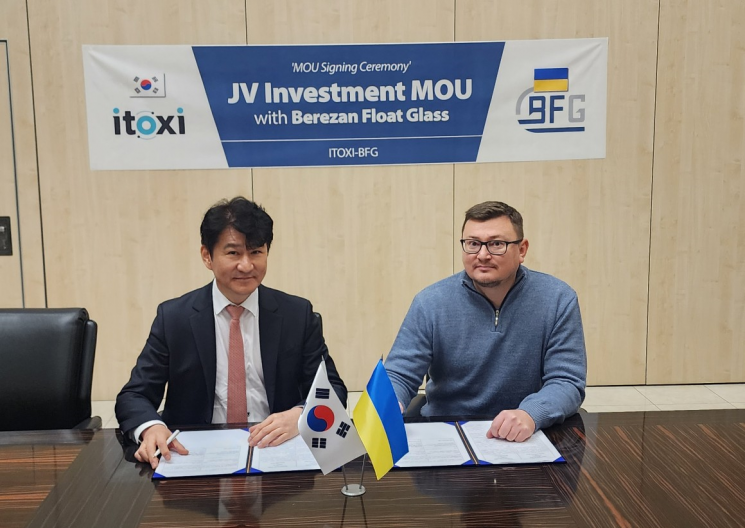
ITOXI (CEO Jeon Bong-gyu) announced that it signed a joint investment agreement with ‘BFG’ (Berezan Float Glass), the only float glass manufacturing plant in Ukraine, for participation in the project. The agreement was signed locally in Kyiv, Ukraine, on the 26th, local time, with ‘BFG’ (CEO Oleksandr Lakei). ITOXI visited Ukraine as a member of the Ukraine Reconstruction Project delegation of the Korea-Ukraine New Building Association (Chairman Lee Yang-gu) for an eight-day schedule starting from the 23rd of this month.
This investment agreement is the first joint investment case in construction raw materials following ITOXI’s establishment of its local subsidiary (ITOXI UA) in Ukraine last November. ITOXI also signed a corporate due diligence contract with the global accounting firm Kreston for ‘BFG’ and plans to conduct detailed corporate due diligence for equity investment purposes by the end of the year.
Before the war, Ukraine imported more than 70% of its float glass mainly from Russia and Belarus, and the only float glass plant located in Donetsk in the east, Glasskomerts, was occupied by Russia, leaving no domestic production base for float glass. After the war, demand for float glass for reconstruction surged sharply, and although imports have been made from neighboring countries such as Poland, the Czech Republic, and Turkey, the local demand has increased so much that supply is severely insufficient.
According to the Ukraine Reconstruction Project White Paper released by USAID (United States Agency for International Development) under the U.S. Department of State in May 2023, key raw materials necessary for reconstruction projects were selected, including cement, steel, float glass, insulation materials, and energy equipment, and it was announced that these should be rapidly and intensively developed. In particular, ‘BFG’ is a core project of the ‘City of Glass’ (glass industry cluster), one of the reconstruction project clusters selected by the Ukrainian Ministry of Economy and Ministry of Reconstruction. The project started in the second half of 2022 and aims for completion in the second quarter of 2026. The ‘City of Glass’ is a one-stop cluster on a 20-hectare site that covers everything from float glass production to processing, coating, and transportation.
‘BFG’ (Berezan Float Glass) is located at the center of the ‘City of Glass’ cluster in Berezan City, 70 km east of Kyiv, and serves as a transportation hub for European railways and natural gas pipelines. It is one of the safe areas that suffered no damage during the war. CityOne Asset Management (Chairman Valerii Kodetskyii), the largest shareholder of ‘BFG’ and one of Ukraine’s top five real estate investment and development groups, has completed the foundational construction of the plant site, establishment permits, and contracts for the most critical power and natural gas supplies for float glass production.
According to the ‘BFG’ project business analysis report conducted by global consulting firm PwC in 2023, the BFG plant is expected to require a total investment of $120 million (approximately 170 billion KRW). After completion in 2026, it is projected to produce 220,000 tons of float glass annually, supplying about 35% of Ukraine’s domestic float glass demand, generating annual sales exceeding $100 million (approximately 140 billion KRW), and achieving an internal rate of return (IRR) of over 31%.
The ‘BFG’ project is highly significant as it is the first supply chain project capable of domestically producing float glass essential for repairing buildings destroyed by the war. Ukraine has over 60 glass processing companies and more than 350 window and door manufacturers, all currently dependent on 100% imported float glass, creating strong demand for a more stable and affordable domestic float glass raw material supply.
Jeon Bong-gyu, CEO of ITOXI, stated, “This ‘BFG’ investment agreement marks the official starting point of ITOXI’s Ukraine reconstruction business,” adding, “We are in close discussions with local partners regarding technology partnerships with Korea and building materials distribution businesses, and we plan to make an official announcement after corporate due diligence.”
An ITOXI official said, “The opportunity to participate in the only float glass plant project that the Ukrainian government and international organizations are highly interested in and supporting was the result of establishing a local subsidiary during the war, conducting thorough market research, and maintaining continuous cooperation with local institutions from a long-term perspective.” The official added, “We will strive to ensure that the local connections and networks created through the float glass plant project will help Korean construction-related companies enter the post-war reconstruction market.”
Meanwhile, Ukraine holds the largest silica sand deposits in Eastern Europe. In addition to producing low-purity silica for float glass, there are many mines capable of extracting high-purity silica, the main raw material for displays and solar panels. This indicates a very bright outlook for future silica mine investments and high-purity silica processing businesses for export.
© The Asia Business Daily(www.asiae.co.kr). All rights reserved.
![Clutching a Stolen Dior Bag, Saying "I Hate Being Poor but Real"... The Grotesque Con of a "Human Knockoff" [Slate]](https://cwcontent.asiae.co.kr/asiaresize/183/2026021902243444107_1771435474.jpg)











