President Sheinbaum "GM, Ford Will Face Danger"
Canadian Prime Minister Trudeau Talks with Trump
Will Trump's Tariff Card Expand Global Trade War?
As President-elect Donald Trump of the United States threatened a 'tariff bomb' against China, Mexico, and Canada, Claudia Sheinbaum, President of Mexico, hinted at retaliatory tariffs in response. With Trump’s 'America First' stance leading to tariff pressures, concerns are rising that retaliatory measures from other countries could trigger a global trade war.
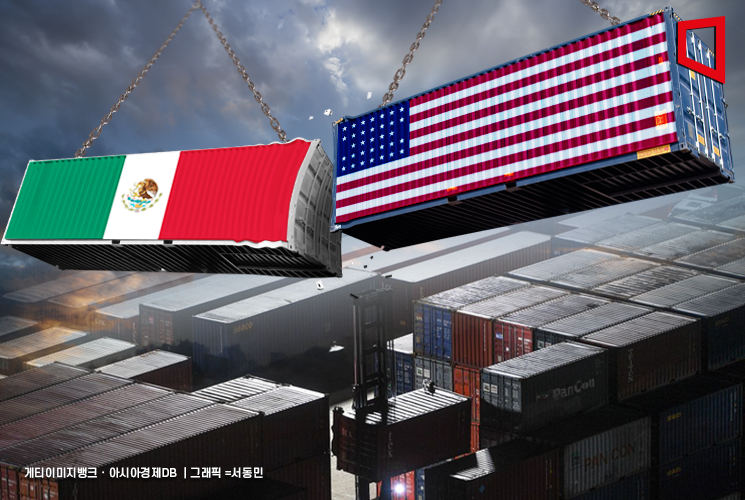
On the 26th (local time), President Sheinbaum said, "If tariffs are imposed on one side, another set of tariffs will be imposed in response, ultimately putting companies at risk." This effectively signaled her intention to impose retaliatory tariffs.
President Sheinbaum mentioned U.S. automobile companies with production bases in Mexico. She said, "Major export companies in Mexico include General Motors (GM), Stellantis, and Ford, which entered the country 80 years ago," adding, "Why should tariffs be imposed that put them at risk? This is unacceptable." She emphasized, "This will cause inflation and job losses in both the United States and Mexico."
This statement came a day after President-elect Trump announced plans to raise tariffs on Mexico, suggesting a retaliatory response. Trump announced on his social media platform Truth Social that he would sign an executive order on January 20 next year, his first day in office, imposing an additional 10% tariff on China and 25% tariffs on Mexico and Canada respectively. He criticized Mexico and Canada for inadequate measures against illegal immigration and China for being passive in cracking down on fentanyl distribution.
China also opposed Trump’s tariff hike announcement. Liu Fengyu, spokesperson for the Chinese Embassy in the U.S., stated the day before, "No one can win a trade and tariff war." In the case of Canadian Prime Minister Justin Trudeau, he focused on finding common ground through a phone call with Trump immediately after the tariff threat.
As Trump predicted the day before, the top targets of the second administration’s trade policy are the United States-Mexico-Canada Agreement (USMCA) and China. The three countries?U.S., Mexico, and Canada?are scheduled to review USMCA implementation in 2026. Ahead of this, Trump’s preemptive tariff hike threats against Mexico and Canada can be seen as an escalation of pressure. Trump believes USMCA has reduced American manufacturing jobs and is being used as a detour route for Chinese exports to the U.S.
Experts warn that while Trump’s tariff card may be a 'negotiation leverage' to address national security issues such as trade deficits or illegal immigration, if actually implemented, it could trigger a domino effect of retaliatory tariffs from trading partners, raising global trade barriers. This would lead to increased global inflation and lower growth rates.
Eswar Prasad, a professor of trade policy at Cornell University, said, "Trump’s remarks clearly signal the start of American protectionism, which will draw many of America’s trading partners into the same (protectionist) fold," adding, "Tariffs will have a destructive impact not only on the U.S. but also on international trade."
© The Asia Business Daily(www.asiae.co.kr). All rights reserved.

















