Holding the Meeting of Ministers for Strengthening Industrial Competitiveness
143 Trillion Won to Be Invested Next Year in Low-Interest Semiconductor Loans, etc.
Promoting More Than Half of Power Transmission Undergrounding Costs to Reduce Corporate Burden
The government will invest more than 14 trillion won next year in the semiconductor sector, including the provision of low-interest loans. It is expected to support more than half of the cost of undergrounding the power transmission lines for the Yongin-Pyeongtaek semiconductor cluster, which is the core of South Korea's semiconductor competitiveness. The government plans to include research and development (R&D) equipment in the tax credit for national strategic technology investments and to raise the tax credit rate for semiconductor companies.
On the 27th, the government held a meeting of ministers related to strengthening industrial competitiveness, chaired by Deputy Prime Minister and Minister of Economy and Finance Choi Sang-mok, and announced the "Plan to Strengthen Support for the Semiconductor Ecosystem." This plan concretizes the semiconductor investment support measures disclosed in June and October. In a situation where uncertainty across the industry is increasing due to policy changes since the inauguration of the Donald Trump administration in the U.S., which has worsened the investment profitability of domestic semiconductor companies, the government has a plan to prepare additional support measures if necessary.
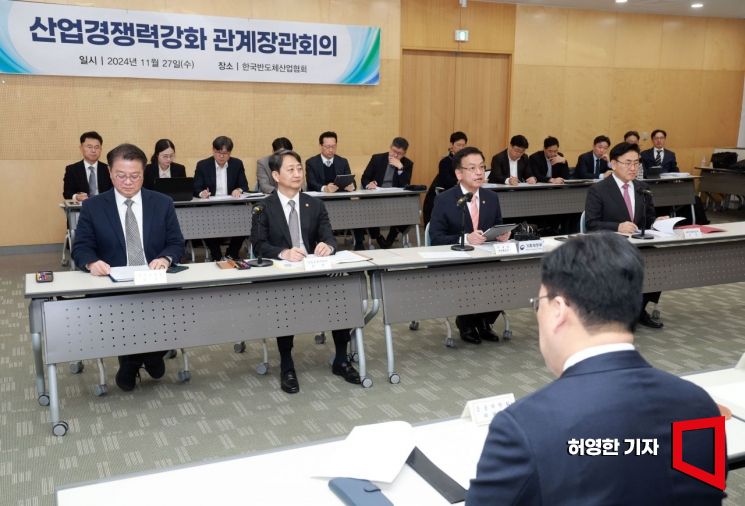 On the 27th, Choi Sang-mok, Deputy Prime Minister and Minister of Economy and Finance, is delivering opening remarks at the Ministerial Meeting on Strengthening Industrial Competitiveness held at the Korea Semiconductor Industry Association in Bundang-gu, Seongnam-si.
Promotion of Designating R&D Facilities as National Strategic Technology... Raising Investment Tax Credit
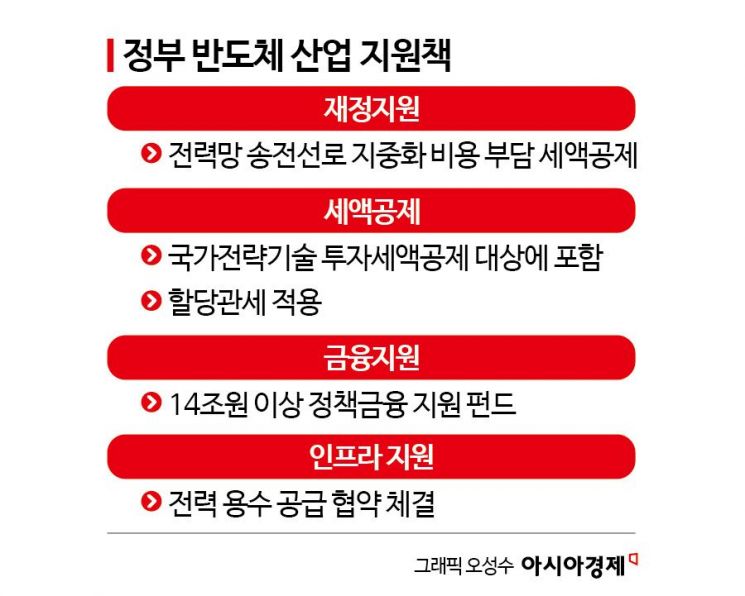
The government has allocated a total budget of 1.7 trillion won next year for financial support including equity investment, R&D, and manpower commercialization projects. This is an increase of 400 billion won compared to this year. First, it decided to share a significant portion of the undergrounding cost of the power transmission lines for the 1.8 trillion won Yongin-Pyeongtaek semiconductor cluster. The undergrounding cost accounts for about 60% of the total project cost of 3 trillion won.
Kang Ki-ryong, Director of Policy Coordination at the Ministry of Economy and Finance, said, "We are in consultation with the National Assembly to have the government bear more than half of the undergrounding cost to ensure large-scale investment and timely project implementation." To nurture semiconductor talent, the government will activate programs to attract outstanding overseas talent and expand incentives for excellent faculty members at four major science and technology institutes, including KAIST.
Tax support for companies' R&D and facility investments will also be significantly increased. The government plans to prioritize the passage of the Restriction of Special Taxation Act in the National Assembly to include facility investments for research and development, such as R&D equipment, in the national strategic technology investment tax credit. It will also pursue raising the tax credit rate for semiconductor companies, which the industry has been requesting.
The scope of tariff exemptions through quota tariffs for semiconductor materials and parts will also be expanded. The application period for quota tariffs on quartz glass substrates will be extended, and from next year, quota tariffs will be applied to major raw materials for semiconductor manufacturing such as copper foil for copper-clad laminates (CCL), glass fiber, and tin ingots used for laser generation in photolithography equipment.
14 Trillion Won in Policy Financing... New 120 Billion Won Fund Established
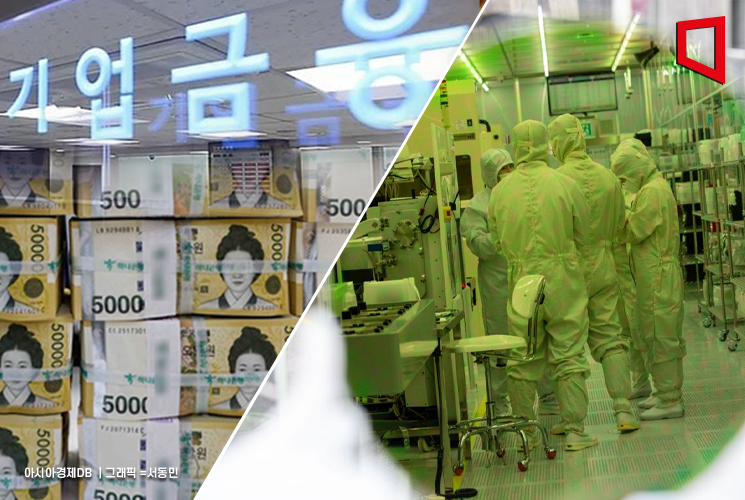
The government will also provide more than 14 trillion won in policy financing next year. A total of 14.3 trillion won in policy financing will be supplied across all semiconductor sectors including materials, parts, equipment (SoBuJang), fabless (semiconductor design specialists), and manufacturing, and semiconductor fund investments will be executed. Through KDB Industrial Bank, a low-interest loan program worth 4.25 trillion won will be provided next year at the lowest market interest rates. A semiconductor ecosystem fund will be newly established with 120 billion won in resources, supplying a total of 420 billion won next year. An investment of 20 billion won within the year for the "System Semiconductor Win-Win Fund" will also be pursued.
Plans for power and water supply have also been prepared. The government announced that it will promptly finalize the power supply plan for the Yongin semiconductor cluster and conclude cost-sharing agreements with related organizations based on this. A Ministry of Economy and Finance official explained, "The government is establishing a phased supply plan considering the power demand according to fab operation schedules."
Regarding water supply, Samsung Electronics, SK Hynix, Korea Water Resources Corporation, and Korea Land and Housing Corporation signed a basic agreement on the same day concerning phased facility plans, water sources, and cost-sharing among institutions. Negotiations on cost-sharing for power grid connection, which had been a source of conflict between the public and private sectors, were also completed with Korea Electric Power Corporation and companies for Phase 1 and 2 of the national industrial complex and Phase 1 of the general industrial complex. Of the total project cost of 2.4 trillion won for Phase 1 of the national industrial complex and Phases 1 and 2 of the general industrial complex, the public sector will bear 700 billion won and companies 1.7 trillion won respectively. For the Yongin national industrial complex, a power supply and cost-sharing plan for about 3GW in Phase 1 has been prepared, and a tentative agreement has been reached on additional supply plans for Phase 2.
Following the exemption of preliminary feasibility studies for the expansion project of National Road No. 45, which passes through the national industrial complex, the government will support it with national funds and aim for opening in 2030. A Ministry of Economy and Finance official said, "We will promptly carry out follow-up procedures such as reviewing the appropriateness of the project plan, design, and construction, and aim to open it from 2030."

The government will actively participate in the ongoing discussions on the enactment of the "Special Act on Semiconductors," centered on the National Assembly, and will consult with the National Assembly as soon as possible regarding additional financial and tax support and related systems. The government stated, "We will speedily promote key tasks that have been pursued to strengthen the semiconductor ecosystem, such as reflecting power grid construction in the basic power supply and demand plan and transmission and transformation facility plans, and implementing the flexible taxation operation plan next year."
© The Asia Business Daily(www.asiae.co.kr). All rights reserved.
![Clutching a Stolen Dior Bag, Saying "I Hate Being Poor but Real"... The Grotesque Con of a "Human Knockoff" [Slate]](https://cwcontent.asiae.co.kr/asiaresize/183/2026021902243444107_1771435474.jpg)


















