Strengthening Emission Regulations Not Reflecting Reality, Cement Industry Voices Management Difficulties
The cement industry has requested that the NOx emission regulation standards be relaxed to around 120ppm (based on the Chungbuk region standard) until the technical stability of high-efficiency nitrogen oxide (NOx) reduction facilities (SCR) is secured.
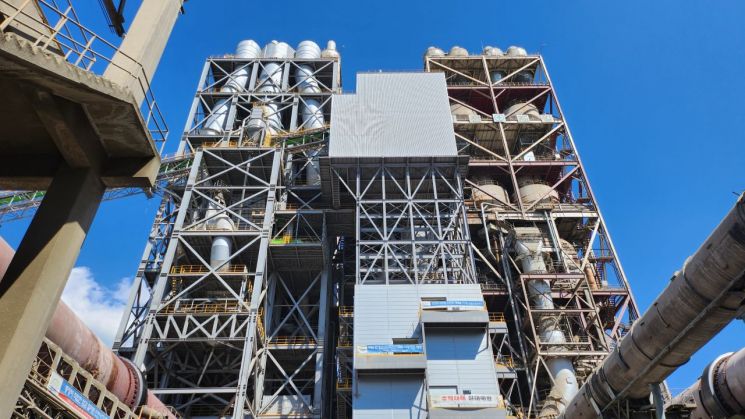 Cement production facilities at Hanil Hyundai Cement's Yeongwol plant. Provided by Hanil Hyundai Cement
The Korea Cement Association, whose members include major domestic cement companies, stated on the 26th, "The cement industry agrees that SCR is necessary for a revolutionary reduction of nitrogen oxides generated during the product manufacturing process," but added, "However, SCR has not been sufficiently verified for stable operation, and there are uncertainties regarding process stability and reduction efficiency, such as additional greenhouse gas emissions during operation, making immediate application on-site difficult."
Overseas, there have been cases where SCR was applied to some small-scale facilities producing about 30-50% of the output compared to domestic cement kilns, but due to efficiency degradation and lack of verification, these were relocated or reinstalled. Due to these concerns, domestic research institutions have also suggested that additional research and review are necessary before installing SCR in domestic cement plants.
On September 13th, the government announced a legislative notice for the "Partial Amendment of the Enforcement Rules of the Special Act on Air Quality Improvement in Air Management Zones," which includes gradually reducing nitrogen oxide emissions from cement companies in the Chungbuk area from 135ppm in 2025 to 110ppm in 2029.
Subsequently, an emergency meeting attended by CEOs of domestic cement companies was held, where a joint statement demanding the relaxation of nitrogen oxide (NOx) emission regulation standards was issued.
After the joint statement was not accepted, the Cement Association has once again announced its position, requesting the relaxation of NOx emission regulation standards.
Recently, the continued downturn in the domestic construction market has become another obstacle to the cement industry's business performance. The third quarter, which corresponds to the peak season for cement, showed a clear contraction. Compared to the same period last year, sales decreased by 11%, operating profit by 24%, and net profit by 65%.
Considering that this year's capital investment execution scale is about 607.6 billion KRW and the cumulative net profit up to the third quarter is about 425.2 billion KRW, the cement industry's net profit for this year is expected to be around 500 billion KRW. This means it is difficult to secure investment funds solely for annual capital investment. Notably, the cost of installing SCR is not included in this capital investment fund.
Assuming SCR installation, a large-scale investment of over 1 trillion KRW is required. Operating costs after installation are also expected to exceed 700 billion KRW annually. While securing funds far exceeding net profit is urgent, the industry argues that since the reduction effect has not been verified, such a large-scale investment could become a sunk cost.
A representative of the Cement Association said, "We are currently undertaking various reduction efforts, including optimizing the efficiency of existing reduction facilities, modifying production equipment to forms with lower NOx generation, and researching new reduction technologies to replace high-efficiency reduction technologies whose economic feasibility and stability have not been confirmed," adding, "Considering the applicability of pollution prevention facilities and the business situation of the cement industry, we appeal to relax the standard to around 120ppm."
© The Asia Business Daily(www.asiae.co.kr). All rights reserved.
![Clutching a Stolen Dior Bag, Saying "I Hate Being Poor but Real"... The Grotesque Con of a "Human Knockoff" [Slate]](https://cwcontent.asiae.co.kr/asiaresize/183/2026021902243444107_1771435474.jpg)
















