With the adoption of the international treaty on the Design Protection Act, international treaties concerning the three major industrial property laws have been completed. The three major laws refer to the Patent Act, Trademark Act, and Design Protection Act.
The Korean Intellectual Property Office (KIPO) announced on the 27th that the "Riyadh Design Law Treaty" was finally adopted through the "Diplomatic Conference for the Conclusion and Adoption of the Design Law Treaty (hereinafter referred to as the Diplomatic Conference)" held recently in Riyadh, Saudi Arabia.
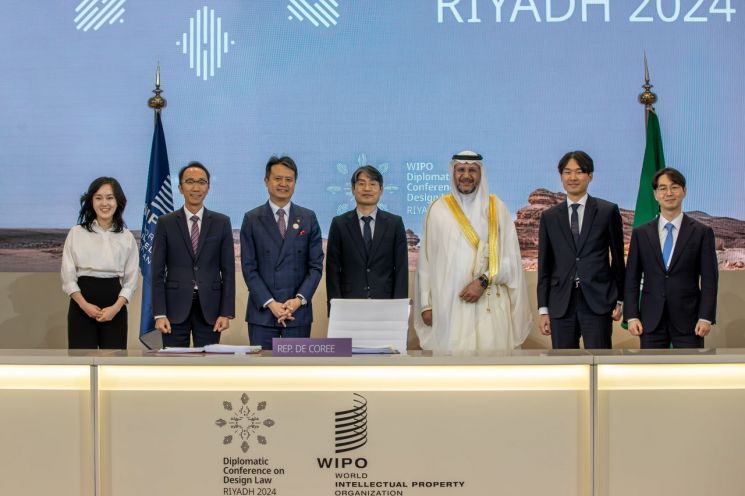 On the 22nd (local time), after the Riyadh Design Law Treaty was adopted in Saudi Arabia, Daren Tang, WIPO Director General (third from the left), Abdulaziz Al-Swailem, Director of the Saudi Arabian Patent Office (fifth from the left), and Kim Ji-maeng, Manager of the Korean Intellectual Property Office (fourth from the left), took a commemorative photo. Photo by WIPO
The Riyadh Design Law Treaty was adopted with the aim of simplifying the design application procedures, which differ by country, and facilitating the management of registered rights by establishing a kind of procedural law.
The member countries of the Diplomatic Conference began discussions in 2005 and drafted the Riyadh Design Law Treaty in 2011, but it took a full 20 years to adopt the actual treaty due to conflicting views on issues such as technical support and capacity building for developing countries.
The Riyadh Design Law Treaty first stipulates the minimum mandatory information required in the application to simplify the design application procedure and specifies that even if the design is disclosed before the application, it will not be rejected due to the applicant's own disclosure if the application is filed within one year.
If the priority claim was not made at the time of application, there is also an opportunity to add or correct it. In addition, the treaty features rights-holder-friendly remedies such as allowing extensions of deadlines or restoration of lost rights if certain conditions are met when documents to be submitted to the patent office are not submitted by the deadline.
Countries that join the treaty must provide systems such as partial and multiple designs, which are currently implemented in major advanced countries including Korea. Also, if the applicant desires, the design must be allowed to remain undisclosed for at least six months or more, enabling the applicant to autonomously choose the timing of disclosure.
Partial design refers to an application method that expresses only a part of the design with solid line drawings to broaden the scope of rights, and multiple design refers to a method of attaching multiple designs in one application and filing them at once.
Previously, in 2000, the World Intellectual Property Organization (WIPO) adopted the Patent Law Treaty (PLT), and in 2006, the Singapore Treaty on the Law of Trademarks (STLT) was adopted. With the recent adoption of the Riyadh Design Law Treaty, the Korean Intellectual Property Office explained that international treaties concerning the three major industrial property laws have all been completed.
Among these, the design field had relatively large differences in systems operated by countries around the world compared to patents and trademarks, causing difficulties for domestic companies in securing design rights overseas. However, the Korean Intellectual Property Office expects that these difficulties will be largely resolved with the adoption of the Riyadh Design Law Treaty.
Above all, the Riyadh Design Law Treaty is more meaningful as it is the result of 20 years of deliberation and negotiation, reflecting a compromise of differing views in the international community. The Diplomatic Conference evaluated this treaty as reflecting the positions of both developed and developing countries in a balanced manner.
The government dispatched a Korean delegation composed of the Korean Intellectual Property Office and the Korea Intellectual Property Research Institute to the Riyadh Diplomatic Conference and closely cooperated with major advanced countries such as the United States and Japan in advance to ensure that the treaty could become an international norm that aligns with national interests.
However, the Korean Intellectual Property Office has not signed (joined) the treaty at the Diplomatic Conference, similar to the United States and Japan, after comprehensively considering consumer opinions and the impact on domestic industries.
A KIPO official said, “KIPO plans to share the contents of the Riyadh Design Law Treaty and the results of the Diplomatic Conference through briefings and other means and to listen to consumer opinions. We will closely monitor the accession trends of major countries and carefully review the necessity and timing of joining the treaty.”
© The Asia Business Daily(www.asiae.co.kr). All rights reserved.

















