Service Value-Added Share Reaches 65.1%
Manufacturing Share Declines and Service Industry Increases in the Sector
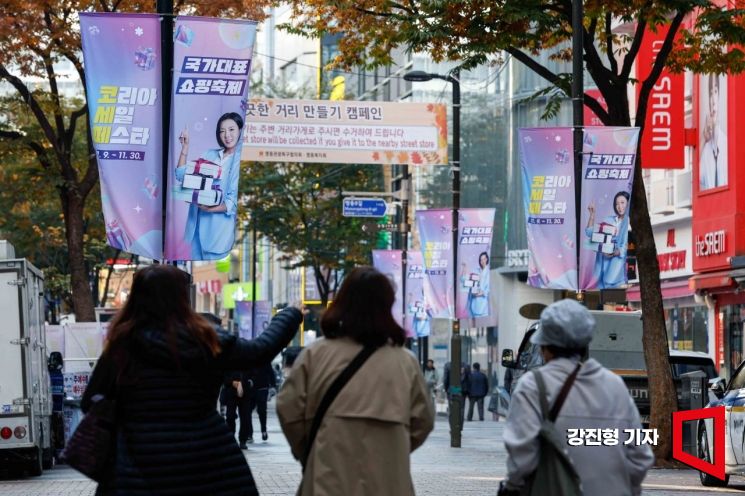 On the 8th, a banner announcing the Korea Sale Festa was hung on Myeongdong Street in Jung-gu, Seoul. Photo by Kang Jin-hyung
The share of value added by the service sector in the domestic industry has been steadily increasing. The employment inducement coefficient of the service sector was also about twice as high as that of the manufactured goods sector. This is interpreted as a trend where the core of our industrial structure is shifting from manufacturing to services.
According to the '2021-2022 Input-Output Table (Extended Table)' released by the Bank of Korea on the 26th, the share of services in the total domestic value added reached a record high of 65.1% in 2022.
The share of services in total value added showed a steady increase, with 63.8% in 2020 and 64.1% in 2021. The rise in the service share was centered on wholesale and retail trade, transportation, food services, and accommodation.
The share of manufactured goods in total value added was 26.2% in 2022, slightly down from 26.3% the previous year. The share of construction increased slightly from 5.9% in 2021 to 6.1% in 2022.
Based on output rather than value added, the share of manufactured goods rose by 1.3 percentage points to 42.8% in 2022 compared to the previous year, while the share of services fell by 1.4 percentage points to 46.8%.
The proportion of employment in services and the employment inducement coefficient were also significantly higher than those of manufactured goods. This is interpreted as the service sector's share in Korea's industrial structure continuing to rise.
In 2022, the employment share by sector was highest in services at 71.1%, followed by manufactured goods at 14.8%, construction at 7.4%, and agriculture, forestry, and fisheries at 5.6%.
The service share increased by 0.1 percentage points compared to the previous year, mainly driven by social services, while the share of manufactured goods slightly declined. The wage worker share was 72.6% in services, 17.7% in manufactured goods, and 8.0% in construction.
The overall employment coefficient in 2022 was 4.4 persons, with agriculture, forestry, and fisheries at 19.4 persons, services at 6.8 persons, construction at 5.7 persons, and manufactured goods at a low level of 1.5 persons. The employment coefficient refers to the number of employees required to produce 1 billion KRW of output.
During the same period, the employment inducement coefficient was 8.1 persons overall. It was 23.4 persons in agriculture, forestry, and fisheries, 10.0 persons in services, 9.2 persons in construction, and 4.9 persons in manufactured goods. The employment inducement coefficient indicates the number of jobs directly and indirectly induced across all products when final demand for a specific product amounts to 1 billion KRW.
© The Asia Business Daily(www.asiae.co.kr). All rights reserved.
![Clutching a Stolen Dior Bag, Saying "I Hate Being Poor but Real"... The Grotesque Con of a "Human Knockoff" [Slate]](https://cwcontent.asiae.co.kr/asiaresize/183/2026021902243444107_1771435474.jpg)
















